
Table of contents
In the modern hospitality and high-end residential landscape, the bathroom has transcended its functional origins to become a critical touchpoint for guest satisfaction and property value. Within this wellness sanctuary, the heated towel rack for bathrooms—once considered a marginal luxury—has emerged as an essential fixture. It serves a triple purpose: enhancing comfort, improving hygiene by accelerating drying times (thus inhibiting bacterial growth), and contributing to the overall energy efficiency of the space by reducing the frequency of towel laundering.
For B2B procurement officers, architects, and developers, selecting the right heated towel rack is not merely an aesthetic choice; it is a critical decision impacting long-term maintenance costs, safety compliance, and brand perception. This guide provides an in-depth, engineer-perspective analysis of heated towel racks, designed to inform large-scale procurement and project planning.
Market Dynamics and the B2B Shift Toward Quality
1.The Evolving Hospitality Landscape
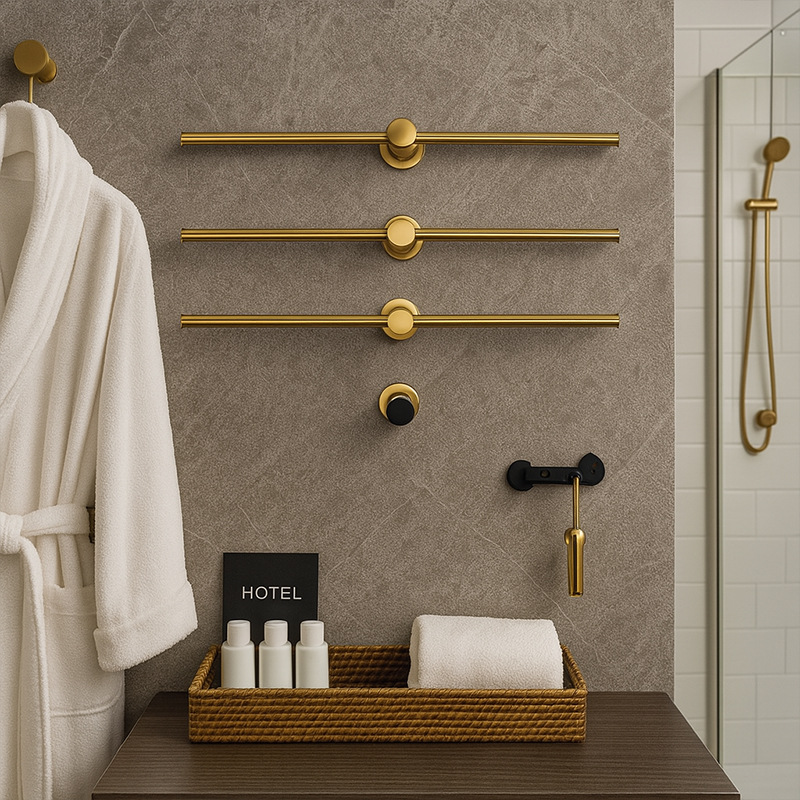
The global hospitality sector is experiencing a significant shift. Guests, particularly in the 4-star and 5-star segments, now expect amenities that mirror or exceed the comfort of their homes. A damp, cold towel is increasingly unacceptable. Furthermore, the post-pandemic focus on hygiene has highlighted the practical benefits of towel warmers. By keeping towels dry, these devices mitigate the “musty bathroom” smell, which is often a result of microbial proliferation in damp textiles.
2.The Real Estate Value Proposition
In residential developments, especially high-rise luxury condos and custom homes, integrated bathroom technology is a key selling point. Automated lighting, smart mirrors, and heated towel racks contribute to a perceived “spa-like” environment. For developers, incorporating these features early in the design phase adds minimal relative cost while significantly boosting marketability and final unit pricing.
According to latest market analyses (e.g., studies by Grand View Research on bathroom fixtures), the demand for energy-efficient and digitally integrated bathroom hardware is projected to grow at a CAGR exceeding 6% over the next five years. This growth is driven largely by commercial renovations and new luxury constructions in APAC and North America.
3.The Core Material: SS304 Stainless Steel
In the commercial sector, material selection is paramount. While residential markets might tolerate chrome-plated low-carbon steel, B2B applications require robust materials that withstand high humidity and frequent cleaning.
At SourceZJ, our heated towel racks are constructed from Grade 304 Stainless Steel (SS304). This austenitic stainless steel contains high levels of chromium and nickel, providing exceptional corrosion resistance. In high-traffic environments, even minor chips in a chrome plating can lead to rapid rusting of the underlying steel. SS304 is homogenous; its corrosion resistance is inherent through the entire thickness of the material.
Technical Specifications and Heating Technologies
When specifying heated towel racks for a project, the primary technical decision revolves around the heating method: Electric (Dry or Liquid-filled) or Hydronic.
1.Electric Heated Towel Racks
Electric models are the most versatile and common choice for renovations and new hospitality projects due to their independent operation.
- Dry Element Technology: These racks utilize a heating cable (often silicone-coated wire) threaded through the tubes.
- Pros: Rapid heat-up times, lightweight, no risk of leaks, can be installed in any orientation.
- Cons: Can have slightly less uniform heat distribution compared to liquid-filled models.
- Liquid-Filled (Oil or Glycol) Technology: A heating element at the bottom heats a specialized fluid (usually an anti-corrosion, thermodynamic oil or glycol mixture) which then circulates via convection.
- Pros: Excellent heat retention, extremely uniform surface temperature, resembles traditional central heating.
- Cons: Longer initial heat-up time, risk of leaks (though rare in high-quality units), must be installed vertically.
2.Hydronic Heated Towel Racks
Hydronic racks connect directly to the building’s closed-loop central heating or hot water system.
- Pros: Extremely energy-efficient if the main heating plant is efficient (e.g., biomass, heat pump), provides consistent, high-output heat.
- Cons: High installation cost, dependent on the building’s heating schedule (often inactive in summer), requires specialized plumbing and valves.
3.Integrated Control Systems and Safety
Modern B2B units must incorporate advanced control. SourceZJ units can be equipped with:
- Built-in Timers: Allowing guests to set 2-hour or 4-hour boost cycles.
- Thermostatic Control: Maintaining a precise surface temperature, typically set between 45°C and 55°C (113°F to 131°F). This is the optimal range for drying towels efficiently while remaining safe to the touch.
- Overheat Protection: A critical thermal cutoff switch that deactivates the element if the temperature exceeds safe limits.
Design, Finishes, and Aesthetic Integration
While functionality is paramount, aesthetic integration is what defines a luxury installation. The heated towel rack must complement other hardware fixtures.
1.Advanced Finish Technology: PVD Coating
For commercial projects, standard electroplating often fails within 3-5 years due to harsh cleaning chemicals and constant humidity. SourceZJ utilizes Physical Vapor Deposition (PVD) coating for our premium finishes. PVD is a vacuum deposition process that applies a thin, extremely hard ceramic layer to the SS304 surface.
- Durability: PVD finishes are up to 10 times more scratch-resistant than electroplating.
- Chemical Resistance: They are virtually impervious to standard bathroom cleaners, maintaining their appearance for the life of the product.
- Color Matching: PVD allows us to offer finishes like Brushed Gold, Matte Black, Satin Nickel, and Gunmetal, which can be precisely matched to our Bathroom Faucets and Shower Systems to ensure cohesive design across the entire bathroom project.
2.Form Factors and Space Optimization
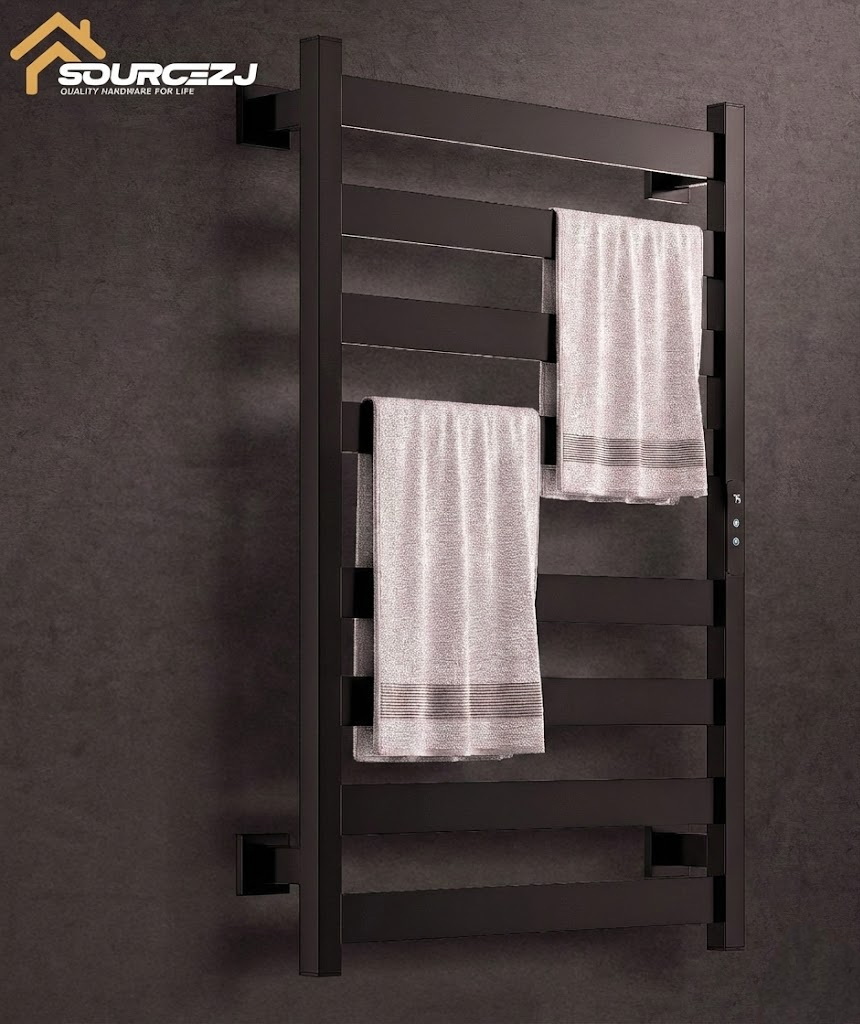
- Ladder Style: The classic multi-bar configuration, providing maximum surface area for multiple towels. Ideal for family suites in hotels.
- Swivel Models: Featuring individual heated arms that can rotate 180 degrees. These are excellent for compact bathrooms where space is limited.
- Freestanding/Plug-in: While less common in high-end commercial projects due to aesthetic and safety preferences for hardwiring, freestanding plug-in models offer flexibility for temporary installations or situations where wall mounting is impossible.
Installation Guide and Safety Compliance for Projects
For commercial installations, compliance with electrical codes and safety standards is critical.
1.Electrical Zones and IP Ratings
Bathrooms are divided into electrical zones based on their proximity to water sources. Any electrical device must have an appropriate Ingress Protection (IP) rating.
- The area directly inside the shower tray or bathtub. Electrical devices are generally not permitted here.
- The area extending 0.6m outside Zone 1 and up to 2.25m high.
- Beyond Zone 2.
Our electric heated towel racks are engineered with an IP55 rating, meaning they are protected against dust ingress and low-pressure water jets from any direction. This certification makes them safe for installation within Zone 2 and Zone 3 of the bathroom, providing architects with significant placement flexibility.
2.Wiring Configurations: Plug-In vs. Hardwired
- Plug-In (Commercial Cons): Exposed cables are an aesthetic negative and a potential safety/tampering hazard in hotels. They also occupy a visible wall outlet.
- Hardwired (Commercial Pros): The preferred method for commercial projects. The electrical connection is made internally through one of the mounting brackets, directly into a wall-mounted junction box. This results in a clean, integrated appearance with no visible wires and significantly reduces tampering risks.
3.Mounting and Structural Considerations
Despite being constructed of lightweight SS304, a heated towel rack, especially when loaded with wet towels, exerts significant force on the wall. For commercial installations, we strongly recommend:
- Reinforced Blocking: Installing wood blocking within the wall cavity at the mounting points during the construction phase.
- Specialized Anchors: If retrofitting onto existing drywall without blocking, high-performance toggle bolts or specialized metal anchors must be used.
Economic Analysis and B2B Procurement Strategy
For procurement professionals, the decision to purchase heated towel racks must be justified by a clear return on investment (ROI) or lifecycle cost analysis.
1.ROI and Lifecycle Costs
While the initial cost of an SS304/PVD-coated rack is higher than a chrome-plated steel model, the total lifecycle cost is significantly lower.
- Replacement Cycles: Hospitality environments often see low-quality chrome fixtures require replacement within 3 years due to corrosion. SS304 units easily last 15+ years.
- Laundry Savings: By efficiently drying towels, hotels can encourage guests to reuse towels, reducing laundry volume, energy usage, and textile wear-and-tear.
- Energy Efficiency: A typical ladder-style rack operates at 100-200 Watts. Integrated timers ensure they only run when needed, minimizing electricity costs.
2.SourceZJ Manufacturing Excellence and Quality Control
Our manufacturing process is designed specifically to meet B2B requirements.
- Neutral Salt Spray (NSS) Testing: Every batch of our PVD finishes undergoes an NSS 48H test (and up to 96H for premium lines), simulating years of coastal or high-humidity exposure. This ensures our finishes do not peel, flake, or corrode.
- ISO 9001 Compliance: Our facilities adhere to strict quality management systems, ensuring consistency across large-scale production runs.
3.B2B Lead Times and Logistics
Effective supply chain management is critical to project timelines.
- Standard Inventory: For our core catalog designs and finishes (e.g., Brushed SS304, Polished SS304), we maintain stock for immediate dispatch, achieving 1-2 day delivery for critical replacements or sample orders.
- Custom and Bulk Orders (OEM/ODM): For large-scale projects requiring custom form factors, specific finish matching, or unique power requirements, our production cycle is typically 25-30 days. This includes finish validation and final NSS testing.
We provide comprehensive logistics support, including tiered pricing for bulk containers and optimized packaging for job-site delivery.
4.OEM/ODM Flexibility for Aesthetic Matching
The ability to customize finishes is a primary advantage for designers. SourceZJ offers extensive OEM flexibility. We can match towel rack finishes to any existing hardware, including Door Handles / Hinges or even frames for Bathroom Mirrors. This ensures a completely unified aesthetic across the entire development.
Technical Comparison: SS304 vs. Low-Carbon Steel Towel Racks
| Feature | SS304 Stainless Steel (SourceZJ) | Low-Carbon Steel (Standard Market) |
| Primary Material | Grade 304 Austenitic Stainless Steel | Low-Carbon Steel (mild steel) |
| Corrosion Resistance | Excellent. Inherent chromium/nickel content protects against high humidity and coastal environments. | Moderate. Relies entirely on the coating. If the coating is scratched or chipped, the steel underneath will rust rapidly. |
| Available Finishes | PVD Coating (e.g., Matte Black, Brushed Gold, Gunmetal), Brushed, High-Polished. | Electroplating (Chrome), Powder Coating (various colors). |
| Finish Durability | Extremely High. PVD is scratch-resistant and chemically stable. | Moderate to Low. Electroplating can peel or flake under stress; powder coating can fade or chip. |
| Salt Spray Testing | NSS 48H – 96H Passed | Typically <24H |
| Warranty/Lifespan | 15+ Years commercial use. | 3-5 Years commercial use. |
| B2B Value | High Lifecycle Value. Lower maintenance, fewer replacements, essential for brand consistency. | Low Initial Cost. High maintenance, high replacement frequency, potential brand damage from visible rust. |
| Heating Method Options | Dry Electric, Liquid-Filled Electric, Hydronic. | Primarily Dry or Liquid-Filled Electric. |
About heated towel racks for bathrooms FAQ
SourceZJ: Your Global Partner for Premium Bathroom Hardware
From boutique hotels to comprehensive luxury residential developments, SourceZJ provides the technical edge, manufacturing quality, and finish consistency your projects deserve.
- In-stock items: 1-2 days delivery.
- Custom orders (OEM/ODM): 25-30 days.
- Certifications: IP55 Waterproof, UL/CE/SAA Components, SS304, ISO 9001.
[Contact Our Engineering Team for a Technical Consultation or Bulk Quote Today]
 English
 العربية
 Русский
 Español