

Table of Contents
A towel dryer rack, also called a heated towel rack or heated towel rail, is no longer only a luxury bathroom accessory. In commercial bathrooms, it can improve guest comfort, support towel drying, reduce damp odors, and strengthen the overall impression of a hotel, spa, serviced apartment, gym, or premium public facility.
However, choosing a towel dryer rack for commercial bathrooms is more complex than choosing a normal towel bar. Buyers must consider material, heating type, surface temperature, electrical safety, moisture protection, installation position, wall structure, energy use, maintenance access, and supplier reliability.
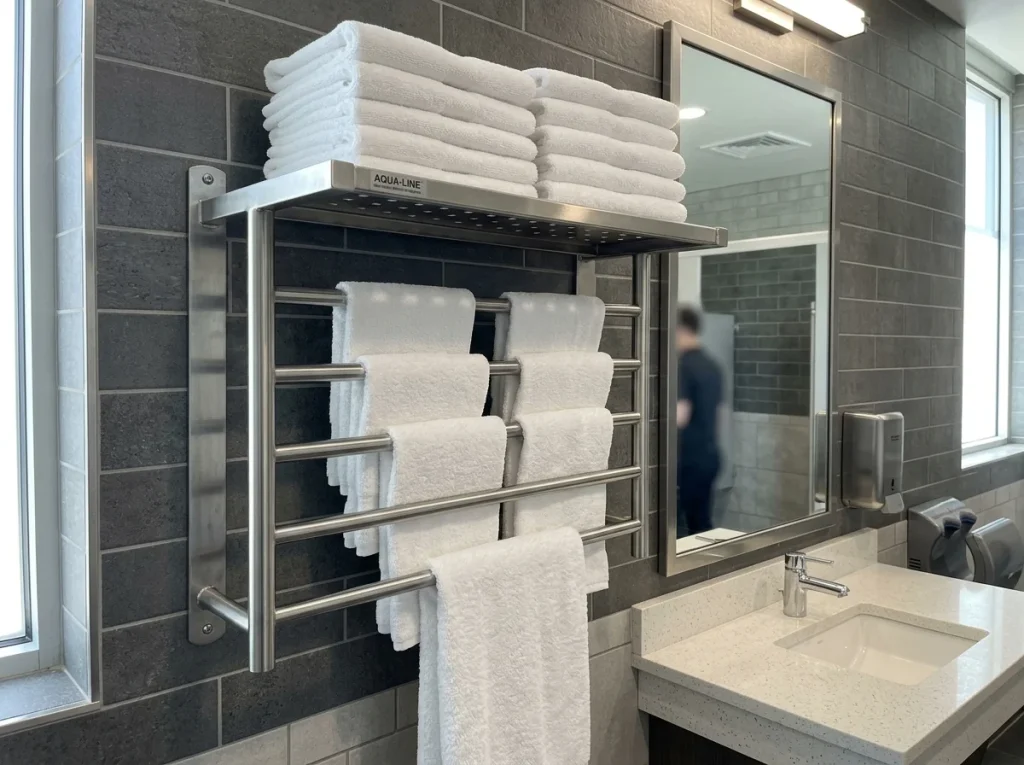
1. Understand What a Towel Dryer Rack Is Used for in Commercial Bathrooms
A towel dryer rack is designed to warm and dry towels after use. In commercial bathrooms, it may serve several purposes:
It improves the guest experience in hotel rooms, spas, resorts, and serviced apartments. It helps towels dry faster in humid environments. It reduces the damp feeling of used towels. It creates a more premium bathroom impression. In some properties, it may also support housekeeping efficiency by keeping guest-use towels more organized.
But it is important to set realistic expectations. A towel dryer rack is not a replacement for bathroom ventilation, laundry systems, HVAC control, or housekeeping management. It supports drying, but it cannot solve poor ventilation, constant water leakage, or excessive towel usage by itself.
For commercial projects, the first question is not “Which design looks best?” but “What problem should this product solve?”
| Commercial scenario | Main purpose of towel dryer rack | Recommended focus |
|---|---|---|
| Hotel guest room | Guest comfort and premium impression | Safe surface temperature, elegant finish, quiet operation |
| Resort or spa | Drying damp towels in humid spaces | Corrosion resistance, moisture protection, stronger output |
| Serviced apartment | Daily long-term user convenience | Durable structure, energy control, easy maintenance |
| Gym changing room | Repeated wet towel exposure | Heavy-duty construction, 316 stainless steel option |
| Senior living facility | Comfort and hygiene support | Safe temperature, rounded edges, accessible placement |
| Public premium restroom | Brand image and functional drying | Simple design, anti-tamper fixing, easy cleaning |
SourceZJ can help project buyers match commercial towel racks and towel dryer rack designs with mirrors, faucets, hooks, shelves, and other bathroom accessories for hotels and public facilities.
2. Decide Whether You Need Electric, Hydronic, or Non-Heated Drying
Commercial towel dryer racks usually fall into three categories: electric heated towel racks, hydronic towel radiators, and non-heated ventilation-friendly towel racks.
Electric heated towel dryer racks
Electric towel dryer racks are common in hotels, apartments, spas, and private commercial bathrooms. They use internal electric heating elements to warm the rail. They can be hardwired or plug-in, depending on market requirements and project design.
For commercial bathrooms, hardwired installation is usually cleaner and safer than plug-in installation because there is no visible cord and less risk of misuse. However, hardwired models require electrical planning during design and installation by qualified electricians.
UL 499 covers electric heating appliances rated at 600 V or less for use in unclassified locations according to the National Electrical Code. For towel dryer rack procurement, buyers should ask suppliers which electrical safety standards, approvals, or testing apply to the target market. (UL Standards Online)
Hydronic towel dryer racks
Hydronic towel racks connect to a hot water or heating system. They are more common in some residential and hospitality markets where central heating infrastructure is already available. They may be suitable for serviced apartments, resorts, or properties with compatible heating systems.
The challenge is engineering coordination. Hydronic towel racks require plumbing design, pressure compatibility, valves, pipe routing, leak testing, and maintenance planning. They are not as simple to retrofit as electric models.
Non-heated towel drying racks
In some commercial bathrooms, a well-designed stainless steel towel rack with good ventilation is more appropriate than a heated model. Public washrooms, office bathrooms, and high-traffic facilities may not need heating at all. A non-heated rack has lower cost, no electrical connection, simpler maintenance, and fewer compliance issues.
| Type | Advantages | Watchpoints | Best use |
|---|---|---|---|
| Electric heated | Easy independent control, premium experience | Requires electrical safety planning | Hotels, spas, serviced apartments |
| Hydronic heated | Efficient where heating system exists | Requires plumbing coordination | Resorts, apartments, colder climates |
| Non-heated drying rack | Low cost, simple maintenance | No active heating | Offices, public restrooms, basic projects |
For many commercial projects, the best strategy is mixed specification: heated towel dryer racks in premium rooms, spa suites, and long-stay apartments; standard stainless steel towel racks in public or budget areas.
3. Choose the Right Material: 304 vs 316 Stainless Steel and Other Metals
Material determines corrosion resistance, strength, surface quality, and service life.
304 stainless steel: the commercial baseline
304 stainless steel is the most practical material for many indoor commercial towel dryer racks. It offers a good balance of strength, corrosion resistance, appearance, and cost. For hotel guest rooms, serviced apartments, office executive bathrooms, and general commercial spaces, 304 stainless steel is often the right baseline.
316 stainless steel: the premium choice for harsh environments
316 stainless steel should be considered for coastal hotels, beach resorts, spas, swimming pool changing areas, gyms, wet rooms, and facilities exposed to chloride-based cleaning chemicals. It offers stronger corrosion resistance in aggressive environments. The International Molybdenum Association explains that 316 stainless steel is commonly selected where better corrosion resistance is needed in more demanding environments. (Amba Products)
Brass and aluminum
Brass can be suitable for premium hotel bathrooms where the heated towel rack must match luxury faucets or decorative hardware. It provides a rich feel and good finishing potential, but cost is higher.
Aluminum is lightweight and may be used in some cost-sensitive heated towel rail designs, but it is generally less impact-resistant than stainless steel. For commercial bathrooms, buyers should be careful about denting, coating durability, and long-term rigidity.
| Material | Commercial suitability | Best environment | Buyer note |
|---|---|---|---|
| 304 stainless steel | High | Indoor hotels, apartments, general commercial bathrooms | Best overall value |
| 316 stainless steel | Very high | Coastal, spa, gym, pool, wet rooms | Higher cost but better corrosion resistance |
| Brass | Medium to high | Luxury hotel suites | Good for premium finishes |
| Aluminum alloy | Medium | Light-duty or budget projects | Check dent resistance and coating quality |
| Plated steel | Low to medium | Temporary or low-use spaces | Higher corrosion risk if coating fails |
Procurement tip: Do not accept vague descriptions like “stainless finish” or “chrome color.” Specify the base material clearly: 304 stainless steel, 316 stainless steel, brass, or aluminum alloy.
4. Check Electrical Safety and Certification Requirements
Because a towel dryer rack may combine metal, heat, electricity, moisture, and human contact, electrical safety is one of the most important selection factors.
For commercial bathrooms, buyers should confirm:
The applicable voltage and frequency for the target market. Whether the product is hardwired or plug-in. Whether it is suitable for bathroom installation. Whether it has relevant electrical safety certification. Whether the surface temperature is controlled. Whether installation must be completed by a licensed electrician. Whether the product has protection against water ingress.
The IEC explains that ingress protection, or IP ratings, grade how well an enclosure resists dust and liquid intrusion. For bathroom electrical products, buyers should not treat IP ratings as decoration; they are part of the safety specification.
In the U.S. and many other markets, bathroom electrical installations may also require ground-fault protection, proper circuit planning, and compliance with local electrical codes. For projects in the U.S., buyers and contractors should confirm requirements with licensed electricians and the local authority having jurisdiction.
Important: The supplier’s product certificate is not the same as a safe installation. A certified product can still become unsafe if it is installed in the wrong zone, wired incorrectly, connected to the wrong voltage, or fixed too close to water exposure.
For OEM/ODM towel dryer rack projects, SourceZJ can help prepare product drawings, electrical data, installation details, and export packaging through its custom bathroom accessories manufacturing support.
5. Review Surface Temperature and User Safety
A towel dryer rack should warm towels, not create a burn risk. In hotels, senior living facilities, spas, and public bathrooms, users may include children, older adults, and people with limited mobility. Surface temperature control is therefore critical.
Ask suppliers these questions:
What is the normal operating surface temperature? Is there a thermostat or temperature limiter? How does the product behave when covered by towels? Does it pass overheating protection tests? Does it have automatic shutoff or timer options? Are there different power ratings for different room types?
For commercial use, avoid products that become excessively hot, especially in bathrooms used by children, elderly guests, or public users. A heated towel rack should be designed for safe touch conditions under normal operation.
Timer control is also useful. In hotels and serviced apartments, timers reduce unnecessary energy consumption and limit continuous operation. In spas or gyms, a central control or scheduled operation may be better than individual user control.
| Safety feature | Why it matters | Commercial recommendation |
|---|---|---|
| Temperature limiter | Reduces overheating risk | Strongly recommended |
| Timer control | Saves energy and improves safety | Recommended for hotels and apartments |
| Overheat protection | Protects product and users | Required for quality products |
| Rounded edges | Reduces injury risk | Important for public and senior facilities |
| Concealed wiring | Reduces tampering and water risk | Preferred for commercial use |
| Clear labeling | Supports maintenance teams | Recommended |
For senior living, healthcare, and accessible rooms, coordinate towel dryer rack temperature, height, and placement with project safety consultants.
6. Match Heating Power to Room Size and Usage
Heating power affects drying performance and energy consumption. A low-power rack may look elegant but dry towels slowly in a humid bathroom. An oversized rack may waste energy or become unnecessarily warm.
Buyers should consider:
Bathroom size, ventilation quality, towel size, towel quantity, humidity level, air-conditioning, guest turnover rate, operating hours, and local electricity cost.
For example, a small hotel bathroom with good ventilation may only need a compact heated towel rail. A spa changing area with thick damp towels may require a larger rack, stronger output, or a different towel management system.
Do not use wattage alone to compare products. A well-designed rack with good rail spacing may dry more effectively than a poorly designed high-wattage rack. Rail diameter, spacing, surface area, and towel contact all matter.
| Use case | Typical requirement | Selection advice |
|---|---|---|
| Single hotel guest room | Comfort warming and light drying | Compact to medium electric rack |
| Luxury suite | Larger towel capacity | Larger rack with timer and premium finish |
| Serviced apartment | Daily repeated use | Durable rack with energy control |
| Spa treatment room | Warm towel presentation | Consider controlled operation schedule |
| Gym changing area | Heavy wet towel use | Heavy-duty model, corrosion-resistant material |
| Public restroom | Usually limited need | Consider non-heated rack unless premium use case |
B2B recommendation: Define expected towel load before selecting rack size. “One bath towel per room” and “multiple wet towels in a spa changing room” are very different design conditions.
7. Select the Right Design and Mounting Style
Towel dryer racks are available in ladder style, horizontal bar style, shelf style, swivel arm style, and combined towel warmer shelf designs.
Ladder-style heated towel rack
This is the most common style for hotels and apartments. It provides multiple rails for towels and has a clean vertical appearance.
Best for: hotel rooms, serviced apartments, resorts, private bathrooms.
Horizontal multi-bar towel dryer
Horizontal bar designs are compact and modern. They are suitable where the wall is wide but height is limited.
Best for: vanity areas, compact bathrooms, boutique hotel rooms.
Heated towel rack with shelf
This design provides folded towel storage and warming. It is suitable for hotels that want a premium guest experience.
Best for: luxury hotels, spa rooms, villas, resorts.
Swivel arm towel dryer
Swivel arms improve towel separation and flexibility, but moving parts may loosen over time. Use carefully in commercial environments.
Best for: low-traffic premium rooms, private suites.
Floor-standing towel dryer
Floor-standing models are easier to place but less suitable for most commercial bathrooms because they can be moved, damaged, or create trip hazards.
Best for: limited retrofit situations, not preferred for high-traffic commercial bathrooms.
For commercial use, wall-mounted and hardwired designs are usually the most professional option. They look cleaner, save floor space, and reduce tampering.
8. Plan Installation Early: Wall, Wiring, and Location
Installation planning should begin during the design stage, not after tiles are installed.
Confirm these details before ordering:
Wall type, wall backing, tile thickness, power supply location, cable route, control switch location, mounting height, clearance from shower or bathtub, IP rating requirement, service access, and local code requirements.
A heated towel rack is heavier and more complex than a normal towel bar. The wall must support the product weight and towel load. For gypsum board, prefabricated bathroom pods, or lightweight wall panels, backing plates or reinforcement may be necessary.
Do not install the towel dryer rack where it blocks door swings, shower doors, grab bars, emergency call buttons, dispensers, or maintenance panels. Also avoid positions where users may accidentally lean on it like a grab bar.
For accessible bathrooms, the ADA 2010 Standards specify unobstructed forward and side reach ranges of 15 inches minimum to 48 inches maximum above the finished floor for many operable parts. Where the towel dryer rack has a switch, timer, or user control intended for accessible use, coordinate placement with accessibility requirements and local regulations. (ADA.gov)
Send bathroom drawings to SourceZJ for accessory layout review, including towel dryer racks, robe hooks, shelves, commercial bathroom mirrors, faucets, and shower accessories.
9. Compare Finish Options for Hotels and Public Facilities
The finish should match the bathroom design and withstand commercial cleaning.
Common finishes include polished chrome, brushed stainless steel, matte black, brushed gold, champagne, gunmetal, and PVD coatings.
For hotels, finish matching is critical. A towel dryer rack should coordinate with faucets, shower systems, mirror frames, robe hooks, and door handles. Inconsistent finishes can make a bathroom look poorly specified.
For public facilities, brushed stainless steel is usually the safest choice because it hides fingerprints and minor scratches better than polished or dark finishes.
| Finish | Best use | Advantages | Risk |
|---|---|---|---|
| Brushed stainless steel | Hotels, gyms, public bathrooms | Practical, hides small scratches | Must control brushing direction |
| Polished chrome | Hotels and apartments | Bright, familiar, easy to match | Shows water spots |
| Matte black | Modern hotels | Strong design effect | Scratches more visible |
| Brushed gold | Luxury hotels | Premium appearance | Batch color control required |
| Gunmetal | Boutique hotels | Modern and premium | Supplier consistency important |
| PVD finish | Premium projects | Better durability when well made | Higher cost |
For heated towel racks, finish durability is especially important because heat cycles may stress poor coatings. Ask suppliers whether the finish has been tested under operating temperature conditions, not only at room temperature.
10. Evaluate Corrosion Resistance and Moisture Protection
Commercial bathrooms are humid, cleaned frequently, and often poorly ventilated during peak use. Corrosion resistance must be specified clearly.
For non-electrical metal parts, stainless steel grade and surface treatment are key. For electrical towel dryer racks, moisture protection around wiring, junction boxes, seals, and controls is also critical.
Buyers should ask:
What is the IP rating? Is the product suitable for bathroom use? Is the heating element sealed? Are electrical components protected from moisture? Are screws and brackets corrosion-resistant? Can the product be used in wet rooms, spas, or pool changing areas? What cleaning chemicals should be avoided?
NEMA notes that IP ratings use a two-number format: the first digit addresses protection from solids, and the second digit addresses protection from water. Higher values represent higher protection levels, but buyers should match the rating to the actual environment instead of assuming “higher is always better.” (NEMA)
For coastal or pool-area projects, corrosion resistance is not optional. Salt air and chlorides can damage low-grade materials and coatings quickly. In these environments, 316 stainless steel and higher moisture protection should be considered.
11. Calculate Lifecycle Cost, Not Only Unit Price
Towel dryer racks can vary widely in price. The cheapest option is often not the most cost-effective option for commercial projects.
A low-cost towel dryer rack may create extra costs through early failure, rust, coating discoloration, overheating issues, wiring problems, guest complaints, room downtime, and replacement labor.
| Cost factor | Low-grade towel dryer rack risk | Commercial-grade rack advantage |
|---|---|---|
| Purchase price | Lower upfront cost | Higher but more predictable |
| Installation | More adjustment or wiring issues | Better drawings and installation consistency |
| Energy use | No timer or inefficient design | Timer, thermostat, controlled operation |
| Maintenance | Higher risk of failure | Longer service life |
| Guest experience | Uneven heating, noise, poor finish | Better comfort and appearance |
| Replacement | Batch mismatch or discontinued model | More stable repeat supply |
| Safety | Weak protection or unclear certification | Better documentation and compliance support |
For hotels, the real cost of failure includes guest dissatisfaction and room maintenance. For spas and gyms, failure can affect premium service quality. For apartments, maintenance calls reduce property management efficiency.
Procurement rule: first define safety, material, finish, heating power, control method, and certification requirements. Then compare prices between suppliers using the same specification.
12. Supplier Evaluation Checklist for Commercial Buyers
A good towel dryer rack supplier should provide more than a catalog price. For B2B projects, buyers need engineering support, stable production, certification documents, finish control, packaging, and after-sales response.
Ask potential suppliers:
Can you provide product drawings and installation instructions? Can you confirm material grade? Can you support 110–120 V, 220–240 V, or market-specific electrical configurations? What safety certifications are available? What is the IP rating? What is the surface temperature range? Can you provide timer or thermostat options? Can you customize size, finish, logo, or packaging? What QC steps are used before shipment? How are products protected during export shipping? Can you supply spare parts or replacement units for future maintenance?
For OEM and distributor buyers, supplier stability is especially important. A product that cannot be repeated consistently creates problems for after-sales service and future projects.
SourceZJ supports commercial bathroom accessory sourcing, OEM/ODM customization, and export-oriented packaging for overseas buyers. For coordinated product packages, buyers can combine towel dryer racks with bulk commercial bath accessories, towel bars, robe hooks, shelves, mirrors, and faucet collections.
13. Common Mistakes to Avoid
Mistake 1: Treating a towel dryer rack like a normal towel bar
A towel dryer rack involves heat, electricity or hot water, user safety, and installation coordination. It needs a more detailed specification.
Mistake 2: Choosing by design photo only
A beautiful product photo does not confirm material, heating performance, wiring quality, IP rating, or surface temperature safety.
Mistake 3: Ignoring bathroom zones and local codes
Electrical equipment in bathrooms must be coordinated with local electrical requirements. Always involve qualified electricians and follow local regulations.
Mistake 4: Using the wrong material in coastal or spa environments
For humid, salty, or chloride-heavy environments, low-grade materials can corrode quickly. Consider 316 stainless steel and higher moisture protection.
Mistake 5: No timer or temperature control
Continuous operation can waste energy and may create unnecessary heat. Timer and thermostat options are valuable in commercial settings.
Mistake 6: Installing without wall reinforcement
A towel dryer rack must be securely fixed. Lightweight walls, prefab pods, and gypsum board may need reinforcement.
Mistake 7: Mixing finishes across suppliers
Matte black, brushed gold, gunmetal, and champagne finishes vary between factories. For hotels, coordinate visible hardware from a controlled supplier set.
14. Practical Specification Template
Commercial buyers can use the following template when requesting quotations.
| Specification item | What to request |
|---|---|
| Product type | Electric heated towel dryer rack, hydronic rack, or non-heated drying rack |
| Application | Hotel room, spa, gym, apartment, public bathroom |
| Material | 304 stainless steel, 316 stainless steel, brass, or aluminum |
| Finish | Brushed stainless, chrome, matte black, PVD gold, gunmetal, etc. |
| Size | Width, height, depth, rail spacing |
| Power | Voltage, wattage, plug-in or hardwired |
| Safety | Certification, temperature limiter, overheat protection |
| Moisture protection | IP rating and bathroom suitability |
| Control | Timer, thermostat, switch, central control |
| Installation | Wall type, mounting bracket, screw type, wiring location |
| Packaging | Individual protection, export carton, pallet option |
| OEM | Logo, private label, custom finish, custom size |
| QC | Inspection standard, sample approval, test report request |
After sending this template, buyers can compare suppliers more fairly. Without a clear specification, the lowest quote may simply be based on a weaker product.
FAQ: Choosing Towel Dryer Racks for Commercial Bathrooms
Business negotiations are welcome
Choosing a towel dryer rack for commercial bathrooms requires a balance of comfort, safety, durability, installation planning, and lifecycle cost.
For most hotel rooms and serviced apartments, an electric 304 stainless steel towel dryer rack with timer control, safe surface temperature, concealed wiring, and a coordinated finish is a strong baseline. For coastal resorts, spas, gyms, wet rooms, and pool changing areas, 316 stainless steel and stronger moisture protection are worth considering. For public bathrooms with heavy traffic, a simple non-heated stainless steel rack may sometimes be the better commercial decision.
The best towel dryer rack is not the most decorative model or the cheapest quotation. It is the product that fits the bathroom environment, wall structure, electrical requirements, maintenance plan, and guest experience target.
For hotel, spa, gym, apartment, office, and public bathroom projects, SourceZJ can support OEM/ODM bathroom accessories manufacturing, towel dryer rack customization, finish matching, sample approval, and export-ready packaging across complete commercial bathroom product categories.
Planning an Electric Towel Rack Project?
Download the 61-page SourceZJ catalog to compare heated towel rack models, finishes, and project applications before requesting a quotation.
Download the Electric Towel Rack Catalog English
 العربية
 Русский
 Español