
Table of Contents
Why Heated Towel Rails Need OEM-Level Planning
A heated towel rail is not the same as a standard towel rack. It is both a bathroom accessory and an electrical heating product. For hotels, serviced apartments, villas, spas, wellness facilities, and premium residential projects, this creates a more complex sourcing decision.
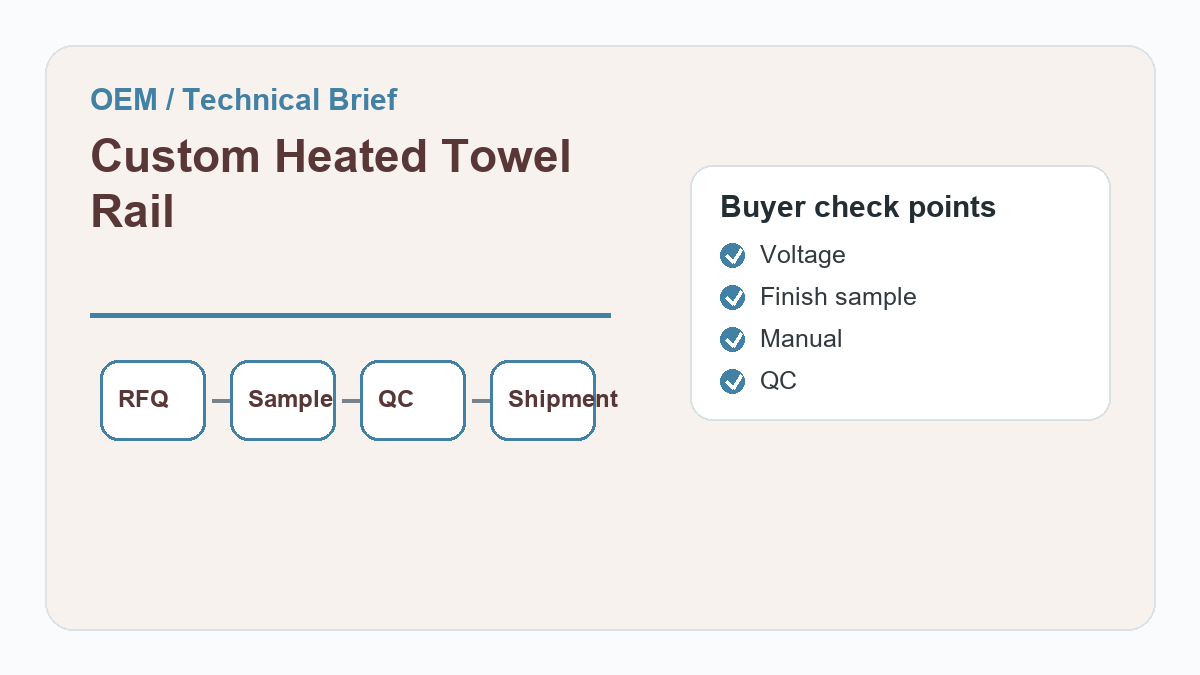
A standard towel rail mainly needs structural strength, finish consistency, corrosion resistance, and safe packaging. A heated towel rail also requires electrical configuration, heating performance, insulation safety, IP protection, wiring method, controller options, voltage compatibility, installation coordination, and market-specific compliance review.
This guide is written for importers, hotel project buyers, bathroom brands, wholesalers, contractors, and developers looking for a custom heated towel rail manufacturer for OEM and project supply. It explains how to evaluate product types, materials, finishes, electrical options, MOQ, quality control, packaging, and project delivery.
For buyers who need manufacturer-level support for custom bathroom accessories and project hardware, SourceZJ can support commercial bathroom accessories OEM and custom manufacturing for hotel, apartment, wholesale, and private-label programs.
1. Define the Heated Towel Rail Application Before Choosing a Design
The first step is not choosing a shape. It is defining where and how the heated towel rail will be used.
A heated towel rail for a luxury hotel bathroom has different requirements from one used in a serviced apartment, a spa room, a villa, or a retail private-label product line. The target market affects voltage, plug type, wiring method, IP rating, control system, packaging, certifications, and installation documentation.
| Application | Buyer Priority | Recommended Configuration Focus | Key Sourcing Risk |
|---|---|---|---|
| Hotel guest rooms | Guest comfort and design consistency | Hardwired electric rail, stable finish, project labeling | Finish mismatch or delayed delivery |
| Serviced apartments | Durability and easy maintenance | Practical wattage, timer option, simple installation | Weak controller or poor spare part planning |
| Spa and wellness areas | Moisture resistance and premium feel | 304/316 stainless steel, higher IP discussion, corrosion control | Humidity-related corrosion or electrical risk |
| Private-label retail | Marketable design and packaging | Standard voltage, plug option, branded box, instruction manual | Compliance and warranty claims |
| Villa and premium residential | Luxury finish and custom size | PVD-style finish, custom dimensions, programmable controller | High MOQ and color variation |
| Contractor project supply | Installation efficiency | Clear wiring diagram, carton labels, accessory packs | Site confusion and missing parts |
A reliable manufacturer should ask project questions before recommending a model. If a supplier only sends a catalog without asking about voltage, installation location, control preference, and target market, the buyer should slow down.
Send SourceZJ your target country, project type, bathroom layout, voltage requirement, finish preference, and estimated quantity. SourceZJ can help organize these details into a custom heated towel rail RFQ.
2. Choose the Right Heating Structure
Heated towel rails can be designed in several ways. The right option depends on project budget, installation method, heating expectation, and maintenance plan.
Electric Dry Heating
Dry electric towel rails use internal heating elements. They are common in hotel and apartment projects because they can be installed independently from the hot-water system. Buyers should confirm rated voltage, wattage, cable position, heating uniformity, controller compatibility, and overheat protection.
Liquid-Filled Electric Heating
Some heated towel rails use internal fluid to distribute heat. These can provide a more even warming feel, but they require careful sealing and leakage control. For large OEM orders, buyers should ask about pressure testing and long-term reliability.
Hydronic Heated Towel Rails
Hydronic towel rails connect to a hot-water or central heating system. They may be suitable in some building systems, but they require plumbing coordination and are more dependent on project engineering design. Importers and hotel buyers should confirm whether the target market prefers electric, hydronic, or dual-fuel configurations.
Dual-Fuel Options
Dual-fuel models can connect to central heating and also use an electric element when central heating is not active. They are more complex and should be evaluated carefully for target market requirements.
| Heating Type | Best Use | Advantage | Buyer Checkpoint |
|---|---|---|---|
| Electric dry heating | Hotels, apartments, retail OEM | Independent installation and clear control | Wattage, voltage, cable outlet, controller |
| Liquid-filled electric | Premium residential and selected projects | More even warming feel | Sealing, leakage testing, safety review |
| Hydronic | Buildings with central hot-water heating | Integrated with building system | Plumbing coordination and valve compatibility |
| Dual-fuel | Markets with seasonal heating systems | Flexible use across seasons | More complex installation and compliance |
| Low-watt warming rail | Hospitality comfort applications | Lower energy demand | Heating expectation must be realistic |
For international sourcing, heated towel rails should be discussed as electrical appliances, not only bathroom hardware. IEC 60335-2-43:2024 covers the safety of electric clothes dryers and towel rails for household and similar purposes with rated voltage not more than 250 V, including DC-powered and battery-operated appliances; use this type of reference when discussing electrical safety expectations with suppliers and testing partners.
3. Confirm Electrical Configuration Early
Electrical details should be confirmed before sample production. If buyers leave electrical configuration until later, sample revisions and certification discussions can become expensive.
Key electrical details include:
- Rated voltage, such as 110–120 V or 220–240 V.
- Rated power or wattage.
- Frequency requirement.
- Plug type or hardwired design.
- Cable outlet position.
- Cable length.
- Switch type.
- Timer or thermostat option.
- Controller location.
- Indicator light.
- Overheat protection discussion.
- Electrical insulation and grounding method.
- Wiring diagram and installation instructions.
- Market-specific testing or certification requirements.
A heated towel rail used in a bathroom must be designed with moisture, user contact, and installation location in mind. Buyers should involve a qualified electrical professional or local compliance advisor for target-market requirements. For hotel and public projects, licensed electrical installation may be required depending on local regulations.
| Electrical Item | Why It Matters | What Buyers Should Ask |
|---|---|---|
| Voltage | Must match destination market | Can the model support the required voltage? |
| Wattage | Affects heating speed and energy use | What wattage is suitable for this rail size? |
| Wiring method | Impacts installation and compliance | Plug-in, concealed wiring, or hardwired? |
| Cable outlet | Affects bathroom layout | Can outlet position be customized? |
| Controller | Affects user experience | Manual switch, timer, thermostat, or smart control? |
| IP protection | Important in wet bathroom environments | What IP rating can be supported and tested? |
| Instruction manual | Reduces installation error | Can OEM instructions be supplied? |
Electrical configuration is one of the biggest differences between a heated towel rail order and a standard bathroom towel rack order. Buyers should treat it as a specification item, not an afterthought.
4. Understand IP Ratings and Bathroom Placement
Bathrooms create moisture exposure. A heated towel rail must be discussed with appropriate protection level and installation position.
IEC 60529 classifies degrees of protection provided by enclosures for electrical equipment, commonly known as the IP Code. This standard is used to describe protection against solid objects and water ingress, making it a useful reference when buyers discuss bathroom electrical product enclosure protection with manufacturers and testing partners.
For sourcing purposes, buyers should not simply write “waterproof” in an RFQ. “Waterproof” is vague. A more professional approach is to specify the target IP rating, installation zone, bathroom use scenario, and local approval requirements.
Important questions include:
- Will the rail be installed near a shower, bathtub, vanity, or dry wall area?
- Is the unit plug-in or hardwired?
- Is the controller integrated or external?
- Is the cable outlet exposed to splash risk?
- Which market-specific installation rules apply?
- Does the project require certified testing documents?
- Who is responsible for electrical installation on site?
A manufacturer can provide product configuration, but the buyer must confirm local building, electrical, and bathroom-zone requirements in the destination market.
Share your target country and bathroom installation position with SourceZJ before sample confirmation. This helps align IP rating, wiring method, controller position, and documentation expectations early.
5. Select Materials Based on Heat, Moisture, and Finish Requirements
Material selection for heated towel rails must consider moisture exposure, heat cycling, surface finish, welding quality, and long-term cleaning. A material that works for a decorative towel bar may not be ideal for an electric heated rail if it performs poorly under repeated heating and bathroom humidity.
304 Stainless Steel
304 stainless steel is commonly used for commercial bathroom accessories because it offers a strong balance of corrosion resistance, durability, and appearance. It is suitable for many hotel, apartment, and residential heated towel rail projects.
316 Stainless Steel
316 stainless steel may be considered for coastal hotels, spa areas, wellness facilities, or highly humid environments. It is usually more expensive, so buyers should use it where the environment justifies the upgrade.
Mild Steel With Coating
Some budget heated towel rails use steel with powder coating or plating. This can reduce cost, but coating quality, edge coverage, and corrosion protection must be checked carefully.
Aluminum
Aluminum can support lightweight designs and fast heat transfer in some structures. Buyers should confirm anodizing or coating quality and structural strength.
| Material | Best Use | Strength | Sourcing Caution |
|---|---|---|---|
| 304 stainless steel | Hotels, apartments, OEM retail | Balanced durability and appearance | Confirm tube thickness and weld polishing |
| 316 stainless steel | Coastal hotels, spas, humid areas | Stronger corrosion resistance | Higher cost and MOQ may apply |
| Coated mild steel | Budget retail or cost-sensitive projects | Lower cost | Check coating, edge protection, and corrosion risk |
| Aluminum | Lightweight designs | Good appearance and heat response | Check finish consistency and strength |
| Brass components | Valves, fittings, selected premium details | Strong and premium | Confirm compatibility with full rail structure |
For metal surfaces and coatings, ISO 9227:2022 specifies neutral salt spray, acetic acid salt spray, and copper-accelerated acetic acid salt spray test procedures for assessing corrosion resistance of metallic materials with or without corrosion protection. This is useful when buyers discuss corrosion-resistance expectations for humid bathroom environments.
6. Compare Finish Options for Custom Heated Towel Rails
Finish choice affects design value, corrosion resistance, cleaning behavior, and batch consistency. Heated towel rails are often installed in highly visible positions, so finish defects are easy to notice.
Common finish options include:
- Polished chrome.
- Brushed stainless steel.
- Matte black.
- White powder coating.
- Brushed gold.
- Gunmetal.
- PVD-style decorative finish.
- Custom project color.
| Finish | Best Project Fit | Key Risk | Recommended Control |
|---|---|---|---|
| Polished chrome | Standard hotel and retail lines | Water spots and plating defects | Check smoothness and surface uniformity |
| Brushed stainless steel | Commercial bathrooms and apartments | Different brushing direction | Approve physical golden sample |
| Matte black | Modern hotels and private-label lines | Scratches, edge wear, gloss variation | Strong packaging and coating adhesion check |
| White coating | Minimalist bathrooms | Dirt visibility and chipping | Check coating thickness and edge coverage |
| Brushed gold | Premium hospitality projects | Color variation between batches | Approve sample under fixed lighting |
| Gunmetal | Modern luxury projects | Tone mismatch across products | Use one approved finish standard |
| Custom color | Brand or design projects | Higher MOQ and longer lead time | Confirm finish batch MOQ early |
For heated towel rails, finish control must also consider heat exposure. Ask the supplier whether the finish is suitable for the operating temperature range and whether heat cycling affects color, adhesion, or surface feel.
Buyers developing black heated towel rails can also review the related black bathroom accessories wholesale guide for deeper finish, packaging, and MOQ considerations.
7. OEM Options: What Can Be Customized?
Custom heated towel rail orders can involve more than logo branding. OEM customization may include structure, size, tube shape, bar spacing, finish, heating power, wiring, controller, packaging, and documentation.
Structural Customization
This includes height, width, number of bars, tube diameter, wall brackets, rail spacing, and mounting positions. For hotels, rail spacing should match actual towel size and guest use. For retail products, dimensions should match market expectations and carton limits.
Electrical Customization
This includes voltage, wattage, heating element type, cable outlet, plug type, switch, timer, thermostat, and controller design. Any electrical customization should be reviewed with target-market compliance in mind.
Finish Customization
This includes matte black, brushed stainless steel, chrome, white, brushed gold, gunmetal, and custom color. Finish customization may require higher MOQ due to coating or plating batch requirements.
Packaging Customization
This includes private-label boxes, instruction manuals, barcode labels, carton marks, installation diagrams, warranty cards, and project labels.
| OEM Option | What Can Be Customized | MOQ Impact | Buyer Warning |
|---|---|---|---|
| Size and bar layout | Height, width, number of rails, spacing | Medium | May require new drawings or tooling |
| Material | 304, 316, coated steel, aluminum | Medium | Material change may affect cost and heating behavior |
| Finish | Chrome, black, white, gold, gunmetal | Medium to high | Finish batch MOQ may apply |
| Wattage | Power level matched to rail size | Medium | Must be reviewed for safety and performance |
| Wiring | Cable side, plug, hardwire option | Medium | Must match market requirements |
| Controller | Switch, timer, thermostat, smart module | High | Increases testing and documentation complexity |
| Packaging | Logo box, manual, barcode, carton marks | Medium | Printing MOQ may apply |
Send SourceZJ your reference design, target size, voltage, wattage range, finish, controller preference, logo requirement, and order quantity. SourceZJ can help organize these details into an OEM heated towel rail specification file.
8. Project Supply Planning for Hotels, Apartments, and Spas
Project supply requires more planning than standard wholesale orders. A hotel may need different heated towel rail sizes for standard rooms, suites, accessible rooms, spa rooms, and VIP bathrooms. An apartment project may need one standardized model for easier maintenance. A spa may need more corrosion-resistant materials and premium finishes.
Project buyers should confirm:
- Room count and room types.
- Quantity per room.
- Spare quantity for replacement.
- Installation wall condition.
- Wiring position.
- Controller access.
- Finish matching with other bathroom accessories.
- Required delivery schedule.
- Carton labeling by floor, room, or area.
- Site storage conditions.
- Installation responsibility.
| Project Type | Recommended Supply Logic | Key Check Before Order |
|---|---|---|
| Hotel standard rooms | One or two standardized models | Finish consistency and delivery batch control |
| Hotel suites | Larger or premium rail option | Custom size and finish approval |
| Serviced apartments | Durable, easy-maintenance model | Spare parts and reorder availability |
| Spa rooms | Higher corrosion-resistance material | Moisture exposure and finish durability |
| Villas | Premium design and custom finish | Low-volume OEM feasibility |
| Contractor projects | Installation-ready cartons | Labels, wiring diagrams, accessory packs |
SourceZJ bathroom towel rack category can support buyers comparing towel storage formats, including standard towel racks and project-oriented towel rail solutions.
9. Build a Clear Heated Towel Rail Specification Sheet
A heated towel rail RFQ should be more detailed than a normal bathroom accessory RFQ. If the RFQ is vague, the quotation will be difficult to compare.
A professional specification sheet should include:
- Product type: electric, hydronic, liquid-filled, or dual-fuel.
- Size: height, width, tube diameter, wall distance.
- Number of bars.
- Material.
- Finish.
- Rated voltage.
- Rated wattage.
- Wiring method.
- Cable outlet position.
- Plug type if applicable.
- Controller type.
- IP rating target.
- Mounting method.
- Accessories included.
- Packaging type.
- Quantity.
- Destination country.
- Sample requirement.
- Testing or certification expectation.
- Delivery schedule.
| Specification Field | Example |
|---|---|
| Product | Wall-mounted electric heated towel rail |
| Size | 800 × 500 mm |
| Material | 304 stainless steel |
| Finish | Matte black powder coating |
| Voltage | 220–240 V |
| Wattage | To be recommended based on size |
| Control | Timer switch or simple on/off switch |
| Wiring | Concealed hardwire, right-side outlet |
| IP target | To be confirmed for bathroom application |
| Packaging | Individual carton with instruction manual |
| Quantity | 500 pcs trial order, project quantity later |
| Destination | EU hotel project |
A clear specification sheet helps the supplier quote accurately and reduces sample revisions.
10. Quality Control Checklist for Heated Towel Rails
QC for heated towel rails must cover both bathroom hardware quality and electrical product quality. A general visual inspection is not enough.
Hardware Checks
- Overall dimensions.
- Tube alignment.
- Weld quality.
- Surface scratches.
- Finish color and gloss.
- Mounting bracket strength.
- Wall distance.
- Screw and accessory pack accuracy.
- Carton condition.
Heating and Electrical Checks
- Rated voltage and wattage confirmation.
- Power cable position.
- Switch or controller function.
- Heating uniformity.
- Temperature behavior according to agreed specification.
- Insulation and safety checks according to testing plan.
- Label and instruction manual.
- Plug or wiring accuracy.
- IP-related documentation where applicable.
Packaging Checks
- Protection of visible surfaces.
- Separation of brackets and accessories.
- Cable protection.
- Controller protection.
- Individual carton strength.
- Master carton labeling.
- Project label accuracy.
- Instruction manual included.
| QC Area | What to Check | Why It Matters |
|---|---|---|
| Structure | Size, welding, tube alignment, bracket fit | Ensures stable installation |
| Finish | Scratches, coating defects, color consistency | Protects visual quality |
| Heating | Wattage, heating response, uniformity | Confirms product performance |
| Electrical | Cable, controller, insulation, label | Supports safety and compliance review |
| Accessories | Screws, brackets, manual, warranty card | Reduces installation complaints |
| Packaging | Inner protection, carton labels, cable protection | Prevents shipping damage |
| Documentation | Wiring diagram, rating label, specification file | Supports project and import review |
For project supply, the buyer should approve a golden sample and keep a signed specification file before production starts.
Ask SourceZJ for a heated towel rail QC checklist before mass production. This helps align sample approval, production inspection, and pre-shipment inspection.
11. MOQ and Lead Time: What Drives Cost and Schedule?
MOQ and lead time depend on customization depth. A standard heated towel rail in a regular finish may have a lower MOQ. Custom size, custom wattage, premium finish, controller customization, or private-label packaging may increase MOQ and lead time.
| Customization Level | Typical Requirement | MOQ / Lead Time Impact |
|---|---|---|
| Standard model, standard finish | Existing design and regular packaging | Lower impact |
| Standard model, custom finish | Same structure, different coating | Medium impact |
| Custom size | New drawing and possible tooling | Medium to high impact |
| Custom electrical configuration | Voltage, wattage, wiring, controller changes | High impact |
| Private-label packaging | Logo box, manual, barcode, carton mark | Medium impact |
| Project-labeled supply | Floor, room, or batch labels | Medium impact |
| New product development | New structure and electrical design | Highest impact |
Buyers should ask suppliers to separate MOQ by structure, finish, electrical configuration, and packaging. This makes negotiation more practical.
Lead time should be divided into stages:
- Design confirmation.
- Engineering review.
- Sample production.
- Sample testing and revision.
- Packaging artwork approval.
- Material preparation.
- Mass production.
- Electrical and heating inspection.
- Packaging.
- Pre-shipment inspection.
- Export shipment.
A supplier who gives only one lead time number without explaining stages may not be suitable for complex OEM orders.
12. Packaging for Export and Project Delivery
Heated towel rails are long, surface-sensitive, and include electrical components. Packaging must protect metal surfaces, brackets, cables, controllers, and instruction documents.
Export packaging should include:
- Protective bag or film for the rail.
- Corner protection.
- Foam or molded support.
- Separate accessory compartment.
- Cable and controller protection.
- Instruction manual.
- Rating label protection.
- Individual carton.
- Master carton if required.
- Clear shipping marks.
- Project labels if used for hotel supply.
For retail private-label orders, packaging should also support brand presentation. For hotel project orders, packaging should support installation efficiency. Cartons may need item codes, floor references, room numbers, or batch labels.
For buyers sourcing broader bathroom accessory packages, SourceZJ commercial bathroom accessories collection can support coordination between heated towel rails, towel racks, robe hooks, paper holders, and related bathroom hardware.
13. Supplier Evaluation Scorecard for Custom Heated Towel Rails
A heated towel rail supplier should be evaluated differently from a standard towel rack supplier. Electrical capability, documentation, and testing coordination matter.
| Evaluation Area | Suggested Weight | What to Check |
|---|---|---|
| Product engineering | 20% | Size, structure, heating design, bracket stability |
| Electrical configuration | 20% | Voltage, wattage, wiring, controller, safety review |
| Material and finish | 15% | Stainless grade, coating, corrosion resistance |
| OEM capability | 10% | Custom size, finish, controller, packaging |
| Quality control | 15% | Hardware checks, heating checks, electrical checks |
| Compliance support | 10% | Documentation and testing coordination |
| Packaging | 5% | Rail, cable, controller, carton protection |
| Project supply | 5% | Labels, phased delivery, spare parts, reorder support |
This scorecard helps buyers avoid choosing a supplier only because the unit price looks attractive. Heated towel rails require more coordination, so the supplier’s technical and documentation ability should carry significant weight.
14. Common Mistakes Buyers Should Avoid
Mistake 1: Treating Heated Towel Rails Like Standard Towel Racks
A heated towel rail has electrical and heating requirements. Buyers must confirm voltage, wattage, wiring, controller, IP protection, and documentation.
Mistake 2: Asking for “Waterproof” Without an IP Target
“Waterproof” is not precise enough. Discuss IP rating, bathroom placement, and local installation rules.
Mistake 3: Approving the Finish Without Heat Consideration
Some finishes may perform differently when exposed to repeated heating. Ask whether the finish is suitable for the expected operating temperature.
Mistake 4: Ignoring Cable Outlet Position
Cable outlet position affects installation. A right-side outlet may not fit a left-side wiring layout. Confirm this before sampling.
Mistake 5: Underestimating Packaging
Heated towel rails are long and visible. Scratches, bent brackets, damaged cables, or broken controllers can create claims.
Mistake 6: Skipping Local Compliance Review
Manufacturers can provide product information and testing support, but importers and project buyers should confirm target-market requirements with local professionals.
Mistake 7: Not Planning Spare Parts
Hotels and apartments should plan replacement brackets, controllers, screws, and manuals. Spare parts reduce maintenance problems after installation.
15. How SourceZJ Supports Custom Heated Towel Rail Projects
SourceZJ supports B2B buyers who need custom bathroom hardware and towel rail solutions for wholesale, hotel, apartment, and OEM programs. For heated towel rail projects, the sourcing process should connect design, material, finish, electrical configuration, packaging, and project delivery from the beginning.
SourceZJ can support:
- Heated towel rail product selection and OEM discussion.
- Custom size, bar spacing, tube shape, and finish planning.
- Material recommendations for 304 stainless steel, 316 stainless steel, coated steel, aluminum, and mixed structures.
- Finish discussions for chrome, brushed stainless steel, matte black, white, brushed gold, and gunmetal.
- Voltage, wattage, wiring, controller, and cable outlet coordination for supplier review.
- Private-label packaging, instruction manuals, carton marks, and barcode labels.
- Sample approval and golden sample control.
- Project labeling for hotel and apartment supply.
- Pre-shipment QC checklist support.
- Related bathroom accessories sourcing for coordinated project packages.
A custom heated towel rail should be attractive, safe, durable, easy to install, and realistic to supply in bulk. The right manufacturer helps buyers reduce project risk by confirming the important details before production starts.
Send SourceZJ your heated towel rail drawings or reference photos, target voltage, wattage preference, size, finish, installation method, project quantity, packaging requirement, and destination country. SourceZJ can help prepare an OEM specification plan and project supply quotation.
FAQ: Custom Heated Towel Rail Manufacturer
1. What should I check when choosing a custom heated towel rail manufacturer?
Check product engineering ability, electrical configuration support, material options, finish control, IP rating discussion, OEM customization, QC process, packaging, documentation, and project delivery capability.
2. Can heated towel rails be customized for OEM orders?
Yes. OEM options may include size, number of bars, tube shape, material, finish, voltage, wattage, wiring method, controller, logo, instruction manual, packaging, and carton marks.
3. What material is best for heated towel rails?
304 stainless steel is a common choice for many commercial and residential projects. 316 stainless steel may be considered for coastal, spa, or humid environments. Coated steel and aluminum may also be used depending on budget, structure, and finish requirements.
4. What IP rating should heated towel rails use in bathrooms?
The correct IP rating depends on installation position, bathroom zone, wiring method, and destination-market rules. Buyers should discuss IP targets with the manufacturer and confirm local requirements with qualified electrical professionals.
5. What affects MOQ for custom heated towel rails?
MOQ is affected by structure, size, finish, heating element, voltage, controller, packaging, and testing requirements. Custom electrical configurations and private-label packaging usually increase MOQ.
6. Should heated towel rails be installed by licensed professionals?
For hotel, apartment, public, or hardwired installations, buyers should involve qualified or licensed electrical professionals according to local rules. This is especially important when products are installed in bathrooms or wet areas.
Planning an Electric Towel Rack Project?
Download the 61-page SourceZJ catalog to compare heated towel rack models, finishes, and project applications before requesting a quotation.
Download the Electric Towel Rack Catalog English
 العربية
 Русский
 Español