
Table of Contents
OEM Towel Rack Sourcing Is a Product Development Process
An OEM towel rack order is not the same as buying standard towel racks from a catalog. For wholesale buyers, bathroom brands, hotel suppliers, apartment developers, and project contractors, OEM sourcing means turning a product idea into a repeatable commercial item. That process includes design confirmation, material selection, finish approval, structure testing, MOQ planning, sample revision, packaging design, bulk production, inspection, and future reorder control.
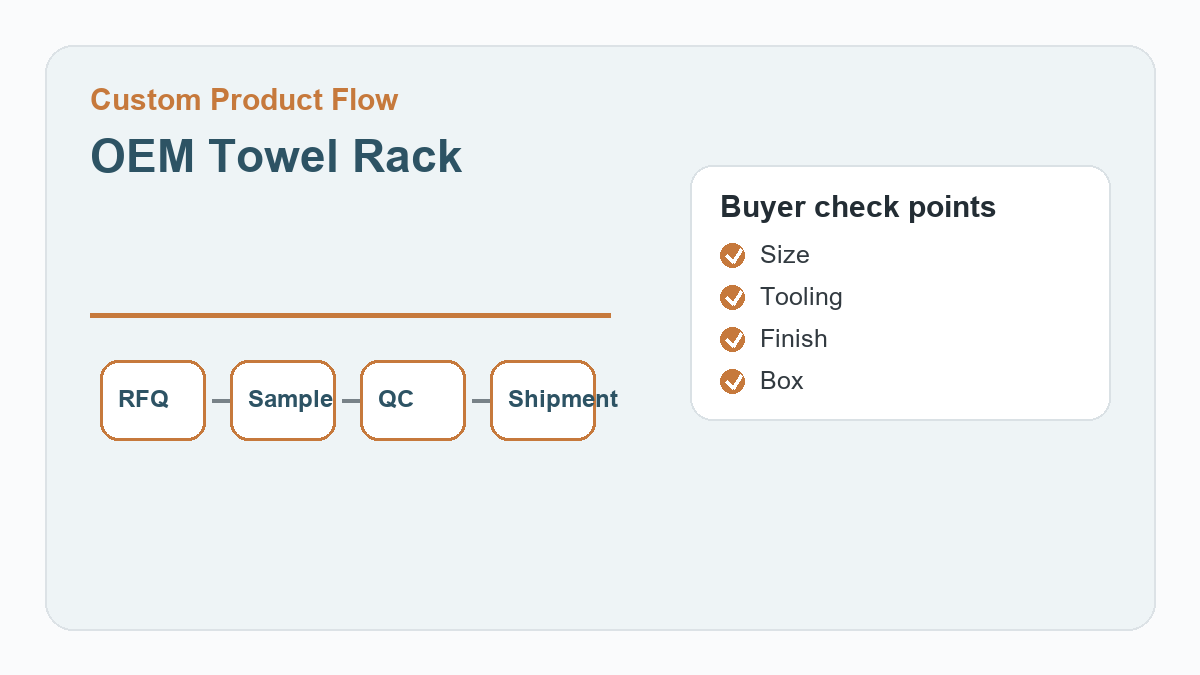
A towel rack may look simple, but OEM customization can affect many details: tube diameter, rack width, shelf depth, bar spacing, mounting brackets, screw packs, surface finish, logo method, packaging, carton size, and production lead time. If these details are not confirmed before mass production, buyers may face finish mismatch, unstable installation, damaged cartons, high MOQ pressure, or delayed shipment.
This guide is written for importers, wholesalers, private-label bathroom brands, hotel project buyers, contractors, and distributors looking for an OEM towel rack manufacturer. It explains how to prepare a custom towel rack brief, evaluate design feasibility, compare materials and finishes, understand MOQ, manage samples, and control lead time for bulk orders.
For buyers who need manufacturer-level support for custom bathroom hardware, SourceZJ provides commercial bathroom accessories OEM and custom manufacturing support for towel racks, towel shelves, bathroom hardware, hotel projects, wholesale programs, and private-label lines.
1. Start With an OEM Brief, Not a Random Reference Photo
Many OEM towel rack projects begin with a reference image. That is useful, but it is not enough. A reference photo shows the design direction, not the production requirement.
A strong OEM brief should explain what the towel rack must do, where it will be used, how it will be installed, and how it will be sold. A towel rack for hotel bathrooms needs different engineering decisions from one sold through e-commerce or regional wholesale distribution.
| OEM Brief Item | Why It Matters | Example Buyer Input |
|---|---|---|
| Target market | Controls material, finish, packaging, and price level | Hotel, apartment, retail, contractor, e-commerce |
| Product type | Affects structure and installation | Wall-mounted rack, towel shelf, freestanding rack |
| Size range | Affects tooling, packaging, and shipping | 450 mm, 600 mm, 800 mm width |
| Material preference | Controls cost and durability | 304 stainless steel, 316 stainless steel, aluminum |
| Finish direction | Controls MOQ and defect risk | Chrome, brushed stainless, matte black, brushed gold |
| Installation method | Affects bracket, screws, and instructions | Concealed wall mount, exposed screws, floor-standing |
| Packaging channel | Affects carton design | Neutral box, color box, project carton, e-commerce carton |
| Order plan | Affects MOQ and unit price | Trial order, project order, annual reorder program |
A clear brief helps the manufacturer respond with engineering feedback instead of only sending a price. It also helps the buyer avoid unnecessary customization that increases MOQ and lead time without improving sales value.
Send SourceZJ your reference photo, target size, material, finish, sales channel, first-order quantity, and packaging idea. SourceZJ can help turn the concept into an OEM-ready towel rack development brief.
2. Decide Which Towel Rack Type Should Be Customized
OEM customization can apply to different towel rack formats. The right format depends on buyer strategy, project environment, and sales channel.
Wall-Mounted Towel Racks
Wall-mounted towel racks are common in hotels, apartments, offices, and commercial bathrooms. OEM options may include width, shelf depth, tube profile, bracket style, hole spacing, and finish. These are practical for bulk orders because they are easy to standardize.
Towel Shelves With Lower Bars
A towel shelf with a lower bar is popular in hotel-style bathrooms because it stores folded towels and hanging towels in one unit. OEM buyers should check shelf strength, weld quality, spacing, and carton protection.
Freestanding Towel Racks
Freestanding towel racks are suitable for villas, suites, spa rooms, rental apartments, and retail markets where wall drilling is not preferred. OEM customization may include height, base shape, anti-slip feet, bar spacing, and packaging. For deeper sourcing details, buyers can refer to the related freestanding towel rack supplier guide.
Ladder-Style Towel Racks
Ladder-style racks support design-led private-label collections. They can create strong visual identity, but they may increase carton volume and require careful stability testing.
Heated Towel Rails
Heated towel rails are a separate OEM category because they involve electrical configuration, voltage, wattage, IP rating, controller, and compliance discussion. They should not be treated as standard metal towel racks.
| Towel Rack Type | OEM Customization Potential | Best Buyer Use | Main Risk |
|---|---|---|---|
| Wall-mounted towel rack | High | Hotels, contractors, wholesale | Wrong brackets or hole spacing |
| Towel shelf with bar | High | Hotel-style retail and project supply | Load strength and packaging damage |
| Freestanding towel rack | Medium to high | Villas, spas, apartments, retail | Base stability and freight volume |
| Ladder-style rack | Medium | Boutique brands and premium lines | Stability and carton size |
| Heated towel rail | High but technical | Premium hotel and wellness projects | Electrical and compliance complexity |
| Compact towel rack | Medium | Small bathrooms and apartments | May not fit real towel sizes |
SourceZJ bathroom towel rack category can support buyers comparing towel rack formats before choosing the right OEM development direction.
3. Convert Design Ideas Into Manufacturable Specifications
A good-looking towel rack design still needs to be manufacturable. OEM buyers should work with the manufacturer to convert design ideas into specifications that can be produced repeatedly.
This stage is often called design-for-manufacturing, or DFM. In practical B2B sourcing terms, it means checking whether the design can be made at the target cost, target MOQ, target finish, and target lead time.
Important specification items include:
- Overall width.
- Height and depth.
- Tube diameter or profile.
- Tube thickness.
- Shelf spacing.
- Bar spacing.
- Wall distance.
- Bracket structure.
- Hole spacing.
- Screw and anchor type.
- Load expectation.
- Material grade.
- Finish process.
- Logo position.
- Packaging size.
- Carton quantity.
| Design Detail | Why It Matters | Supplier Feedback Needed |
|---|---|---|
| Tube diameter | Affects appearance, strength, and price | Is the tube size standard or custom? |
| Tube thickness | Affects strength and cost | What thickness is suitable for bulk production? |
| Shelf depth | Affects towel storage and carton size | Is the depth practical for hotel towels? |
| Bracket design | Affects installation stability | Can it be installed easily on target walls? |
| Hole spacing | Affects contractor work | Can drawings be provided before production? |
| Wall distance | Affects usability and cleaning | Is there enough clearance for towels? |
| Base design | Affects freestanding stability | Is the base heavy and balanced enough? |
| Product size | Affects packaging and freight | What is the carton size and gross weight? |
A reliable OEM manufacturer should not blindly accept every design request. Good feedback may include suggestions to simplify a bracket, adjust tube thickness, reduce carton volume, improve weld access, or use an existing finish to reduce MOQ.
Share your sketch or reference drawing with SourceZJ before requesting final pricing. SourceZJ can help identify which design details may affect tooling, MOQ, packaging, or lead time.
4. Choose Materials Based on Function, Not Only Cost
Material selection should follow the towel rack’s use environment and brand positioning. A budget towel rack for retail promotion does not require the same material as a hotel towel shelf for humid guest bathrooms. A coastal spa project may require stronger corrosion resistance than a standard apartment bathroom.
304 Stainless Steel
304 stainless steel is widely used for commercial bathroom towel racks because it offers a practical balance of durability, corrosion resistance, appearance, and cost. It is suitable for many hotel, apartment, office, and wholesale programs.
316 Stainless Steel
316 stainless steel may be considered for coastal hotels, spas, poolside areas, and high-humidity environments. It usually costs more, so buyers should use it where the environment or product positioning justifies the upgrade.
Aluminum
Aluminum can be suitable for lightweight towel rack designs, modern frames, or selected bathroom accessories. Buyers should confirm strength, coating or anodizing quality, and finish consistency.
Zinc Alloy Components
Zinc alloy may be used for decorative bases, brackets, or small components. It can reduce cost and support certain shapes, but coating quality and load performance must be checked.
Coated Steel
Coated steel may be used for price-sensitive orders. Buyers should be careful about rust risk, especially around cut edges, screw holes, welds, and damaged coating areas.
| Material | Best OEM Use | Advantage | Buyer Checkpoint |
|---|---|---|---|
| 304 stainless steel | Hotels, apartments, wholesale lines | Durable and widely accepted | Confirm grade, tube thickness, and screws |
| 316 stainless steel | Coastal, spa, humid projects | Better corrosion resistance | Use where environment supports the cost |
| Aluminum | Lightweight or modern designs | Lower weight and clean appearance | Check strength and finish consistency |
| Zinc alloy components | Brackets, bases, decorative parts | Shape flexibility and cost control | Check coating and load performance |
| Coated steel | Budget or promotional lines | Lower price | Check edge protection and rust risk |
| Mixed material | Premium or design-led racks | Stronger visual differentiation | Check assembly and packaging complexity |
The material should be written into the production file. A vague description such as “metal towel rack” is not enough for OEM orders.
5. Treat Finish as an Engineering Decision
Finish is not only a color. It affects appearance, scratch visibility, corrosion resistance, MOQ, packaging, inspection, and future reorder consistency.
Common OEM towel rack finishes include chrome, brushed stainless steel, matte black, brushed gold, gunmetal, white coating, and custom colors. Each finish has different commercial and technical implications.
| Finish | Best Buyer Positioning | OEM Risk | Control Method |
|---|---|---|---|
| Chrome | Standard wholesale and hotel use | Plating defects and water spots | Check smoothness and coating quality |
| Brushed stainless steel | Commercial and hotel-grade lines | Brushing direction mismatch | Approve physical sample |
| Matte black | Modern retail and boutique hotels | Scratches, edge wear, gloss variation | Use golden sample and strong packaging |
| Brushed gold | Premium private label and suites | Color variation between batches | Approve finish board |
| Gunmetal | Modern premium collections | Tone mismatch across products | Centralize finish standard |
| White coating | Minimalist bathroom lines | Chipping and dirt visibility | Check adhesion and edge coverage |
| Custom color | Brand-exclusive OEM lines | Higher MOQ and longer lead time | Confirm finish batch MOQ early |
For metallic materials and coated surfaces, ISO 9227:2022 specifies neutral salt spray, acetic acid salt spray, and copper-accelerated acetic acid salt spray test methods used to assess corrosion resistance of metallic materials with or without corrosion protection. Buyers can use this as a reference when discussing corrosion expectations, while still defining their own exposure time and acceptance criteria in the project specification.
For matte black, brushed gold, and gunmetal towel racks, physical sample approval is essential. Photos cannot reliably show gloss, texture, brushing direction, or color tone.
For dark-finish sourcing, buyers can also review the related black bathroom accessories wholesale guide to control finish, packaging, and MOQ risks.
6. Separate Standard OEM From Full Custom Development
OEM does not always mean starting from zero. Many buyers can reduce cost and lead time by using an existing structure and customizing size, finish, logo, or packaging. Others need full custom development with new tooling or exclusive design.
| OEM Level | What Changes | Best For | MOQ / Lead Time Impact |
|---|---|---|---|
| Level 1: Standard model customization | Finish, logo, packaging | First-time wholesale buyers | Low to medium |
| Level 2: Size adjustment | Width, height, shelf depth, bar spacing | Hotels and apartment projects | Medium |
| Level 3: Structure adjustment | Bracket, tube profile, base, shelf layout | OEM brands and project buyers | Medium to high |
| Level 4: Exclusive design | New shape, tooling, private mold | Premium brands | High |
| Level 5: Full product family | Towel racks plus hooks, shelves, holders | Long-term private-label programs | High but scalable |
The right OEM level depends on business stage. A new wholesale buyer may start with Level 1 or Level 2. A hotel project may need Level 2 customization for size and finish. A mature private-label brand may invest in Level 4 or Level 5 to build stronger differentiation.
A good manufacturer should explain which customization level is realistic for your quantity and timeline.
Ask SourceZJ to classify your towel rack idea into standard customization, size adjustment, structure adjustment, or full custom development. This makes MOQ and lead time easier to estimate.
7. Understand What Drives MOQ
MOQ is one of the most important issues in OEM towel rack manufacturing. Buyers often ask for the lowest MOQ, but the better approach is to understand what creates the MOQ.
MOQ can be driven by material purchase, tube size, surface finishing batch, packaging printing, logo process, tooling, accessory packs, carton production, and factory scheduling.
| MOQ Driver | Why It Affects Quantity | Buyer Question |
|---|---|---|
| Product structure | New design may require setup or tooling | Is this an existing structure or new development? |
| Tube size | Non-standard tube may need minimum material purchase | Is this tube profile standard? |
| Finish | Black, gold, gunmetal, or custom colors may need batch production | What is MOQ for this finish? |
| Packaging | Printed color boxes require printing MOQ | Can we start with label packaging? |
| Logo | Laser, engraving, printing, or label methods differ | Which logo method has the lowest MOQ? |
| Tooling | New molds require development cost | Can tooling cost be separated from unit price? |
| Mixed SKU | Multiple models increase production complexity | Can SKUs be combined in one shipment? |
| Reorder | Future orders may use existing records | Can reorder MOQ be lower? |
A smart first-order strategy is to reduce unnecessary customization. For example, choose an existing towel rack structure, use a proven finish, add private-label packaging, and postpone exclusive tooling until reorder demand is proven.
This approach protects the buyer’s cash flow while still building a differentiated product line.
8. Plan Lead Time by Stage, Not by a Single Promise
OEM towel rack lead time should be broken down into stages. A supplier may say “30 days,” but that may refer only to mass production after sample approval. Real OEM development includes design confirmation, engineering review, sample production, sample revision, finish approval, packaging approval, mass production, inspection, and export shipment.
| Lead Time Stage | What Happens | Common Delay Risk |
|---|---|---|
| Design brief | Buyer confirms target model, size, finish, quantity | Vague requirements |
| Engineering review | Supplier checks structure and manufacturability | Custom parts or unclear drawings |
| Sample production | Prototype or production sample is made | Special finish or tooling |
| Sample revision | Buyer requests adjustments | Multiple design changes |
| Finish approval | Physical finish is confirmed | Color mismatch or coating issue |
| Packaging approval | Box, label, manual, carton confirmed | Late artwork or barcode files |
| Material preparation | Metal, brackets, screws, cartons prepared | Non-standard materials |
| Mass production | Cutting, bending, welding, polishing, assembly | Mixed SKU complexity |
| Surface finishing | Brushing, plating, coating, PVD-style process | Finish batch scheduling |
| Inspection and packing | QC, accessory check, carton labeling | Defects or missing parts |
| Shipment | Booking, documents, export coordination | Trade term or freight delay |
International buyers should confirm trade terms early. Trade.gov explains that Incoterms are internationally recognized rules defining seller and buyer responsibilities in export transactions, including shipment, insurance, documentation, customs clearance, and other logistics activities.
Send SourceZJ your target delivery date before starting custom design. SourceZJ can help check whether your design, finish, packaging, and MOQ plan fit the required lead time.
9. Build a Sample Approval System
Sample approval is the bridge between design and mass production. For OEM towel racks, the sample should represent the final order as closely as possible.
A strong sample approval system should include:
- Structural sample.
- Final material confirmation.
- Final finish sample.
- Accessory pack review.
- Installation test.
- Packaging mockup.
- Carton label review.
- Golden sample retention.
- Written approval record.
| Sample Type | Purpose | Buyer Decision |
|---|---|---|
| Prototype sample | Checks shape and size | Is the design direction correct? |
| Finish sample | Checks color, gloss, texture | Is the finish approved? |
| Functional sample | Checks brackets, screws, installation | Does it install correctly? |
| Packaging sample | Checks protection and branding | Can it survive shipping and selling? |
| Golden sample | Controls future production | Is this the approved production reference? |
Do not approve a sample without checking mounting hardware. For towel racks, screws, anchors, brackets, decorative covers, and instruction sheets affect customer satisfaction as much as the main metal frame.
For hotel or contractor channels, sample testing should include actual wall conditions where possible. For e-commerce, sample testing should include packaging review. For retail, sample review should include product presentation and barcode label accuracy.
10. Prepare a Complete OEM Production File
An OEM production file protects both buyer and manufacturer. It reduces misunderstanding and helps future reorders match the original product.
A complete OEM towel rack production file should include:
- Product name.
- SKU code.
- Drawing or dimension sheet.
- Material by component.
- Tube diameter and thickness.
- Finish standard.
- Bracket type.
- Screw and anchor details.
- Load expectation.
- Logo method.
- Packaging structure.
- Instruction sheet.
- Barcode label.
- Carton mark.
- Quantity per carton.
- Golden sample reference.
- Inspection checklist.
- Reorder note.
| Production File Section | Example |
|---|---|
| Product | OEM wall-mounted towel rack with shelf |
| SKU | TR-SS-600-BS |
| Size | 600 mm width × 220 mm depth |
| Material | 304 stainless steel main body |
| Finish | Brushed stainless steel |
| Mounting | Concealed bracket, wall screws and anchors |
| Packaging | Individual box, 10 pcs per master carton |
| Logo | Box logo and instruction sheet logo |
| QC | Dimensions, finish, welds, brackets, accessory pack |
| Reorder rule | Match golden sample and same carton file |
ISO describes ISO 9001 as the international standard for quality management systems and notes that it provides a framework to help organizations deliver consistent products and services, improve efficiency, and meet customer and regulatory expectations. Buyers can use this as a process-control reference when discussing manufacturing consistency, while still checking product-level QC details directly with the supplier.
A supplier that can maintain production files, samples, and batch records is more suitable for long-term OEM cooperation than one that only communicates through casual messages.
11. Packaging Should Be Designed During Product Development
Packaging should not be an afterthought. For OEM towel racks, packaging affects product protection, brand image, carton volume, freight cost, warehouse handling, and customer reviews.
A towel rack may have long metal rails, brackets, screws, shelves, or bases. If parts rub together inside the carton, scratches are likely. Matte black, gunmetal, brushed gold, and polished finishes need especially careful protection.
| Packaging Type | Best Use | Key Check |
|---|---|---|
| Neutral individual box | Wholesale and contractor supply | SKU label, inner protection, carton efficiency |
| Private-label color box | Retail and e-commerce | Brand design, barcode, instruction sheet |
| Project carton | Hotel and apartment supply | Room-type or area labels |
| E-commerce reinforced carton | Online sellers | Stronger corner protection and drop resistance |
| Bulk export carton | Large project orders | Product separation and stacking strength |
A packaging plan should include:
- Inner bag or film.
- Foam or paper separation.
- Corner protection.
- Accessory bag.
- Instruction sheet.
- Barcode label.
- Individual box.
- Master carton.
- Carton size.
- Gross weight.
- Shipping mark.
- Project label if needed.
For buyers building a broader bathroom accessory program, SourceZJ bathroom accessories product collection can support coordinated packaging across towel racks, hooks, shelves, paper holders, and related bathroom hardware.
12. Quality Control for OEM Towel Rack Bulk Orders
OEM QC should check both the product and the customization details. A towel rack may pass basic visual inspection but still fail if the logo is wrong, the carton label is mismatched, or the screw pack is incomplete.
Product QC
Check dimensions, tube thickness, welding, polishing, edge smoothness, finish, bracket alignment, wall distance, and product cleanliness.
Finish QC
Check scratches, coating defects, color consistency, gloss, brushing direction, edge coverage, and batch difference.
Accessory QC
Check screws, anchors, brackets, decorative covers, Allen key where applicable, and instruction sheets.
Packaging QC
Check inner protection, individual boxes, carton strength, SKU labels, barcode labels, shipping marks, and carton quantity.
OEM Detail QC
Check logo position, packaging artwork, manual content, SKU code, product claim wording, and golden sample match.
| QC Area | Common Defect | Business Impact |
|---|---|---|
| Dimensions | Wrong width, depth, or hole spacing | Installation failure |
| Finish | Scratches, color variation, coating defects | Customer complaints |
| Brackets | Weak fixing or wrong alignment | Safety and installation risk |
| Accessories | Missing screws or anchors | After-sales claims |
| Packaging | Rubbing, carton damage, weak protection | Freight damage |
| Logo | Wrong position or unclear mark | Brand quality issue |
| Labels | Wrong SKU or barcode | Warehouse and reorder confusion |
Ask SourceZJ for an OEM towel rack pre-shipment inspection checklist before production. A custom checklist helps align product, finish, packaging, logo, and accessory requirements.
13. Compare OEM Manufacturers With a Development Scorecard
OEM manufacturer evaluation should focus on development capability, not only catalog size.
| Evaluation Area | Suggested Weight | What to Check |
|---|---|---|
| Design engineering | 20% | Can the supplier convert ideas into manufacturable specs? |
| Material and structure | 15% | Grade, tube thickness, brackets, load suitability |
| Finish control | 15% | Physical samples, golden sample, batch consistency |
| MOQ clarity | 10% | Product, finish, packaging, logo, tooling MOQ |
| Sample process | 10% | Prototype, revision, final sample, approval record |
| Lead time reliability | 10% | Stage-by-stage timeline and realistic delivery |
| Packaging capability | 10% | Retail, project, e-commerce, export protection |
| QC process | 5% | Inspection checklist and defect handling |
| Reorder support | 5% | Production file, sample retention, replacement parts |
A low price may not help if the manufacturer cannot support design revision, sample control, finish matching, or future reorders. OEM sourcing requires a partner who can manage detail.
14. Common Mistakes in OEM Towel Rack Development
Mistake 1: Treating OEM as Logo Printing Only
OEM can include size, structure, material, finish, packaging, installation parts, and production records. Logo printing is only one small part.
Mistake 2: Customizing Too Many Details at Once
Custom size, custom tube, custom finish, custom logo, custom packaging, and new tooling can make the first order too complex. Start with the most valuable custom points.
Mistake 3: Approving Photos Instead of Samples
Photos cannot show real finish, weight, weld quality, bracket strength, or packaging protection. Physical sample approval is essential.
Mistake 4: Ignoring Mounting Hardware
A towel rack is only as reliable as its brackets, screws, anchors, and installation method. Check the complete system.
Mistake 5: Not Separating MOQ Drivers
MOQ may come from finish, packaging, tube material, or tooling. Ask the manufacturer to explain each MOQ layer.
Mistake 6: Confirming Lead Time Without Sample Approval
Production lead time usually starts after sample, specification, finish, and packaging are approved.
Mistake 7: Failing to Keep Golden Samples
Without golden samples, future batches may drift in finish, dimensions, or packaging.
15. How SourceZJ Supports OEM Towel Rack Buyers
SourceZJ supports B2B buyers who need custom towel racks for wholesale, hotel, apartment, contractor, e-commerce, and private-label programs. The focus is not only supplying towel racks, but helping buyers convert design ideas into manufacturable, repeatable, export-ready products.
SourceZJ can support:
- Wall-mounted towel racks, towel shelves, freestanding towel racks, and selected custom towel storage products.
- OEM size, tube profile, shelf depth, bar spacing, bracket, and finish discussion.
- Material recommendations for 304 stainless steel, 316 stainless steel, aluminum, zinc alloy components, coated steel, and mixed structures.
- Finish options such as chrome, brushed stainless steel, matte black, brushed gold, gunmetal, white, and custom colors.
- MOQ planning by product, finish, packaging, logo, tooling, and reorder.
- Sample approval, revision tracking, and golden sample retention.
- Private-label packaging, barcode labels, instruction sheets, and carton marks.
- Project packaging for hotels, apartments, and contractors.
- Pre-shipment inspection checklist support.
- Reorder record support for long-term OEM programs.
- Category expansion into robe hooks, towel bars, shelves, paper holders, mirrors, faucets, and bathroom hardware sets.
A strong OEM towel rack manufacturer should help buyers reduce product-development risk. The right supplier makes the design manufacturable, the finish repeatable, the MOQ understandable, the lead time realistic, and the bulk order easier to inspect.
Send SourceZJ your towel rack concept, drawing or reference photo, target size, material, finish, logo requirement, packaging style, first-order quantity, destination country, and required delivery date. SourceZJ can help prepare an OEM development plan, sample recommendation, MOQ breakdown, and lead time estimate.
FAQ: OEM Towel Rack Manufacturer
1. What can be customized in an OEM towel rack order?
OEM customization can include size, width, height, shelf depth, tube diameter, tube thickness, bracket design, hole spacing, material, finish, logo, packaging, instruction sheet, barcode label, carton mark, and accessory pack.
2. What material is best for OEM towel racks?
304 stainless steel is a practical choice for many hotel, apartment, and wholesale towel racks. 316 stainless steel may be used for coastal, spa, or humid projects. Aluminum, zinc alloy components, and coated steel may also be suitable depending on design, budget, and target market.
3. Why does MOQ vary for custom towel racks?
MOQ depends on product structure, tube size, finish batch, packaging printing, logo method, tooling, mixed SKU complexity, and reorder planning. A standard model with custom packaging usually has lower MOQ than a fully custom structure.
4. How long does OEM towel rack development take?
Lead time depends on design complexity, sample revisions, finish approval, packaging approval, material preparation, production, inspection, and shipment. Buyers should ask suppliers to break the timeline into stages instead of accepting one simple delivery promise.
5. How do I reduce risk before bulk production?
Prepare a clear OEM brief, request production-representative samples, approve physical finish samples, confirm mounting hardware, review packaging, keep golden samples, and use a pre-shipment inspection checklist.
6. Should I choose an existing towel rack model or create a new design?
For first orders, an existing model with custom finish, logo, or packaging often reduces MOQ and lead time. A new design is better when the buyer has a clear brand strategy, sufficient quantity, and time for sampling and revision.
 English
 العربية
 Русский
 Español