

Table of Contents
I. The Commercial Paradigm Shift
In the highly competitive hospitality and premium wellness sectors, guest experience is directly tied to the architectural details of the facility. The smart, electric heated towel rack has transcended its status as a “luxury upgrade” and is now a mandatory performance baseline in five-star hotels, luxury fitness clubs, and boutique corporate suites.
However, searching online for installation instructions yields a dangerous void. The internet is saturated with B2C “DIY tutorials” designed for homeowners mounting lightweight, plug-in racks. Applying these residential methods to a commercial project is a recipe for operational disaster, electrical code violations, and catastrophic maintenance overhead.
There is a fundamental difference between commercial engineering and residential DIY. A commercial environment demands High-Traffic Reliability, strict Electrical Code Compliance, and Low-Maintenance Architectures.
If you are a Facility Manager, a Commercial Building Contractor, an Interior Architect, or a Project Sourcing Director, this 2026 Professional Guide is your definitive blueprint. Engineered by the B2B sourcing experts at SourceZJ (Zhenjia Hardware), this whitepaper will transition your perspective from a “basic installer” to a “strategic facility operator,” ensuring your heated towel rack deployments are secure, compliant, and infinitely scalable.
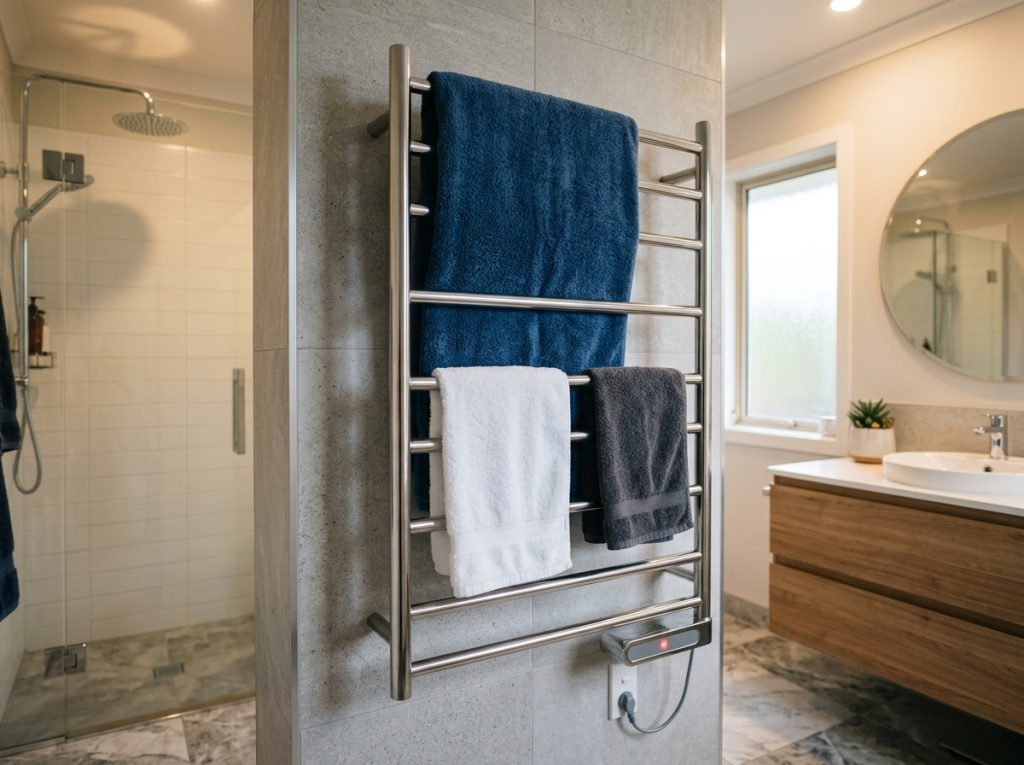
Commercial Procurement Notice: Are you managing the procurement for a multi-room hospitality or commercial development? Do not rely on retail-grade hardware. Contact SourceZJ today for a customized OEM/ODM commercial specification quote.
II. Pre-Installation Planning: The Decisive Commercial Factor
In commercial construction, 90% of a successful installation occurs before the drywall is even hung. You must treat the heated towel rack not as an accessory, but as a permanent electrical appliance integrated into the building’s infrastructure.
1. Electrical Load Management (Amperage Strategy)
While a single carbon fiber dry-heating towel rack only draws 100W to 150W (approx. 1 to 1.5 Amps on a 110V circuit), scaling this across a 50-room hotel floor changes the engineering math entirely. You cannot simply daisy-chain these fixtures.
- Actionable Step: Facility electrical engineers must calculate the aggregate continuous load. Bathrooms must be wired with dedicated 15A or 20A circuits that account for the towel warmer operating simultaneously with high-draw appliances like commercial hair dryers.
2. Centralized Control via Building Automation Systems (BAS)
Commercial facilities cannot rely on guests to turn appliances off.
- The BMS Integration: Commercial-grade heated towel racks should be wired through contactor relays linked directly to the hotel’s Building Management System (BMS) or Building Automation System (BAS). This allows facility managers to implement global “Occupancy Sensor” triggers or “Time-of-Use” scheduling, ensuring the racks automatically power down when rooms are vacant, drastically reducing aggregate CapEx energy costs.
3. The “Hardwired Only” Mandate
Under no circumstances should a Plug-in (Surface Mounted) towel rack be utilized in a public or commercial restroom. Exposed electrical cords represent a severe tripping hazard, a liability for electrocution in wet zones, and an invitation for vandalism.
- The Commercial Standard: You must specify Hardwired (Concealed Wiring) models exclusively. The electrical connections must be terminated entirely within the wall cavity inside a code-compliant junction box.
III. Product Specification: Durability Above All Else
Installing the wrong hardware is an operational liability. Before finalizing your procurement sheet, evaluate the fixtures against this strict commercial benchmark.
| Commercial Specification | Residential / Retail Grade | The SourceZJ Commercial Standard |
|---|---|---|
| Material Integrity | 201 Stainless Steel or Plated Iron (Prone to rust) | SAE 304 or 316 Marine-Grade Stainless Steel. Withstands high-frequency metal fatigue and harsh commercial cleaning chemicals. |
| Vandalism Prevention | Standard exposed Phillips screws. Easy to steal. | Concealed Anti-Theft Hex Set-Screws. Requires specialized tooling to detach from the mounting bracket. |
| Heating Technology | Liquid-Filled (Requires fluid maintenance and risks leaking) | Carbon Fiber Dry-Heating. Zero maintenance, lightweight, rapid heating, and 100% leak-proof. |
| Compliance & Safety | Unverified or basic IPX3 ratings | UL / CE Certified with a strict IPX5 Rating (Protected against low-pressure commercial cleaning water jets). |
IV. Professional Installation Workflow (Standard Operating Procedure)
To guarantee consistency across hundreds of bathroom units, contractors must adhere to a rigid, standardized installation workflow.
Phase 1: Wall Reinforcement (The Pre-Burying Stage)
In a commercial environment, guests will inevitably lean on, pull, or hang heavy luggage on the towel rack.
- The Standard: During the stud framing stage, contractors must install solid wood blocking or heavy-gauge steel backing plates precisely at the designated mounting coordinates. Mounting a commercial rack directly to standard 5/8″ gypsum board, even with heavy-duty toggles, will inevitably result in drywall failure over time.
Phase 2: Anti-Theft Anchoring & Positioning
- ADA Compliance Alignment: Ensure the mounting height aligns with commercial accessibility standards.
- Anchoring: Secure the stainless steel mounting flanges directly into the pre-buried blocking using industrial lag bolts. Once the rack is mounted to the flanges, lock the assembly using concealed anti-theft set screws to ensure the fixture cannot be easily dismantled or stolen by unauthorized individuals.
Phase 3: Code-Compliant Electrical Termination
- Waterproof Junctions: The hardwiring must take place inside a sealed, moisture-resistant electrical junction box housed within the wall.
- GFCI Mandate: The circuit powering the towel rack must be protected by a Ground Fault Circuit Interrupter (GFCI) breaker at the main electrical panel to comply with commercial wet-zone electrical codes (e.g., NEC Article 406 in the US).
Phase 4: Waterproofing & Commissioning
- Silicone Sealing: Apply a continuous bead of professional-grade, mold-resistant structural silicone around the perimeter of the wall flanges. This prevents commercial pressurized cleaning water from breaching the wall cavity.
- Commissioning Test: Before handover, facilities must perform a Thermal Cycle Test (verifying rapid heat-up and uniform distribution) and a Grounding Resistance Test to guarantee absolute electrical safety.
V. Operational Maintenance & Safety Redundancy
A facility manager’s primary goal is maximizing uptime while minimizing operational expenditure (OpEx). Commercial towel racks must be designed for preventative maintenance.
- Preventive Maintenance Protocols: Maintenance staff should conduct quarterly visual inspections of the mounting bracket integrity and the PVD surface coating. Because the heating element is a solid-state carbon fiber wire, internal maintenance is zero.
- Safety Redundancy: Commercial environments demand fail-safes. Ensure the specified SourceZJ commercial hardware includes an integrated Thermal Cut-off (Overheat Protection). If a guest covers the entire rack in thick insulating blankets, the system will automatically sever power before reaching a combustible temperature.
- Modular Replacement (SLA Uptime): In the rare event of an electrical failure, the design must allow for “Modular Replacement.” A trained technician should be able to detach the anti-theft screws, disconnect the pigtail wiring harness, and swap the unit within 15 minutes, ensuring the hotel room can be returned to active inventory immediately.
VI. About Heated Towel Rack for Commercial FAQ
VII. Business Negotiations are Welcome
Installing a heated towel rack in a commercial environment is not an aesthetic afterthought; it is a complex intersection of electrical engineering, risk mitigation, and guest experience optimization.
By elevating your perspective to that of a strategic Facility Manager, you recognize that the true cost of an accessory includes its installation labor, its energy footprint, and its maintenance lifecycle. By mandating Hardwired installations, integrating with your BAS, and strictly procuring SS304 Stainless Steel, Carbon Fiber Dry-Heating fixtures with concealed anti-theft mechanisms, you safeguard your property against vandalism, liability, and downtime.
Do not compromise your commercial facility with retail-grade hardware. Align your infrastructure with the engineered resilience of SourceZJ.
Take the next step in professional commercial sourcing.
For Architects, Developers & Facility Managers: Schedule a Professional Commercial Project Assessment & Request a Custom OEM/ODM Quote
Need Immediate Engineering Support? Connect with our commercial project directors via WhatsApp or send your architectural blueprints to sales1@zhenjiahardware.com for a rapid compliance and capacity analysis.
 English
 العربية
 Русский
 Español