
Table of Contents
Why Freestanding Towel Racks Need a Different Sourcing Strategy
A freestanding towel rack looks like a simple bathroom accessory. For B2B buyers, however, it is rarely just a decorative item. In wholesale and hotel projects, it must meet several expectations at the same time: stable structure, corrosion resistance, attractive finish, easy installation, safe packaging, predictable lead time, and a price level that still works for bulk purchasing.
This guide is written for importers, wholesalers, hotel procurement teams, serviced apartment developers, contractors, and bathroom accessory brands looking for a reliable freestanding towel rack supplier. The goal is not only to help you compare products, but also to help you build a sourcing process that reduces rework, sample delays, finish inconsistencies, and hidden logistics costs.
Freestanding towel racks are especially popular in hotel guest bathrooms, rental apartments, villas, spa rooms, showrooms, and projects where drilling into walls is not preferred. Compared with wall-mounted towel bars, they offer flexibility and easier placement. But because they stand independently, their base weight, balance, weld quality, surface treatment, and packaging design become more important.
For buyers building a wider bathroom accessory program, SourceZJ can support freestanding towel racks as part of a broader commercial bathroom accessories OEM manufacturer solution, including material selection, finish matching, packaging customization, and export coordination.
Start With the Buying Scenario, Not the Product Photo
Many sourcing problems begin when buyers search by image only. A towel rack may look acceptable in a catalog, but the same design may fail in a hotel room if the base is too light, the surface scratches during housekeeping, or the packaging cannot protect long metal tubes during sea freight.
Before contacting suppliers, define the commercial scenario clearly. A wholesaler selling through online or offline distribution needs a different product mix from a hotel developer purchasing for 300 guest rooms. A spa project may care more about finish and visual softness, while an apartment project may prioritize durability and cost control.
| Buying Scenario | Main Buyer Concern | Recommended Supplier Focus | Common Risk |
|---|---|---|---|
| Wholesale distribution | Margin, MOQ, sell-through speed | Multiple styles, stable stock, neutral packaging | Too many SKU with slow turnover |
| Hotel guest rooms | Appearance, consistency, long-term replacement | Finish consistency, project BOQ, batch control | Color variation between batches |
| Serviced apartments | Durability, easy maintenance | Strong base, anti-slip feet, scratch-resistant finish | Lightweight racks tipping over |
| Spa and wellness projects | Premium look, moisture resistance | 304/316 stainless steel, brushed or matte finish | Poor corrosion resistance in humid rooms |
| Brand OEM/ODM | Design ownership, packaging, private label | Custom dimensions, logo, carton design | Supplier lacks engineering support |
This table helps prevent a common sourcing mistake: treating all freestanding towel racks as the same product. They may share the same function, but their business requirements are different.
If you are sourcing for a hotel, apartment, or wholesale program, prepare your target quantity, finish, packaging style, and room type. SourceZJ can help turn those details into a project-ready towel rack specification sheet.
Understand the Product Architecture Before Comparing Prices
A freestanding towel rack usually includes four major parts: the vertical frame, towel bars or rails, base structure, and surface finish. Price differences often come from details that are not obvious in product photos.
The frame determines the visual style and structural strength. Round tubes create a softer hotel look, while square tubes often feel more modern and architectural. Tube thickness matters because thin tubes may reduce cost but can also make the rack feel unstable or easy to deform during transportation.
The base is even more important. A freestanding rack with a narrow or hollow base may look elegant, but it can tip easily when wet towels are placed on one side. For commercial projects, the base should be stable enough for daily guest use and housekeeping movement. Anti-slip feet are also useful because they reduce floor scratching and improve stability on tile or stone.
The towel bars should be spaced well enough for drying and easy access. In hotel projects, a rack that only looks compact on paper may become inconvenient once real towels are placed on it. Buyers should request sample testing with the actual towel size used in the project.
The surface finish controls both appearance and maintenance. Polished chrome may suit some classic bathrooms, but brushed stainless steel, matte black, brushed gold, gunmetal, and PVD-style finishes are common in modern hospitality projects. The key is not only choosing a finish, but confirming whether the supplier can keep that finish consistent across repeated batches.
SourceZJ freestanding and wall-mounted towel rack options can be used as a starting point for buyers who want to compare towel rack styles within a broader commercial bathroom accessory package.
Material Selection: Match the Rack to the Environment
Material choice should follow the project environment. A towel rack used in a dry apartment bathroom does not face the same conditions as one used in a seaside hotel, spa, or humid wellness facility.
For most hotel and commercial projects, stainless steel is preferred because it offers a good balance of durability, appearance, and maintenance. 304 stainless steel is widely used for bathroom accessories. 316 stainless steel may be considered for coastal hotels, spa areas, or locations with higher chloride exposure. Lower-cost iron or zinc alloy parts may work in some budget programs, but buyers should be cautious about rust risk, especially around joints, welds, and cut edges.
| Material / Finish Option | Suitable Use | Advantages | Procurement Caution |
|---|---|---|---|
| 304 stainless steel, brushed | Hotels, apartments, offices | Durable, clean appearance, good value | Confirm tube thickness and weld polishing |
| 316 stainless steel | Coastal hotels, spas, humid areas | Better corrosion resistance in harsh conditions | Higher cost; request clear material confirmation |
| Chrome-plated steel | Budget wholesale lines | Lower price, familiar appearance | Higher rust risk if plating is thin or damaged |
| Matte black powder coating | Modern hotels, apartments | Strong visual impact, popular design style | Check scratch resistance and coating adhesion |
| Brushed gold / PVD-style finish | Premium hospitality projects | High-end decorative effect | Confirm color consistency across batches |
| Mixed material with stone or weighted base | Villa, spa, luxury rooms | Stronger stability and premium feel | Higher packaging and freight cost |
For metal bathroom accessories, corrosion testing can support quality comparison. ISO 9227:2022 specifies neutral salt spray, acetic acid salt spray, and copper-accelerated acetic acid salt spray test methods for evaluating metallic materials and coated surfaces. Use this type of reference when setting supplier QC expectations, while remembering that lab results should be combined with real project use conditions. External reference — mark as nofollow when publishing.
Ask SourceZJ for material suggestions based on your project location, room type, expected finish, and target budget. For coastal or spa projects, request corrosion-resistance discussion before confirming the final specification.
Hotel Project Requirements: Stability, Safety, and Placement
Hotel projects require more than attractive product design. A towel rack must fit the room layout, cleaning process, guest behavior, and accessibility requirements.
Freestanding racks are useful where wall drilling is limited or where designers want flexible placement near bathtubs, vanities, or shower areas. But placement must be coordinated carefully. The rack should not block walking routes, door swings, shower entries, vanity access, or housekeeping movement.
For U.S.-market hotel and public accommodation projects, bathroom accessories should be coordinated with accessibility requirements during the design stage. The U.S. Access Board states that ADA accessibility standards apply to places of public accommodation and commercial facilities, so buyers should ensure towel rack placement does not interfere with required clearances, reach ranges, or grab-bar zones. External reference — mark as nofollow when publishing.
A practical hotel sourcing checklist should include:
- Rack height and width matched to towel size.
- Base weight tested with wet towels.
- Anti-slip feet for tile or stone floors.
- Rounded or polished edges to reduce safety concerns.
- Finish resistance to frequent cleaning.
- Carton strength suitable for project-site handling.
- Replacement availability for future maintenance.
Hotel buyers should also confirm whether all units will be produced in one batch or multiple batches. If a project requires phased delivery, finish consistency becomes important. A matte black or brushed gold rack from one batch may not perfectly match another batch if the supplier has weak finish control.
Wholesale Sourcing: Build a SKU System Instead of Buying Random Styles
Wholesale buyers often face a different challenge. They need a product line that can sell across multiple customer segments. A freestanding towel rack supplier should therefore offer not only one attractive model, but a manageable SKU system.
A good wholesale range may include three levels. The entry-level line focuses on price-sensitive buyers. The mid-range line offers better materials and more finish choices. The premium line supports hotel, villa, or boutique project customers.
| SKU Level | Target Customer | Suggested Features | Commercial Purpose |
|---|---|---|---|
| Entry level | Retailers, online sellers, budget distributors | Simple design, basic finish, compact carton | Fast turnover and price competitiveness |
| Mid-range | Apartment projects, regional wholesalers | Better tube thickness, brushed/matte finishes, stable base | Balanced margin and quality |
| Premium | Hotels, spas, villas, design projects | 304/316 stainless steel, custom finish, weighted base | Higher order value and project positioning |
The key is to avoid over-expansion. Too many towel rack styles can create inventory pressure. A stronger strategy is to choose a few proven structures, then customize finish, packaging, or dimensions according to market demand.
For buyers who want towel racks together with robe hooks, towel bars, toilet brush holders, shelves, mirrors, and other items, SourceZJ bathroom accessories collection for hotel projects can support category-level sourcing instead of single-product purchasing.
Send your target market, preferred price range, and current best-selling bathroom accessory styles. SourceZJ can help you build a freestanding towel rack line with controlled SKU depth and export-ready packaging.
How to Evaluate a Freestanding Towel Rack Supplier
A supplier should not be judged only by unit price. For B2B sourcing, the better question is: can this supplier deliver the same product quality repeatedly, at the agreed cost, within the required timeline?
1. Product Engineering Capability
Ask whether the supplier can adjust dimensions, tube thickness, base size, towel bar spacing, and finish. A strong supplier should be able to explain why a certain base design is more stable, why a tube thickness is suitable for the product size, and how the rack is packed to avoid bending.
2. Material and Finish Control
Request material information, finish samples, and clear production standards. For stainless steel racks, confirm whether the visible surface, inner structure, and screws are made from suitable materials. Sometimes buyers only check the main tube and ignore screws, joints, or base components.
3. Sampling Speed and Accuracy
Samples should match the final production plan. If the sample is handmade but mass production uses different tooling or different material thickness, the approved sample may not represent the real order. Ask the supplier to explain whether the sample is production-representative.
4. MOQ and Batch Flexibility
Wholesale buyers may need lower MOQ for new SKU. Hotel buyers may need project-based quantity support. A useful supplier can discuss MOQ by finish, structure, packaging, and customization level instead of giving only one fixed number.
5. Packaging Design
Long towel rack components can scratch, bend, or puncture cartons if packaging is weak. Export packaging should protect surface finishes, separate metal parts, and survive stacking. For online distribution, drop-test-ready packaging may be needed.
6. Export Documentation and Trade Terms
For international sourcing, clarify Incoterms, delivery point, payment method, commercial invoice, packing list, and HS code discussion early. ICC’s official Incoterms® 2020 resources are useful for understanding how responsibilities are divided between buyer and seller under trade terms such as EXW, FOB, CIF, and DAP. External reference — mark as nofollow when publishing.
7. Communication Discipline
A good supplier gives structured answers. They confirm drawings, samples, lead time, packaging, labeling, and inspection requirements in writing. This matters because bathroom accessory orders often include many SKU, and small misunderstandings can create expensive corrections.
Supplier Scorecard for RFQ Comparison
Use a scorecard before choosing a freestanding towel rack supplier. It prevents the purchasing team from over-weighting price and under-weighting risk.
| Evaluation Area | What to Check | Suggested Weight |
|---|---|---|
| Material and finish | Stainless grade, coating quality, finish consistency | 20% |
| Structure and stability | Base design, tube thickness, anti-slip feet, load behavior | 20% |
| OEM/ODM support | Custom size, finish, packaging, logo, drawings | 15% |
| Sampling reliability | Sample accuracy, revision speed, approval process | 10% |
| Mass production QC | Inspection process, batch control, defect handling | 15% |
| Packaging and logistics | Export carton, protection, labeling, container loading | 10% |
| Commercial terms | MOQ, price validity, payment terms, delivery schedule | 10% |
A supplier with the lowest unit price may still be expensive if the product has finish defects, unstable structure, poor packaging, or delayed delivery. The scorecard gives hotel and wholesale buyers a more balanced decision framework.
Use this scorecard when comparing quotations. SourceZJ can review your target specification and help prepare a cleaner RFQ for freestanding towel racks and matching bathroom accessories.
RFQ Details Buyers Should Send to Suppliers
A clear RFQ saves time. Instead of asking, “What is your best price for freestanding towel racks?” send specific details.
Your RFQ should include the following information:
- Target quantity by model and finish.
- Project type: hotel, apartment, wholesale, spa, villa, or retail.
- Preferred material: 304 stainless steel, 316 stainless steel, plated steel, or other.
- Finish requirement: brushed, polished, matte black, brushed gold, gunmetal, etc.
- Approximate dimensions or reference drawing.
- Towel size and expected usage.
- Packaging requirement: bulk, individual box, private label, e-commerce carton.
- Destination country and preferred trade term.
- Required certificates, inspection standards, or test reports.
- Target delivery schedule.
For hotel projects, include room count and room type if possible. For example, a 200-room hotel may require different towel rack quantities for standard rooms, suites, accessible rooms, and spa areas. For wholesalers, include your target retail channel because packaging and carton strength may change depending on whether the product is sold through distributors, physical stores, or e-commerce platforms.
OEM and Customization Options
Freestanding towel racks are suitable for OEM and ODM development because buyers often need design differentiation. Customization can involve dimensions, tube shape, finish, base design, packaging, logo, or full product structure.
However, not every customization is equally complex. Changing carton artwork is relatively simple. Adjusting height or width may require drawing confirmation. Changing tube diameter, base structure, or finish may affect tooling, MOQ, and testing requirements.
Buyers should divide customization into three levels:
Level 1: Branding customization.
This includes logo labels, instruction sheets, carton marks, and packaging design. It is suitable for wholesalers and private-label importers.
Level 2: Specification customization.
This includes rack height, width, bar spacing, tube thickness, base weight, and finish. It is suitable for hotel projects and apartment developers.
Level 3: Structural customization.
This includes a new frame shape, special base design, mixed materials, or a unique premium product line. It may require tooling, longer sampling, and higher MOQ.
The best customization process starts with project use, not appearance only. A beautiful rack that is unstable, too narrow for hotel towels, or difficult to pack will create problems after production.
Packaging: The Hidden Cost in Towel Rack Sourcing
Packaging is often underestimated in towel rack sourcing. Freestanding towel racks are not always heavy, but they are long, surface-sensitive, and easy to scratch. Poor packaging can turn a good product into a claims problem.
A proper packaging plan should separate metal parts, protect corners, prevent movement inside the carton, and keep accessories organized. Screws, feet, and assembly parts should be packed in labeled small bags. Instruction sheets should be clear enough for hotel contractors, distributors, or end users.
For wholesale distribution, packaging also affects shelf appeal and customer satisfaction. For hotel projects, packaging affects site efficiency. If each carton is poorly labeled, contractors may waste time sorting products by room, floor, or model.
Buyers should ask for packaging photos before mass production. For high-volume orders, request a packaging drop test or at least a packaging review using real carton dimensions, product weight, and loading method.
Quality Inspection Before Shipment
Pre-shipment inspection should be specific. A general visual check is not enough for freestanding towel racks.
Inspection points should include:
- Overall dimensions.
- Base flatness and stability.
- Surface scratches, dents, color variation, and coating defects.
- Weld polishing and joint alignment.
- Tube deformation.
- Assembly fit.
- Anti-slip foot quality.
- Carton condition and labeling.
- Quantity and accessory pack accuracy.
For hotel projects, approve a golden sample before mass production. This sample should define the accepted finish, dimensions, structure, and packaging method. For wholesale orders, keep production samples from each batch to support future quality comparison.
A reliable supplier should welcome clear inspection standards because they reduce disputes. If a supplier resists written QC requirements, buyers should treat it as a warning sign.
Price Structure: What Actually Affects the Quotation?
Freestanding towel rack prices are affected by more than material cost. Buyers should understand the quotation structure before negotiating.
Main price drivers include:
- Material grade and tube thickness.
- Product size and base weight.
- Finish process.
- Welding and polishing complexity.
- Packaging type.
- MOQ and batch size.
- Custom tooling or molds.
- Inspection and testing requirements.
- Freight volume and carton dimensions.
For example, a larger base improves stability but increases material cost and shipping weight. A premium finish improves visual value but may require more careful handling and higher rejection control. Individual color boxes help wholesale sales but increase packaging cost.
The goal is not always to reduce price. The better goal is to remove unnecessary cost while protecting the features that matter. For hotel projects, it may be smarter to simplify the design but keep strong material, finish, and packaging standards. For wholesale programs, it may be smarter to limit the number of finishes and increase volume per SKU.
Sample-to-Order Workflow for Hotel and Wholesale Buyers
A disciplined sourcing workflow helps reduce mistakes.
| Step | Buyer Action | Supplier Output | Decision Point |
|---|---|---|---|
| 1. Requirement definition | Confirm project type, quantity, finish, budget | Initial product recommendation | Is the product direction correct? |
| 2. RFQ submission | Send dimensions, material, packaging, destination | Quotation and MOQ | Is the price commercially workable? |
| 3. Sample request | Select 1–3 models for sample testing | Physical samples | Does the rack pass stability and finish checks? |
| 4. Specification confirmation | Approve drawing, finish, packaging, labeling | Proforma invoice and production file | Are all details written clearly? |
| 5. Mass production | Monitor schedule and key materials | Production updates | Is delivery on track? |
| 6. Inspection | Check dimensions, finish, assembly, packaging | Inspection report | Is the batch acceptable? |
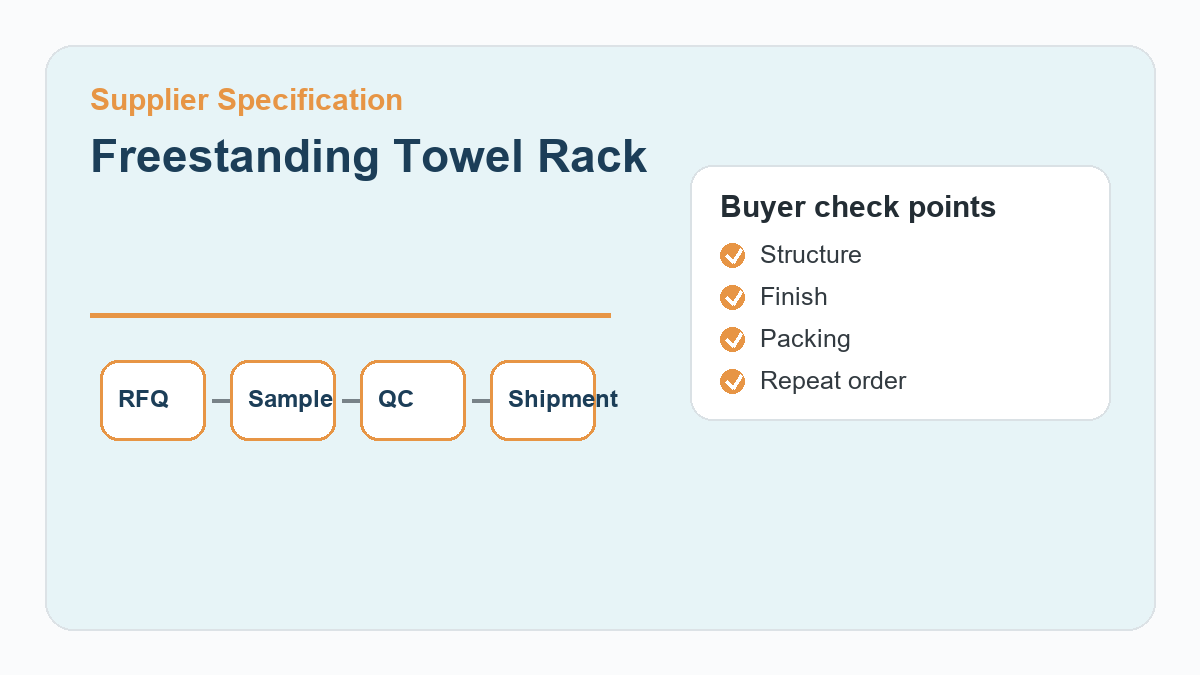
| 7. Shipment and reorder planning | Confirm shipping documents and future demand | Export documents and reorder support | Can the model become a long-term SKU? |
This workflow is especially useful for buyers managing multiple bathroom accessory items at once. When towel racks are sourced together with mirrors, faucets, shelves, towel bars, robe hooks, and toilet brush holders, the specification file becomes the center of the whole project.
For broader project matching, buyers can review SourceZJ broader commercial bathroom product category to coordinate towel racks with other bathroom fixtures and accessories.
Common Sourcing Mistakes to Avoid
The first mistake is choosing by appearance only. A towel rack must be tested with real towels and real floor conditions. Stability cannot be judged from a catalog image.
The second mistake is ignoring packaging. Scratches, bent tubes, and missing accessories often come from poor packaging, not poor product design.
The third mistake is accepting unclear material descriptions. “Stainless steel” is not enough. Ask which grade, which components, and which surface treatment.
The fourth mistake is approving a sample without confirming whether mass production will use the same process. A beautiful sample is meaningless if the production batch has different tube thickness, finish, or base weight.
The fifth mistake is buying too many styles for wholesale distribution. A focused SKU system usually performs better than a large but untested range.
The sixth mistake is failing to coordinate towel racks with the rest of the bathroom accessory package. Finish mismatch between towel racks, faucets, mirrors, shower accessories, and door hardware can reduce the perceived quality of the whole project.
Why Work With a Source Manufacturer for Freestanding Towel Racks?
A trading company can help with basic sourcing, but a source manufacturer is often more useful when buyers need stable quality, customization, batch consistency, and technical communication.
A manufacturer can discuss structure, material, finish, packaging, and production feasibility directly. This is important for hotel projects and private-label programs because design changes must be translated into production details. When communication passes through too many layers, small details are easily lost.
For freestanding towel racks, direct manufacturing support can help with:
- Adjusting rack dimensions for hotel towel sizes.
- Improving base stability.
- Matching finishes with other bathroom accessories.
- Customizing packaging for wholesale or project delivery.
- Controlling batch consistency.
- Supporting reorder planning and replacement needs.
SourceZJ is positioned to support B2B bathroom accessory buyers who need export-oriented production, OEM/ODM cooperation, and category-level sourcing rather than one-off product searching.
Send SourceZJ your target quantity, finish, preferred material, destination country, and project type. The team can help recommend freestanding towel rack options, prepare a quotation, and coordinate matching bathroom accessories for wholesale or hotel use.
FAQ: Freestanding Towel Rack Supplier Guide
1. What is the best material for hotel freestanding towel racks?
For most hotel projects, 304 stainless steel is a strong balance of durability, appearance, and cost. For coastal hotels, spas, or very humid environments, 316 stainless steel may be considered. The final choice should also depend on finish, cleaning chemicals, budget, and expected service life.
2. What MOQ should I expect when sourcing freestanding towel racks wholesale?
MOQ depends on the supplier, material, finish, packaging, and customization level. Standard models with regular finishes usually have lower MOQ. Custom finishes, private-label packaging, or structural changes usually require higher MOQ because they affect production planning and material preparation.
3. Can freestanding towel racks be customized for hotel projects?
Yes. Common customization options include height, width, towel bar spacing, base design, finish, logo, carton marks, and packaging. For large hotel projects, buyers should confirm drawings, samples, finish standards, and packaging details before mass production.
4. Are freestanding towel racks better than wall-mounted towel bars?
They solve different problems. Freestanding towel racks are flexible, movable, and useful where wall drilling is not preferred. Wall-mounted towel bars save floor space and may be better for compact bathrooms. Many hotel and apartment projects use both, depending on room layout.
5. How do I check whether a towel rack supplier is reliable?
Check product engineering ability, material clarity, sample accuracy, QC process, packaging design, communication speed, export experience, and willingness to document specifications. A reliable supplier should provide clear answers before production, not only after problems occur.
6. What should be included in a freestanding towel rack RFQ?
A strong RFQ should include quantity, material, finish, dimensions, project type, packaging requirement, destination country, preferred trade term, quality expectations, and delivery schedule. Photos are helpful, but drawings or target measurements are better for accurate quotation.
 English
 العربية
 Русский
 Español