

Table of Contents
Commercial electric heated towel rails are no longer limited to luxury residential bathrooms. They are increasingly used in hotels, serviced apartments, resorts, spas, gyms, senior living facilities, wellness centers, and premium public bathroom projects. For guests and users, they provide warm, dry towels and a more comfortable bathroom experience. For developers and operators, they can help improve perceived room quality, support towel organization, and differentiate premium bathroom spaces.
However, a heated towel rail is not just a metal bathroom accessory. It is an electrical heating product installed in a humid environment. That means project buyers must evaluate electrical safety, IP rating, surface temperature, material grade, corrosion resistance, installation method, energy control, finish consistency, and long-term maintenance before placing an order.
1. What Is a Commercial Electric Heated Towel Rail?
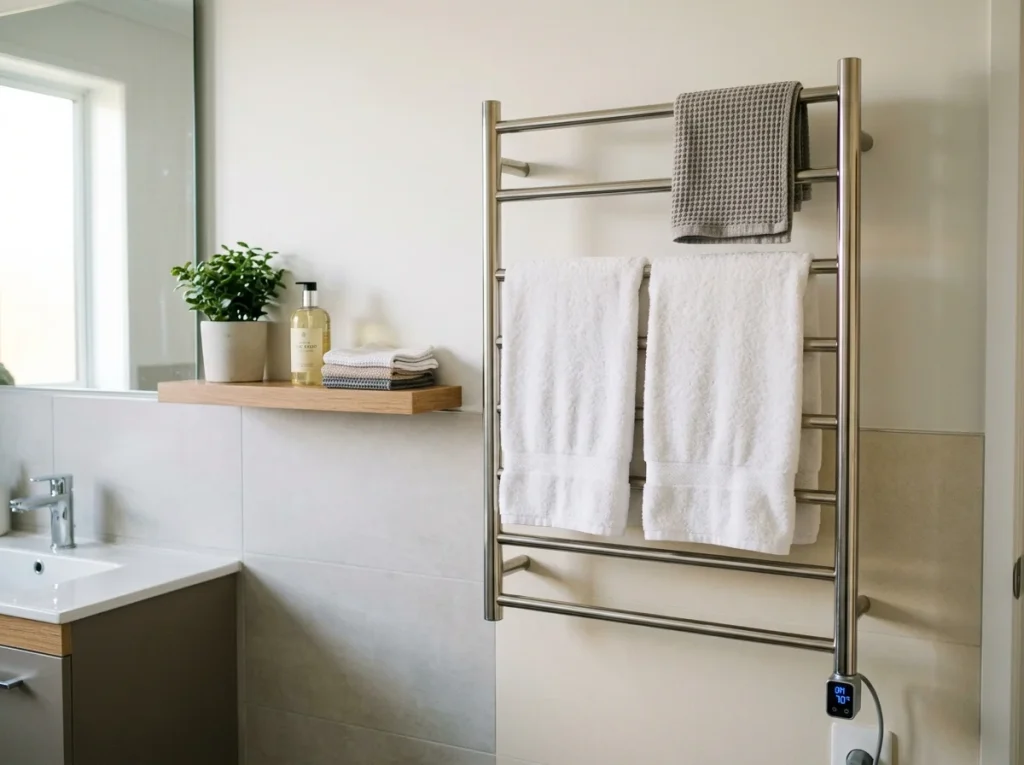
A commercial electric heated towel rail is a wall-mounted or rail-style bathroom accessory that uses electric heating elements to warm the metal rails. Towels placed on or near the rails become warmer and can dry more effectively than on a standard towel bar.
In commercial bathroom projects, heated towel rails are commonly used in:
Hotels and resorts, serviced apartments, luxury villas, spas, gyms, wellness centers, senior living bathrooms, executive office bathrooms, and premium modern bathroom projects.
Unlike a basic towel rack, a commercial electric heated towel rail must be selected as both a bathroom accessory and an electrical appliance. UL 499 covers electric heating appliances rated at 600 V or less for use in unclassified locations, which is relevant because electric heated towel rails are heating products rather than ordinary metal fittings. (UL Standards Online)
SourceZJ can help project buyers match commercial towel racks and heated towel rail options with faucets, mirrors, hooks, shelves, and other bathroom accessories for hotel and public bathroom projects.
2. Best Applications for Electric Heated Towel Rails
Not every commercial bathroom needs an electric heated towel rail. The strongest applications are spaces where comfort, premium perception, towel drying, or humidity control support the project value.
| Project scenario | Heated towel rail value | Recommended direction |
|---|---|---|
| Hotel guest room | Improves guest comfort and room quality | Wall-mounted electric rail with timer |
| Luxury suite | Supports premium towel presentation | Larger rail or heated shelf-style model |
| Serviced apartment | Adds daily-use convenience | Timer or thermostat-controlled rail |
| Spa or wellness center | Helps manage damp towels | 316 stainless steel option, stronger moisture protection |
| Gym changing room | Supports wet towel drying | Heavy-duty rail, strong fixing, corrosion-resistant material |
| Senior living bathroom | Provides warmth and comfort | Safe surface temperature, rounded edges |
| Executive office bathroom | Adds premium function | Compact heated rail with clean finish |
| Public restroom | Usually limited need | Use only in premium or special facilities |
For most projects, a mixed specification works best. Heated towel rails can be used in premium guest rooms, suites, spas, and serviced apartments, while standard stainless steel towel racks may be more practical for basic staff areas, public washrooms, and budget zones.
3. Electric vs Hydronic vs Standard Towel Rails
Before specifying an electric heated towel rail, confirm whether electric heating is the right system for the project.
| Type | Advantages | Watchpoints | Best use |
|---|---|---|---|
| Electric heated towel rail | Independent operation, flexible layout, good for hotels | Requires electrical planning and safety approval | Hotels, apartments, spas, modern bathrooms |
| Hydronic heated towel rail | Works with hot-water heating systems | Requires plumbing coordination and leak control | Resorts, apartments, cold-climate buildings |
| Standard non-heated towel rail | Low cost, simple installation, low maintenance | No active warming or drying | Public restrooms, offices, basic commercial areas |
For hotel and bathroom projects, electric heated towel rails are often preferred because each room can operate independently. They are easier to control than hydronic systems and do not depend on central hot-water heating. However, they require careful coordination with electrical design, wall construction, bathroom zones, and local code requirements.
4. Choose the Right Material: 304 vs 316 Stainless Steel
Material selection affects corrosion resistance, appearance, strength, and service life.
304 stainless steel: best commercial baseline
For most indoor hotel and apartment bathrooms, 304 stainless steel is the most practical choice. It offers good corrosion resistance, stable strength, and a clean commercial appearance. It also supports common finishes such as brushed stainless steel, polished chrome, matte black, brushed gold, gunmetal, and PVD colors.
Use 304 stainless steel for:
Standard hotel rooms, serviced apartments, villas, executive bathrooms, and general indoor commercial bathroom projects.
316 stainless steel: best for harsh environments
For coastal hotels, beach resorts, spas, swimming pool changing areas, gyms, and high-humidity wet rooms, 316 stainless steel is often the better long-term option. The International Molybdenum Association notes that Type 316 and similar grades are typically used where greater corrosion resistance is needed, while Type 304 is widely used for interior bathroom applications.
Use 316 stainless steel for:
Coastal resorts, spa bathrooms, pool areas, gyms, wellness centers, humid wet rooms, and projects exposed to chloride-containing cleaning chemicals.
| Material | Best use | Advantages | Buyer note |
|---|---|---|---|
| 304 stainless steel | Most indoor commercial bathrooms | Balanced durability, cost, and appearance | Best baseline |
| 316 stainless steel | Coastal, spa, gym, pool, wet areas | Higher corrosion resistance | Higher cost but safer in harsh environments |
| Brass | Luxury suites and premium hotels | Rich decorative appearance | More expensive |
| Aluminum alloy | Lightweight modern designs | Lower weight, flexible styling | Check rigidity and coating |
| Plated steel | Low-cost projects | Cheap upfront | Higher corrosion risk if coating fails |
Procurement rule: do not accept vague terms such as “stainless finish” or “chrome color.” Specify the actual base material: 304 stainless steel, 316 stainless steel, brass, aluminum alloy, or another defined metal.
5. Electrical Safety Comes Before Design
Because electric heated towel rails combine electricity, heat, metal, moisture, and direct user contact, safety must be the first buying criterion.
Project buyers should confirm:
Voltage and frequency, wattage, hardwired or plug-in design, grounding requirement, overheat protection, temperature limiter, certification for the destination market, installation manual, product labeling, and wiring protection.
For hotels and commercial projects, hardwired installation is usually preferred. It looks cleaner, avoids visible cords, reduces tampering, and supports a more professional bathroom finish. Plug-in models may be acceptable for some retrofit projects, but they are generally less suitable for new commercial construction.
| Installation type | Advantages | Disadvantages | Best use |
|---|---|---|---|
| Hardwired | Clean appearance, no exposed cord, better for projects | Requires early electrical planning | Hotels, apartments, commercial bathrooms |
| Plug-in | Easier for retrofit | Visible cord, possible misuse | Limited renovation projects |
| Central-controlled | Good operational control | Requires system coordination | Spas, gyms, managed facilities |
| Timer-integrated | Saves energy and improves usability | Must be guest-friendly | Hotels and serviced apartments |
A certified product can still become unsafe if installed incorrectly. The electrical engineer, contractor, supplier, and local inspection authority should confirm circuit design, bathroom zone location, moisture protection, and installation method before production and site installation.
6. Understand IP Rating and Moisture Protection
Bathrooms are humid, wet, and frequently cleaned. For electric heated towel rails, moisture protection is essential.
The IEC explains that IP ratings grade how well an enclosure resists intrusion from dust and liquids. For bathroom electrical products, IP rating is part of the technical suitability review, not just a marketing phrase.
When comparing heated towel rails, ask suppliers:
What is the IP rating? Which product parts are protected? Is the heating element sealed? Is the junction box suitable for bathroom installation? Can the rail be installed near a shower or bathtub? What does the installation manual say about bathroom zones? Are the switches or timers suitable for humid environments?
| Bathroom risk | What to check | Why it matters |
|---|---|---|
| Water splash | IP rating and installation zone | Reduces electrical risk |
| Humidity | Sealed heating element and wiring | Supports long-term reliability |
| Wet towels | Rail spacing and finish resistance | Improves drying performance |
| Cleaning chemicals | Material and coating resistance | Helps prevent corrosion and discoloration |
| Hidden wiring | Cable route and junction protection | Improves installation safety |
| User contact | Surface temperature control | Reduces burn risk |
Do not assume that one IP rating is suitable for every bathroom position. A heated towel rail near a dry vanity area faces different risk from one near a shower, wet room, spa, or pool changing area.
7. Surface Temperature and User Safety
A heated towel rail should warm towels, not create a burn risk. This is especially important in hotels, senior living facilities, healthcare-related bathrooms, family resorts, and public-facing commercial spaces.
Ask suppliers these questions:
What is the normal operating surface temperature? Does the product include a temperature limiter? Is there overheat protection? What happens when thick towels cover the rail? Can the temperature be adjusted? Does the rail include an automatic shutoff or timer? Is the product safe for normal accidental touch?
For commercial bathrooms, the best heated towel rail is not necessarily the hottest one. A moderate, stable, controlled temperature is usually better for guest comfort and safety.
| Safety feature | Why it matters | Commercial recommendation |
|---|---|---|
| Temperature limiter | Helps prevent excessive surface temperature | Strongly recommended |
| Overheat protection | Protects product and user | Essential |
| Timer control | Limits continuous operation | Recommended for hotels |
| Rounded edges | Reduces impact injury risk | Important for public and senior spaces |
| Concealed wiring | Reduces tampering and moisture exposure | Preferred |
| Clear user control | Improves guest experience | Recommended |
For senior living and accessible rooms, controls should be simple, reachable, and easy to operate. ADA guidance for operable parts includes reach ranges, with unobstructed side reach generally between 15 and 48 inches above the finished floor. (Access Board)
8. Select the Right Size, Wattage, and Rail Layout
Sizing should be based on towel capacity, bathroom size, humidity, ventilation, and user expectations.
A compact hotel bathroom may only need a slim heated rail. A luxury suite may need a larger ladder-style model. A spa or gym changing room may need multiple rails or a separate towel management system.
| Room type | Typical towel need | Recommended direction |
|---|---|---|
| Compact hotel room | One towel or hand towel | Slim electric heated rail |
| Standard hotel room | One to two towels | Medium ladder-style rail |
| Luxury suite | Multiple towels and premium display | Large rail or heated shelf rail |
| Serviced apartment | Daily repeated use | Timer-controlled multi-rail model |
| Spa room | Warm towel presentation | Larger heated rail or towel shelf |
| Gym changing area | Frequent wet towel exposure | Heavy-duty stainless steel rail |
| Senior living bathroom | Comfort and safe access | Moderate-temperature rail with simple control |
Do not compare products by wattage alone. Higher wattage does not automatically mean better drying. Rail spacing, surface area, heating distribution, towel contact, ventilation, and operating time all affect real performance.
Send your bathroom layout, room type, towel schedule, and target finish to SourceZJ to receive a project-ready heated towel rail recommendation and accessory BOQ.
9. Best Design Options for Commercial Projects
Ladder-style electric heated towel rail
This is the most common choice for hotels and apartments. It provides multiple horizontal rails, good towel capacity, and a clean vertical appearance.
Best for: standard hotel rooms, serviced apartments, villas, and modern bathrooms.
Heated towel rail with shelf
This design combines folded towel storage with warming or drying function. It is useful in luxury hotel suites, resorts, and spa rooms where towel presentation matters.
Best for: luxury hotels, resorts, villas, and spa bathrooms.
Slim minimalist heated rail
A slim heated rail works well in modern bathrooms where clean lines and compact installation are important.
Best for: boutique hotels, compact bathrooms, modern apartments, and premium vanity areas.
Swivel-arm heated towel rail
A swivel design improves towel separation, but moving parts may loosen under heavy use.
Best for: private suites and low-traffic premium bathrooms.
Freestanding heated towel rail
Freestanding models are usually less suitable for commercial bathrooms because they can be moved, damaged, unplugged, or create trip hazards.
Best for: limited retrofit use only.
For most commercial projects, wall-mounted hardwired designs are the most professional and reliable option.
10. Finish Selection for Hotel and Modern Bathroom Design
Finish consistency matters in commercial bathrooms. A heated towel rail should coordinate with faucets, showers, mirrors, robe hooks, shelves, door handles, and other visible hardware.
| Finish | Best use | Advantages | Watchpoint |
|---|---|---|---|
| Brushed stainless steel | Hotels, gyms, public bathrooms | Hides fingerprints and small scratches | Brushing direction must be consistent |
| Polished chrome | Hotels and apartments | Bright, familiar, easy to match | Shows water spots |
| Matte black | Modern hotels | Strong contemporary look | Scratches are more visible |
| Brushed gold | Luxury hotels | Premium appearance | Batch color control is critical |
| Gunmetal | Boutique hotels | Modern and high-end | Supplier consistency matters |
| PVD finish | Premium commercial projects | Better decorative durability when well made | Higher cost |
For heated products, finish quality is especially important because heat cycles can expose weak coatings. Ask whether the finish has been tested under normal operating conditions, not only at room temperature.
SourceZJ can help coordinate heated towel rail finishes with commercial bathroom faucets, mirrors, hooks, shelves, and other visible bathroom hardware.
11. Installation Planning: Wall, Wiring, and Location
Installation planning should happen before tile installation and electrical rough-in are complete.
Confirm:
Wall type, wall reinforcement, tile thickness, cable route, junction box location, switch or timer position, mounting height, clearance from shower screens, door swing, vanity drawers, grab bars, emergency buttons, and maintenance panels.
A heated towel rail is heavier and more complex than a normal towel bar. It must be securely fixed and correctly wired. Gypsum board, prefabricated bathroom pods, lightweight partitions, and hollow walls may require backing plates or reinforcement.
Also remember: a heated towel rail should not be used as a grab bar. If users need body support, specify proper grab bars separately.
For engineering projects, SourceZJ can review drawings and support custom size, bracket design, finish matching, and installation coordination through its OEM and custom bathroom accessories manufacturing service.
12. Energy Control and Operating Cost
For one bathroom, the energy use of a heated towel rail may seem small. For a 200-room hotel or large serviced apartment project, operating hours become important.
Useful control options include:
Manual switch, built-in timer, thermostat, central control, occupancy-based control, and hotel key-card integration.
| Control method | Best use | Advantage | Watchpoint |
|---|---|---|---|
| Manual switch | Basic rooms | Simple and low cost | May be left on |
| Timer | Hotels and apartments | Reduces unnecessary operation | Must be easy to understand |
| Thermostat | Premium rooms | Better comfort control | Higher cost |
| Central control | Spas and gyms | Facility-level management | Needs system coordination |
| Key-card integration | Hotels | Reduces unused operation | Requires early electrical planning |
For hotels, a timer is often the most practical choice. It gives guests a clear function while helping operators control unnecessary energy use.
13. Lifecycle Cost: Why the Cheapest Rail Is Not Always Best
A low-cost heated towel rail may look attractive during procurement but create higher cost after installation.
Hidden costs include:
Electrical rework, early heating failure, rust, coating discoloration, guest complaints, room downtime, wall repair, replacement labor, inconsistent repeat-order finishes, and after-sales disputes.
| Cost factor | Low-grade rail risk | Commercial-grade rail value |
|---|---|---|
| Purchase price | Lower upfront cost | Higher but more predictable |
| Electrical safety | Weak documentation | Better compliance support |
| Installation | Poor drawings or inconsistent brackets | Easier contractor coordination |
| Energy use | No timer or inefficient operation | Timer or thermostat control |
| Maintenance | Higher failure risk | Longer service life |
| Guest experience | Uneven heating or poor finish | Better comfort and appearance |
| Replacement | Batch mismatch risk | More stable repeat supply |
For commercial bathroom projects, define the specification first, then compare prices. A fair quotation should be based on the same material, size, voltage, finish, control method, packaging, and QC standard.
14. Recommended Specification Template
Use this table when requesting quotations from suppliers.
| Specification item | What to define |
|---|---|
| Product type | Commercial electric heated towel rail |
| Application | Hotel, apartment, spa, gym, senior living, public facility |
| Material | 304 stainless steel, 316 stainless steel, brass, aluminum |
| Finish | Brushed stainless, chrome, matte black, brushed gold, gunmetal, PVD |
| Size | Height, width, depth, rail spacing |
| Electrical data | Voltage, frequency, wattage |
| Installation | Hardwired or plug-in |
| Safety features | Overheat protection, temperature limiter, grounding |
| Moisture protection | IP rating and bathroom suitability |
| Control | Switch, timer, thermostat, central control |
| Wall fixing | Bracket type, screws, anchors, reinforcement requirement |
| Packaging | Individual protection, export carton, pallet option |
| OEM/ODM | Logo, custom size, custom finish, private label packaging |
| QC | Sample approval, inspection standard, test reports |
This template helps project buyers compare suppliers fairly. Without it, one supplier may quote a reliable stainless steel hardwired rail, while another quotes a cheaper product with thinner metal, weaker coating, limited documentation, and lower safety performance.
15. Supplier Evaluation Checklist
A reliable supplier should provide more than product photos and a unit price.
Evaluate suppliers in these areas:
Electrical documentation: voltage options, wiring diagrams, safety certificates, IP rating information, installation manuals, and product labels.
Material confirmation: clear confirmation of 304 stainless steel, 316 stainless steel, brass, aluminum, or other specified material.
Finish consistency: ability to match heated towel rails with faucets, mirrors, robe hooks, shelves, and other bathroom hardware.
OEM/ODM capability: custom size, rail spacing, finish, logo, packaging, bracket design, and control method.
Production and QC: inspection of dimensions, welding, surface finish, wiring, heating performance, packaging, and finished goods.
Export support: export cartons, pallet loading, shipping marks, packing lists, spare parts, production photos, and after-sales service.
SourceZJ supports commercial bathroom accessory sourcing, OEM/ODM customization, finish matching, and export-ready packaging. Buyers can combine heated towel rails with commercial bathroom mirrors, faucets, towel bars, hooks, shelves, and other products from the bathroom product category.
FAQ: Commercial Electric Heated Towel Rails
Business negotiations are welcome
Commercial electric heated towel rails can add real value to hotel, apartment, spa, gym, and premium bathroom projects, but they must be specified carefully. The best product is not simply the most stylish or lowest-priced option. It must meet the project’s requirements for safety, moisture protection, corrosion resistance, installation reliability, energy control, finish consistency, and lifecycle cost.
For most indoor hotel and bathroom projects, a wall-mounted 304 stainless steel electric heated towel rail with timer control is a strong baseline. For coastal resorts, spas, gyms, pool areas, and humid commercial bathrooms, 316 stainless steel and upgraded moisture protection should be considered. For luxury suites and premium bathrooms, heated shelf-style rails or high-quality PVD finishes can improve the guest experience.
Before bulk ordering, define the material, voltage, wattage, IP rating, control method, surface temperature, finish, wall fixing, packaging, and QC standard. Then compare suppliers using the same specification.
For hotel, resort, serviced apartment, spa, gym, senior living, and modern bathroom projects, SourceZJ can support OEM/ODM electric heated towel rail customization, project samples, finish matching, export packaging, and coordinated supply across commercial bathroom accessories.
Planning an Electric Towel Rack Project?
Download the 61-page SourceZJ catalog to compare heated towel rack models, finishes, and project applications before requesting a quotation.
Download the Electric Towel Rack Catalog English
 العربية
 Русский
 Español