
Table of Contents
A Practical Checklist for Choosing a Bathroom Hardware Supplier
Choosing a bathroom hardware supplier is not only about finding the lowest quotation. For importers, wholesalers, hotel procurement teams, contractors, and OEM brands, the real question is whether the supplier can deliver stable products repeatedly, with the right material, consistent finish, safe packaging, and realistic lead time.
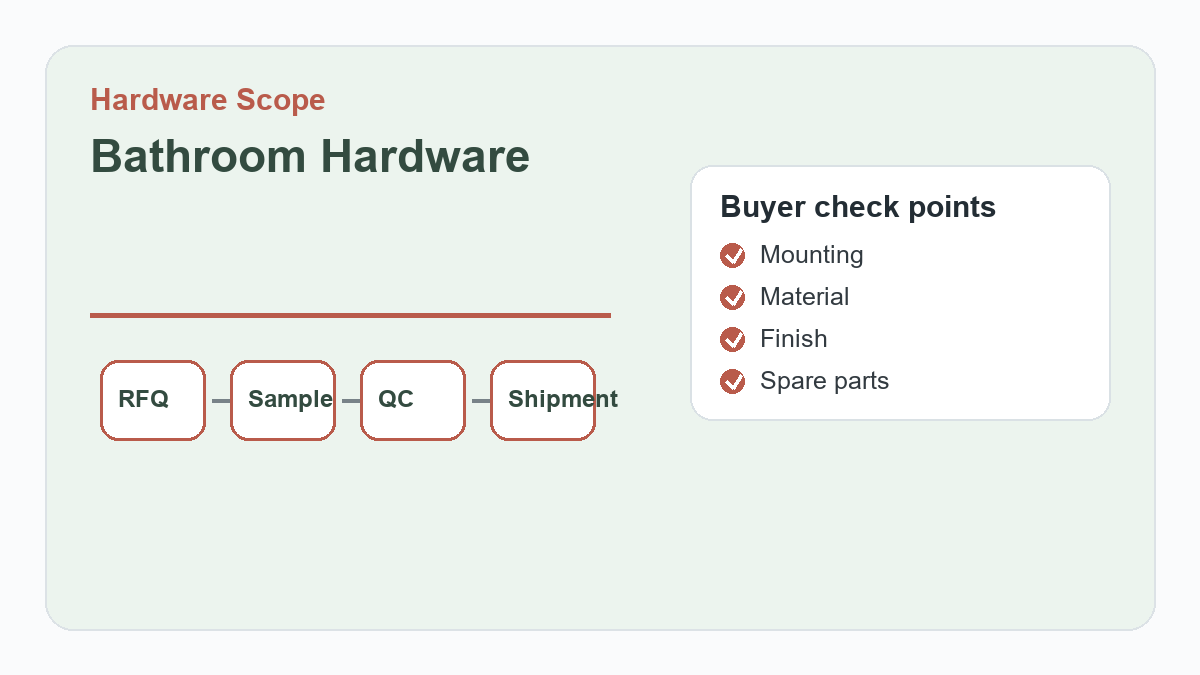
Bathroom hardware includes products such as towel bars, towel racks, robe hooks, toilet paper holders, bathroom shelves, shower baskets, mirrors, door handles, and related accessories. These products may look simple, but bulk orders often involve multiple SKU, several finishes, different packaging rules, and strict delivery windows.
A weak supplier can create problems that are much more expensive than the unit price difference: scratched surfaces, incorrect screws, rust complaints, mismatched matte black finishes, unstable cartons, delayed production, or unclear export documents.
This guide gives B2B buyers a practical supplier checklist built around four core areas:
- Factory capability
- Material selection
- Surface finish control
- Lead time and delivery reliability
It also includes RFQ tips, inspection points, packaging checks, and supplier scorecards for wholesale and OEM purchasing.
For buyers who need manufacturer-level cooperation, SourceZJ provides commercial bathroom hardware OEM and custom manufacturing support for bulk orders, hotel projects, apartment programs, and private-label bathroom accessory lines.
1. First Define the Hardware Scope Before Auditing Suppliers
Before judging any supplier, define what “bathroom hardware” means in your order. Some buyers use the term only for wall-mounted accessories. Others include faucets, mirrors, shower fittings, door handles, towel racks, and complete bathroom accessory sets.
This matters because not every supplier is strong in every category. A factory that produces towel bars and hooks may not be qualified for faucets. A mirror supplier may not control metal accessory finishes. A trading company may offer a wide catalog but have limited control over actual production.
| Hardware Scope | Typical Products | Main Supplier Capability Needed | Key Buyer Risk |
|---|---|---|---|
| Bathroom accessories | Towel bars, robe hooks, shelves, paper holders | Metal forming, finish control, packaging | Scratches, weak coating, missing screws |
| Towel storage hardware | Towel racks, towel shelves, freestanding racks | Structural strength, weld quality, stability | Bending, loose joints, poor load capacity |
| Decorative hardware | Door handles, hooks, holders, trim parts | Surface consistency and design matching | Finish mismatch across rooms |
| Bathroom mirrors and frames | LED mirrors, black frames, aluminum frames | Glass protection, frame finish, electrical coordination where applicable | Breakage and packaging claims |
| Hardware sets | 3-piece, 4-piece, 5-piece accessory sets | Set coordination, SKU control, packaging | Inconsistent design or missing items |
| Project package | Accessories, mirrors, faucets, shower items | BOQ support and category coordination | Delivery delays and finish mismatch |
A clear scope helps you select the right supplier type. It also helps the supplier quote accurately. Without a defined product scope, quotations may look cheap but exclude important details.
Before sending an RFQ, prepare your product list, target market, finish preference, and estimated order quantity. SourceZJ can help organize these details into a supplier-ready bathroom hardware checklist.
2. Factory Checklist: Is This a Real Manufacturing Partner?
A reliable bathroom hardware supplier should be able to explain how products are made, not only show catalog images. Factory capability should be checked before large-order negotiation.
2.1 Core Factory Questions
Ask these questions early:
- Which products are made in-house?
- Which processes are outsourced?
- What materials are regularly used?
- What finishes are available?
- Can the factory support OEM dimensions or packaging?
- What is the normal MOQ by item and finish?
- How are samples made?
- What QC steps are used before shipment?
- Can the supplier provide carton size, packing quantity, and export documents?
A strong supplier gives clear, specific answers. A weak supplier often gives general replies such as “good quality,” “no problem,” or “we can do everything.”
2.2 Production Process Visibility
For bathroom hardware, relevant production steps may include cutting, bending, welding, polishing, drilling, surface treatment, assembly, accessory packing, and final carton packing. The supplier does not need to own every process, but it must control quality and timing.
For example, powder coating may be handled by a finishing partner. That can be acceptable if the supplier has stable process control, finish samples, batch records, and inspection standards. It becomes risky when the supplier cannot explain how the finish is controlled.
2.3 Factory Fit by Buyer Type
| Buyer Type | Factory Capability to Prioritize | Why It Matters |
|---|---|---|
| Wholesale importer | SKU range, repeat supply, packaging options | Supports catalog sales and reorder planning |
| Hotel project buyer | Batch consistency, BOQ coordination, delivery reliability | Reduces project-site risk |
| OEM brand | Custom dimensions, logo, packaging, finish development | Supports brand differentiation |
| Contractor supplier | Clear labels, spare parts, installation-ready packing | Saves time on job sites |
| Distributor | Stable pricing, carton data, mixed-SKU support | Improves warehouse and sales planning |
If you are sourcing complete sets rather than single items, the related bathroom hardware sets manufacturer guide can support set-level evaluation.
3. Quality System Checklist: Look for Process, Not Promises
Quality is not proven by one perfect sample. A sample can be carefully selected, polished, and packed. Mass production shows whether the supplier has a repeatable quality process.
ISO describes ISO 9001 as a globally recognized quality management standard that helps organizations improve performance, meet customer expectations, and demonstrate commitment to quality. For bathroom hardware buyers, this is useful as a reference point when discussing process control, but certification alone should not replace product-level inspection.
A practical quality checklist should include:
| QC Area | What to Check | Buyer Question |
|---|---|---|
| Incoming material | Stainless steel grade, tube thickness, hardware parts | How do you verify material before production? |
| In-process control | Dimensions, hole positions, welding, polishing | Which checkpoints happen before finishing? |
| Surface inspection | Scratches, dents, coating defects, color variation | What is the acceptable defect standard? |
| Assembly check | Screws, brackets, mounting plates, accessory bags | Is every part checked before packing? |
| Load or stability check | Towel bars, racks, shelves, freestanding items | Is the product tested for real use conditions? |
| Packaging inspection | Inner protection, carton strength, labels | Can you provide packaging photos before shipment? |
| Final inspection | Quantity, carton marks, documents | Is there a pre-shipment inspection report? |
A strong supplier can show checklists, inspection photos, retained samples, or batch records. A weak supplier may only inspect after all products are packed, which makes correction more difficult.
Ask SourceZJ for a bathroom hardware pre-shipment inspection checklist. It can help your team compare suppliers using the same standard instead of relying on general promises.
4. Material Checklist: Match Material to Function and Environment
Material selection should follow the product’s function, installation area, and target market. Bathroom hardware is exposed to moisture, cleaning chemicals, hand contact, towel weight, and repeated use. A product that works in a dry retail showroom may fail faster in a hotel, spa, coastal apartment, or public restroom.
4.1 Common Materials in Bathroom Hardware
| Material | Common Products | Advantages | Buyer Checklist |
|---|---|---|---|
| 304 stainless steel | Towel bars, racks, shelves, hooks, holders | Durable and suitable for many commercial bathrooms | Confirm grade, thickness, and screw material |
| 316 stainless steel | Coastal hotels, spas, humid environments | Better corrosion resistance in harsh conditions | Use where environment justifies higher cost |
| Zinc alloy | Hooks, decorative holders, small bases | Cost-effective and easy to shape | Check coating quality and load strength |
| Brass | Premium holders, faucet-related hardware | Strong and premium feel | Confirm composition and finish quality |
| Aluminum | Mirror frames, rails, light-duty accessories | Lightweight and modern | Check anodizing or coating consistency |
| Glass | Shelves, mirrors, decorative components | Clean appearance | Check edge safety and packaging |
| Plastic or nylon parts | Anchors, washers, inserts | Practical and low cost | Confirm durability and replacement support |
The whole product structure matters. A stainless steel towel bar with poor screws can still fail. A zinc alloy hook with strong coating may perform better than a poorly finished stainless item in some retail applications. Buyers should review the complete bill of materials, not only the main visible part.
4.2 Material Questions to Ask Suppliers
Ask the supplier:
- What is the main material?
- Are the screws and mounting plates the same material?
- What is the tube thickness?
- Are there hollow or solid parts?
- Is the product suitable for humid environments?
- Can the material be confirmed in the production file?
- Are alternative material options available for different price levels?
For buyers building a broad product line, SourceZJ commercial bathroom product category can help coordinate towel racks, mirrors, faucets, shelves, and related hardware items within one sourcing plan.
5. Finish Checklist: Control Appearance, Durability, and Batch Consistency
Surface finish is one of the most visible quality factors in bathroom hardware. It affects how the product looks, how easy it is to clean, and how customers judge value.
Common finishes include chrome, brushed stainless steel, matte black, brushed gold, gunmetal, white coating, polished gold, and PVD-style finishes. Each finish has different cost, MOQ, risk level, and inspection requirements.
5.1 Finish Comparison for B2B Orders
| Finish | Best Use | Key Risk | Inspection Focus |
|---|---|---|---|
| Chrome | Standard wholesale and commercial lines | Water spots, plating defects | Smoothness, pinholes, corrosion resistance |
| Brushed stainless steel | Hotels, offices, apartments | Different brushing direction | Texture consistency and surface scratches |
| Matte black | Modern hotels, apartments, retail sets | Scratches, edge wear, gloss variation | Adhesion, color consistency, packaging protection |
| Brushed gold | Premium hotel and brand lines | Color mismatch between batches | Physical sample approval and batch comparison |
| Gunmetal | Modern premium collections | Supplier-to-supplier variation | Finish standard and golden sample |
| White coating | Minimalist bathrooms | Dirt visibility and chipping | Coating coverage and cleaning resistance |
| PVD-style finish | Premium hardware and matching fixtures | Higher cost and MOQ | Color tone, adhesion, surface durability |
For metallic products and coated surfaces, ISO 9227 specifies neutral salt spray, acetic acid salt spray, and copper-accelerated acetic acid salt spray test procedures for assessing corrosion resistance of metallic materials with or without corrosion protection. This can be used as a reference when discussing corrosion expectations with suppliers.
5.2 Finish Approval Checklist
Before mass production, confirm:
- Physical finish sample.
- Golden sample retained by buyer and supplier.
- Finish name or code.
- Gloss level where relevant.
- Brushing direction for brushed finishes.
- Color matching across product categories.
- Coating coverage on edges, holes, and hidden areas.
- Cleaning and maintenance expectations.
- Packaging method to prevent scratches.
This is especially important for matte black, brushed gold, and gunmetal hardware. These finishes are popular but less forgiving than chrome. Small variations are more visible when items are installed close to each other.
For buyers focusing on dark finishes, the related black bathroom accessories wholesale guide provides deeper guidance on matte black sourcing, MOQ, packaging, and finish inspection.
6. Lead Time Checklist: Separate Sample Time, Production Time, and Shipping Time
Lead time is often misunderstood. A supplier may say “30 days,” but that may only refer to mass production after all details are approved. The real timeline includes inquiry, quotation, sample development, sample shipping, revision, production approval, material preparation, finishing, assembly, inspection, packing, and international transport.
6.1 Lead Time Components
| Stage | What Happens | Common Delay Reason |
|---|---|---|
| RFQ review | Supplier checks product, material, finish, quantity | Missing specifications |
| Sample preparation | Supplier makes or selects sample | Custom finish or new size |
| Sample approval | Buyer reviews structure, finish, packaging | Slow feedback or unclear standard |
| Material preparation | Supplier purchases metal, parts, packaging | Special material or low MOQ |
| Production | Cutting, welding, polishing, assembly | Mixed SKU or capacity pressure |
| Surface finishing | Plating, coating, brushing, PVD-style process | Finish batch scheduling |
| Packaging | Inner packing, cartons, labels, set packing | Artwork or carton confirmation delay |
| Inspection | Final QC and buyer inspection | Defects or incomplete documents |
| Shipment | Booking, loading, customs documents | Space, port, or documentation issues |
Buyers should ask suppliers to break down lead time by stage. This makes the schedule easier to manage and reduces unrealistic expectations.
6.2 Lead Time Questions to Ask
Ask:
- Is the quoted lead time before or after deposit?
- Is it before or after sample approval?
- Does the finish require separate processing time?
- Does custom packaging add time?
- Are there peak-season capacity risks?
- What is the lead time for repeat orders?
- Can production be split by urgent and non-urgent items?
- When will carton data be available for freight booking?
For hotel and apartment projects, lead time should be linked to site installation dates. For wholesalers, it should be linked to sales season, warehouse planning, and reorder cycles.
Share your required delivery window with SourceZJ early. The team can help check whether the product scope, finish, packaging, and inspection plan fit the project schedule.
7. MOQ Checklist: Understand What Drives the Minimum Order
MOQ depends on much more than the supplier’s preference. It can be driven by material purchase, surface finishing batch, packaging printing, tooling, carton production, or factory scheduling.
7.1 MOQ Layers
| MOQ Type | Applies To | Why It Exists |
|---|---|---|
| Item MOQ | One towel bar, hook, shelf, or holder | Production setup and material planning |
| Finish MOQ | Matte black, brushed gold, gunmetal, custom color | Coating or plating batch requirement |
| Packaging MOQ | Color box, printed carton, private label | Packaging printing setup |
| OEM MOQ | Custom dimensions, new molds, exclusive design | Engineering and tooling cost |
| Mixed-SKU MOQ | Multiple items in one order | Warehouse and production complexity |
| Project MOQ | Hotel or apartment BOQ order | Batch control and delivery planning |
A good supplier can explain MOQ clearly. A weak supplier may give a fixed number without explaining which part of the order creates the minimum.
7.2 MOQ Reduction Strategies
Buyers can reduce MOQ pressure by:
- Starting with standard models.
- Using existing finishes.
- Limiting the first order to core SKU.
- Delaying custom packaging until the second order.
- Combining related products into one shipment.
- Using one finish across multiple items.
- Planning repeat orders instead of negotiating only the first order.
For OEM buyers, it is better to ask for tiered MOQ and tiered pricing. This allows you to test the market while giving the manufacturer a path to better production efficiency.
8. RFQ Checklist: What to Send Before Asking for Price
A vague RFQ creates vague quotations. For bathroom hardware orders, buyers should send enough information for the supplier to quote accurately.
8.1 Basic RFQ Information
Include:
- Product list.
- Quantity by item.
- Target market.
- Material preference.
- Finish preference.
- Product dimensions or reference photos.
- Required packaging type.
- Logo or private-label requirement.
- Destination country.
- Preferred trade term.
- Sample requirement.
- Target delivery date.
- Inspection requirement.
8.2 Better RFQ Format
| RFQ Field | Example |
|---|---|
| Product | Wall-mounted towel bar |
| Size | 600 mm length |
| Material | 304 stainless steel |
| Finish | Brushed stainless steel or matte black |
| Quantity | 1,000 pcs |
| Packaging | Individual neutral box, barcode label |
| Market | EU wholesale distribution |
| Trade term | FOB or CIF comparison |
| Sample | 2 pcs in final finish |
| Inspection | Surface, dimension, accessory pack, carton label |
A well-prepared RFQ saves time for both buyer and supplier. It also makes quotations easier to compare.
9. Price Checklist: Compare Total Cost, Not Only Unit Price
Unit price is important, but it is not the full cost. Bathroom hardware buyers should compare the total landed and commercial cost.
A lower unit price may hide thinner material, weaker finish, lighter packaging, fewer accessories, higher defect risk, or less reliable delivery. A slightly higher unit price may reduce after-sales cost and improve reorder stability.
9.1 Price Factors to Compare
| Price Factor | Why It Matters | Buyer Check |
|---|---|---|
| Material grade | Affects durability and cost | Confirm grade and thickness |
| Finish process | Affects appearance and defect rate | Approve physical sample |
| Accessory pack | Affects installation and complaints | Confirm screws, anchors, brackets |
| Packaging | Affects damage rate and freight volume | Review carton size and inner protection |
| MOQ | Affects inventory cash flow | Compare standard and custom MOQ |
| Lead time | Affects sales and project delivery | Confirm schedule by stage |
| Trade term | Affects landed cost | Compare EXW, FOB, CIF, or DAP carefully |
| Defect handling | Affects after-sales cost | Confirm replacement or claim process |
The International Chamber of Commerce describes Incoterms® rules as eleven three-letter trade terms reflecting B2B practice in contracts for the sale and purchase of goods. Buyers should use the correct Incoterms® 2020 reference in sales contracts and quotations to clarify responsibilities, risks, and costs.
10. Packaging Checklist: Protect the Product and the Buyer’s Business
Packaging is part of product quality. Bathroom hardware often has visible finishes, small accessories, sharp edges, glass parts, or long metal bars. Poor packaging can cause scratches, missing parts, dents, broken items, and warehouse confusion.
10.1 Packaging by Sales Channel
| Sales Channel | Packaging Priority | Recommended Focus |
|---|---|---|
| Wholesale distribution | SKU control and carton efficiency | Item labels, barcodes, stable master cartons |
| Retail stores | Shelf presentation | Color box, product image, clear specifications |
| E-commerce | Parcel protection | Reinforced carton and strong inner protection |
| Hotel projects | Site installation efficiency | Room/floor labels, item codes, organized accessories |
| OEM brands | Brand consistency | Logo, instruction sheet, private-label packaging |
10.2 Packaging Checklist
Confirm:
- Individual product protection.
- Separation between metal parts.
- Corner protection for shelves and mirrors.
- Accessory bag labeling.
- Installation instruction sheet.
- Barcode or SKU label.
- Master carton strength.
- Carton size and gross weight.
- Shipping marks.
- Pallet requirement if needed.
- Photos of final packing before shipment.
For buyers sourcing multiple accessories together, SourceZJ bathroom accessories product collection can support coordinated packaging and product selection across towel bars, hooks, shelves, holders, and related items.
11. Pre-Shipment Inspection Checklist
Inspection should happen before shipment, not after goods arrive. For bathroom hardware, inspection should cover appearance, dimensions, assembly, packaging, and documentation.
11.1 Product Inspection
Check:
- Product dimensions.
- Hole positions.
- Tube thickness where measurable.
- Surface scratches.
- Finish color and gloss.
- Welding and polishing quality.
- Coating coverage on edges.
- Mounting base stability.
- Screw and accessory pack accuracy.
- Function and load suitability.
- Product cleanliness.
11.2 Packaging Inspection
Check:
- Inner protection.
- Individual box condition.
- Carton strength.
- Correct SKU label.
- Correct barcode.
- Correct quantity per carton.
- Correct shipping mark.
- Accessory bags included.
- Instruction sheets included.
- Carton photos recorded.
11.3 Document Check
Check:
- Commercial invoice.
- Packing list.
- Product description.
- Carton quantity.
- Gross weight and net weight.
- HS code discussion with broker.
- Trade term.
- Loading photos where applicable.
A supplier who cooperates with inspection is easier to work with long term. Resistance to inspection is a warning sign.
12. Supplier Scorecard: Factory, Material, Finish, Lead Time
Use a scorecard to compare suppliers objectively. This prevents the purchasing decision from being controlled by unit price only.
| Evaluation Area | Suggested Weight | What to Check |
|---|---|---|
| Factory capability | 20% | Product scope, in-house processes, customization ability |
| Material control | 15% | Grade, thickness, screws, mounting parts |
| Finish consistency | 20% | Samples, batch control, corrosion and adhesion discussion |
| Lead time reliability | 15% | Sample, production, finishing, packaging, shipment schedule |
| QC process | 10% | Inspection stages, reports, defect handling |
| Packaging capability | 10% | Inner protection, labels, retail/OEM/project packing |
| MOQ and pricing | 5% | Standard/custom MOQ and tiered pricing |
| Communication | 5% | Clear replies, written confirmation, problem solving |
The right weighting depends on your business. A hotel buyer may increase lead time and finish consistency weights. An OEM brand may increase packaging and customization weights. A wholesale importer may increase MOQ and SKU range weights.
13. Red Flags When Choosing a Bathroom Hardware Supplier
Avoid suppliers that show several of these warning signs:
- They cannot explain material grade.
- They avoid physical samples.
- They provide only catalog photos.
- They use vague finish descriptions.
- They cannot separate standard MOQ from custom MOQ.
- They do not provide carton data.
- They resist packaging review.
- They cannot explain lead time by stage.
- They change prices frequently without explanation.
- They do not confirm specifications in writing.
- They cannot support pre-shipment inspection.
- They promise unrealistic delivery dates.
A supplier does not need to be perfect. But it must be transparent. In B2B sourcing, unclear answers often become expensive problems later.
14. Recommended Supplier Evaluation Workflow
A structured workflow helps buyers move from inquiry to order without losing control.
| Step | Buyer Action | Supplier Output | Decision Point |
|---|---|---|---|
| 1. Define scope | List products, finish, quantity, market | Initial product match | Is this supplier relevant? |
| 2. Send RFQ | Provide material, packaging, destination | Quotation and MOQ | Is the quotation comparable? |
| 3. Check factory fit | Ask process and capability questions | Factory information | Can the supplier support this order? |
| 4. Request samples | Approve physical product and finish | Samples in final finish | Does the sample match expectations? |
| 5. Confirm production file | Lock material, finish, packaging, labels | Written specification | Are all details clear? |
| 6. Track production | Monitor material, finish, assembly | Progress updates | Is the order on schedule? |
| 7. Inspect shipment | Check product, packaging, documents | QC report and carton data | Is the order ready to ship? |
| 8. Review performance | Check defect rate and customer feedback | Reorder proposal | Should this supplier become long-term? |
This workflow is suitable for importers, wholesalers, OEM brands, and hotel project buyers. It turns supplier selection into a controlled process rather than a price negotiation.
15. How SourceZJ Supports Bathroom Hardware Buyers
SourceZJ supports B2B buyers who need bathroom hardware for wholesale, hotel, apartment, commercial, and OEM orders. The focus is not only supplying products, but helping buyers control sourcing details that affect long-term business: factory communication, material selection, finish matching, packaging, MOQ planning, and delivery coordination.
SourceZJ can support:
- Bathroom towel bars, racks, shelves, hooks, holders, mirrors, and related accessories.
- Material recommendations for stainless steel, zinc alloy, brass, aluminum, glass, and mixed-material products.
- Finish discussions for chrome, brushed stainless steel, matte black, brushed gold, gunmetal, and custom finishes.
- OEM dimensions, logo, packaging, barcode labels, and carton marks.
- Sample approval and golden sample control.
- MOQ planning for trial orders, wholesale orders, and project orders.
- Export packaging and documentation coordination.
- Pre-shipment inspection checklist support.
A good bathroom hardware supplier helps buyers reduce uncertainty. The right manufacturer gives clear specifications, realistic lead time, stable finish control, safe packaging, and repeatable production quality.
Send SourceZJ your bathroom hardware checklist, including product list, material preference, finish, quantity, packaging style, destination country, and required delivery date. The team can help prepare a structured quotation and supplier evaluation plan for your bulk or OEM order.
FAQ: Bathroom Hardware Supplier Guide
1. How do I choose a reliable bathroom hardware supplier?
Choose a supplier by checking factory capability, material control, finish consistency, MOQ logic, lead time reliability, packaging quality, QC process, export experience, and communication discipline. Do not choose by unit price alone.
2. What materials are best for bathroom hardware?
304 stainless steel is widely used for towel bars, shelves, racks, and holders. 316 stainless steel may be used in coastal or humid environments. Zinc alloy can work for small decorative parts. Brass, aluminum, glass, and plastic components may also be suitable depending on the product.
3. Why is finish control important for bathroom hardware?
Finish affects appearance, durability, and customer satisfaction. Matte black, brushed gold, gunmetal, and brushed stainless steel require physical sample approval because color, gloss, texture, and scratch visibility can vary between suppliers and batches.
4. What should I include in a bathroom hardware RFQ?
Include product list, quantity, material, finish, dimensions, reference photos, packaging requirement, logo requirement, destination country, trade term, sample requirement, inspection requirement, and target delivery date.
5. How can I avoid lead time delays?
Confirm lead time by stage: sample, approval, material preparation, production, finishing, packaging, inspection, and shipment. Provide complete specifications early and approve samples before mass production.
6. What should be inspected before shipping bathroom hardware?
Inspect dimensions, surface finish, coating coverage, screws, brackets, accessory packs, packaging, labels, carton quantity, carton condition, and shipping documents. For large orders, use a written pre-shipment inspection checklist.
 English
 العربية
 Русский
 Español