

Table of Contents
Why Bathtub Tray Caddy Size Matters More Than Many Buyers Think
A bathtub tray caddy looks like a simple bathroom accessory, but for commerce buyers it can create surprisingly expensive problems when the size is wrong. A tray that is too short may slip into the tub. A tray that is too long may look awkward, create packaging waste, or fail to fit alcove bathtubs. A tray that does not match the bathtub rim shape may wobble, scratch the surface, or create a poor guest experience.
For hotels, serviced apartments, resorts, spas, wholesalers, and bathroom accessory brands, choosing the right bathtub tray caddy size is not only about one bathtub. It is about fitting many bathtub models across multiple rooms, projects, markets, and customer preferences. The right size strategy helps reduce returns, simplify SKU planning, improve product reviews, and protect brand image.
Most standard alcove bathtubs are around 60 inches long, 30 inches wide, and 14–16 inches high, while soaking tubs and oversized tubs can vary significantly in width, depth, and rim shape. This means buyers should not select a tray size based on bathtub length alone; the key measurement is usually the rim-to-rim span across the tub where the caddy will sit.
This guide explains how to choose the right bathtub tray caddy size from a commercial procurement perspective. It covers measurement methods, size categories, bathtub types, materials, user scenarios, accessibility concerns, supplier specifications, and OEM customization options.
For buyers planning a coordinated bathroom accessory package, SourceZJ can support bulk commercial bathroom accessories for hotels, apartments, and project bathrooms with OEM/ODM options.
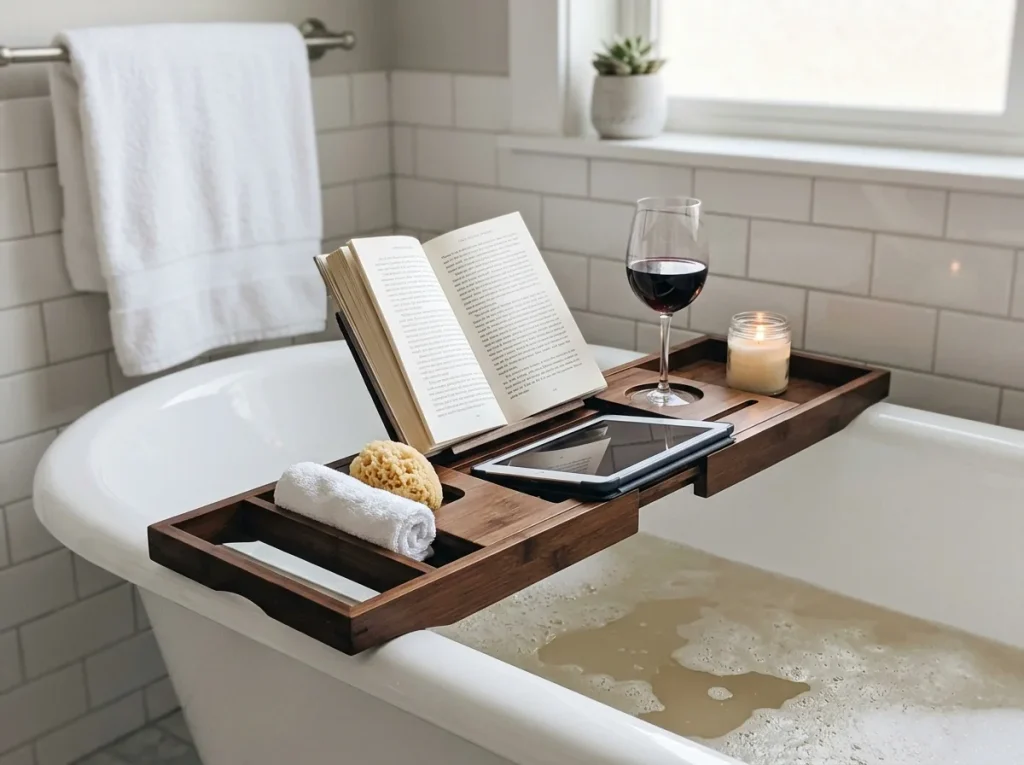
1. Start with the Real Measurement: Rim-to-Rim Width, Not Bathtub Length
The most common sizing mistake is measuring the bathtub length from head to foot. A bathtub tray caddy does not usually span the length of the tub. It sits across the width of the bathtub, resting on the left and right rims.
For most caddy designs, the critical measurement is:
Outside rim-to-outside rim width at the intended tray position.
This measurement tells you whether the tray can safely bridge the bathtub opening. For adjustable bathtub caddies, the measurement must fall within the product’s extension range.
For example:
| Bathtub rim-to-rim width | Recommended tray type | Suggested adjustable range | commerce use case |
|---|---|---|---|
| 650–750 mm | Compact tray | 650–800 mm | Small apartments, compact guest bathrooms |
| 700–850 mm | Standard tray | 700–900 mm | Typical hotel guest rooms, standard alcove tubs |
| 800–1,000 mm | Extended tray | 750–1,050 mm | Freestanding tubs, premium apartments |
| 950–1,150 mm | Oversized tray | 850–1,200 mm | Luxury suites, spa rooms, large soaking tubs |
A good bathtub tray caddy should have enough overlap on both rims. In commercial use, avoid choosing a size where the tray is extended to its absolute maximum. A safer approach is to keep at least 10–20 mm of adjustment margin on each side, depending on the locking structure and rim shape.
Send SourceZJ your bathtub drawings or project room schedule to get a recommended bathtub tray caddy size range before mass production.
2. Understand the Bathtub Type Before Choosing the Caddy Size
Different bathtub types create different sizing risks. A tray that fits a standard alcove tub may not sit correctly on a curved freestanding tub. A luxury soaking tub may require a longer tray but a narrower contact foot. A drop-in bathtub may need anti-slip pads positioned differently because the rim is wider or tiled.
Common Bathtub Types and Tray Size Implications
| Bathtub type | Typical sizing issue | Tray caddy recommendation | Procurement note |
|---|---|---|---|
| Alcove bathtub | Width is usually predictable, but walls may limit tray movement | Standard adjustable size | Best for hotel standard rooms |
| Freestanding bathtub | Curved rim and wider body can reduce stable contact | Extended adjustable tray with anti-slip feet | Request fit testing on actual tub model |
| Drop-in bathtub | Wide deck may make standard feet too narrow | Larger tray or custom foot position | Confirm deck width and tray contact points |
| Soaking bathtub | Wider and deeper than standard tubs | Extended or premium size | Suitable for suites and wellness rooms |
| Whirlpool bathtub | Controls, jets, and curves may interfere | Custom layout or shorter tray | Avoid covering controls |
| Compact bathtub | Standard trays may be too long | Compact tray | Useful for apartments and small bathrooms |
Home Depot’s bathtub sizing guidance shows that common bathtub dimensions vary by type, with soaking tubs and oversized tubs extending beyond standard alcove dimensions. This reinforces why commerce buyers should define caddy size by actual tub width and rim geometry, not by a generic “standard bathtub” label. (The Home Depot)
For projects that include tubs, faucets, showers, and accessories together, buyers can coordinate with SourceZJ broader commercial bathroom product category to reduce mismatch between accessories and fixtures.
3. Measure These 7 Points Before Confirming Bathtub Tray Caddy Size
A professional buyer should request more than one measurement from the project team or customer. The best bathtub tray caddy size depends on width, rim shape, contact area, obstruction, and intended use.
| Measurement checkpoint | Why it matters | Recommended action |
|---|---|---|
| Outside rim-to-rim width | Determines whether the tray can bridge the tub | Measure across the exact tray position |
| Inner basin width | Helps confirm usable tray span and balance | Avoid feet slipping into the tub opening |
| Flat rim contact width | Determines stability | Check whether anti-slip pads fully contact the rim |
| Rim slope or curve | Affects wobble and grip | Use wider silicone pads for curved rims |
| Wall clearance | Important for alcove tubs | Make sure handles or side arms do not hit the wall |
| Faucet/control location | Prevents interference | Avoid covering controls, hand showers, or spouts |
| Intended load | Affects tray width and structure | Define load test requirements before sampling |
The best practice is to create a simple measurement sheet for each bathtub model. For hotel projects, ask the contractor or interior design team to confirm the bathtub model and provide a plan view or actual site photos.
Recommended commerce rule:
Choose a tray size only after confirming the bathtub rim-to-rim width, not only the bathtub model name.
For bulk orders, SourceZJ can help prepare a bathtub tray caddy measurement checklist for your purchasing team or project contractor.
4. Choose the Right Tray Length Range
The tray length range is the most important size parameter. For adjustable caddies, buyers should review both the closed length and maximum extended length.
4.1 Closed Length
Closed length affects packaging, storage, and visual proportion. A tray that is too long in its closed state may look bulky in compact bathrooms. For e-commerce brands and wholesalers, closed length also influences carton size and shipping cost.
4.2 Maximum Extended Length
Maximum extended length determines the largest bathtub width the caddy can cover. However, maximum length should not be treated as the ideal working length. If the tray is always used at full extension, the structure may feel less stable, especially with heavy items placed near the edge.
4.3 Working Length
The working length is the range where the tray remains stable, balanced, and visually acceptable. For example, a tray may technically extend from 700 mm to 1,050 mm, but its best working range may be 740–1,000 mm.
For commerce procurement, ask the supplier to define:
- Closed length
- Maximum extended length
- Recommended working range
- Tolerance
- Anti-slip pad position
- Load rating at normal and maximum extension
For buyers developing private-label accessories, SourceZJ can support OEM and custom bathroom hardware manufacturing based on project dimensions, branding, and target retail price.
5. Do Not Ignore Tray Width and Usable Surface Depth
Many buyers focus only on the tray length, but the front-to-back width of the caddy also matters. A narrow tray may look elegant but may not hold hotel amenities securely. A wide tray may offer more storage but can feel bulky or interfere with the user’s body position in the tub.
Typical Tray Width Recommendations
| Tray width | Best use | Advantages | Possible risk |
|---|---|---|---|
| 120–150 mm | Minimalist hotel accessory | Slim, easy to store, lower material cost | Limited usable space |
| 160–200 mm | Standard hospitality use | Good balance of function and appearance | Needs good drainage design |
| 210–250 mm | Premium bath experience | Can hold book, tablet, candle, amenities | May feel heavy or oversized |
| 250 mm+ | Spa or luxury suite | Strong visual impact, more storage | Higher shipping and packaging cost |
For hotel rooms, the best size is usually not the largest size. A tray should support the intended guest experience without creating cleaning, storage, or breakage problems.
For example, a luxury hotel may want a caddy that can hold a book, tablet, small towel, bath salt jar, and beverage holder. A serviced apartment may only need space for soap, shampoo, and a phone holder. A spa room may need more stable compartments for branded amenities.
Ask SourceZJ for sample layouts before tooling or mass production. Small changes in tray width, slot position, and drainage holes can significantly improve usability.
6. Match the Bathtub Tray Caddy Size to the User Scenario
The right size depends on the property type and user expectations. A five-star resort suite, an urban serviced apartment, and a retail bathroom accessory brand should not use the same sizing strategy.
| Scenario | Suggested size strategy | Key buyer priority |
|---|---|---|
| Standard hotel guest room | Medium adjustable tray | Stable fit, easy cleaning, controlled cost |
| Luxury hotel suite | Extended premium tray | Guest experience, visual quality, stronger structure |
| Serviced apartment | Compact or standard tray | Durability, easy storage, broad fit |
| Spa/wellness center | Wider tray with compartments | Load capacity, anti-slip performance, water resistance |
| Retail/wholesale brand | 2–3 SKU size system | Market coverage, packaging efficiency, return reduction |
| OEM private label | Custom adjustable range | Brand differentiation and target market fit |
For large projects, the safest approach is to group bathrooms by bathtub model and choose one or two tray sizes that cover most rooms. Avoid using too many custom sizes unless the project has strong luxury positioning or a clear design requirement.
If your project also includes towel racks, hooks, shelves, and other bath accessories, SourceZJ hotel-style bathroom towel rack options can be coordinated with bathtub caddy finishes for a consistent bathroom design language.
7. Consider Material and Structure Before Finalizing Size
Material affects how large the tray can be without becoming unstable, too heavy, or too expensive.
Common Material Options
| Material | Size suitability | Strengths | commerce considerations |
|---|---|---|---|
| Bamboo | Compact to standard | Warm appearance, popular retail style | Needs moisture-resistant finish |
| Teak or wood-look material | Standard to premium | Spa-like visual appeal | Higher cost, finish consistency matters |
| 304 stainless steel | Standard to extended | Strong, durable, modern | Good for hotel and commercial use |
| Aluminum alloy | Standard to extended | Lightweight, corrosion-resistant | Surface treatment quality is important |
| Mixed metal + wood | Premium sizes | Strong structure and warm design | More complex QC and packaging |
For commercial bathrooms, metal structures often provide better dimensional stability for larger adjustable trays. Bamboo and wood-style trays can work well, but buyers should pay close attention to coating, water exposure, cracking risk, and cleaning chemical resistance.
Size and structure should be tested together. A beautiful oversized tray may fail in daily use if the extension rails are weak or the feet are too small. A compact tray may perform better than a large tray if it has better grip, drainage, and load distribution.
For buyers sourcing a complete bathing area package, SourceZJ can coordinate bathtub tray caddies with commercial bathroom faucet selections and bathroom shower accessories to reduce finish and installation mismatches.
8. Check Stability: The Size Must Fit the Rim, Not Just the Opening
A bathtub tray caddy can technically be long enough but still unstable. This usually happens when the tray feet do not sit correctly on the rim.
Key stability questions to ask the supplier
- What is the minimum flat rim width required?
- Are the anti-slip pads replaceable?
- Can the feet be adjusted inward or outward?
- Does the tray remain stable at maximum extension?
- What is the tested load capacity?
- Is the load test performed in the center only or also near the edges?
- Does the surface include drainage grooves or holes?
For commercial use, load testing should reflect real guest behavior. Guests may place a tablet, phone, book, cosmetics, beverage, towel, or bath amenities on the tray. In spas, staff may place heavier branded products or ceramic containers.
A good commerce specification should define both a static load and a practical use load. For example:
| Test item | Suggested test method | Why it matters |
|---|---|---|
| Static load | Place weight at center for a fixed time | Confirms basic structure |
| Edge load | Place weight near one side | Checks tipping risk |
| Extension load | Test at maximum extension | Confirms sliding rail strength |
| Wet slip test | Test with wet rim and pads | Simulates bathroom conditions |
| Cleaning test | Wipe with common cleaners | Checks surface durability |
The correct bathtub tray caddy size is not only the one that reaches both sides of the tub. It is the one that stays stable under wet, repeated, real-world use.
9. Accessibility and Safety: Be Careful in ADA or Accessible Guest Rooms
For accessible bathrooms, a bathtub tray caddy should be treated carefully. It should not block grab bars, controls, shower spray units, or required clearances.
The U.S. Access Board explains that bathing room grab bars, controls, and clearances have specific requirements. For example, grab bars around tubs have defined positions, and projecting objects such as dispensers must stay outside required clear areas near grab bars. Grab bars are also required to withstand significant force under ADA guidance.
For bathtubs, ADA technical provisions include specific grab bar placements, control locations, shower spray requirements, and water temperature limits. These details matter in commercial buildings, hotels, hospitals, senior living, and public-use facilities.
Practical recommendation for commerce buyers
Do not install fixed bathtub trays in accessible rooms unless the design has been reviewed by the project’s accessibility consultant or code professional. For removable trays, train housekeeping teams not to leave the tray across the bathtub if it blocks grab bars, transfer space, controls, or emergency access.
This is especially important for:
- Hotels with ADA rooms
- Senior living projects
- Hospitals and rehabilitation facilities
- Public wellness centers
- Government or education buildings
The National Kitchen & Bath Association is a major kitchen and bath industry organization that provides professional resources, research, and certification pathways, which reinforces the value of treating bathroom planning as a professional design and compliance task rather than a simple product purchase. (nkba.org)
10. Build a Size Specification Sheet Before You Request a Quotation
A clear specification sheet helps suppliers quote accurately and prevents misunderstanding. This is especially important for OEM/ODM bathtub tray caddy orders.
Recommended Bathtub Tray Caddy Specification Sheet
| Specification item | Example requirement |
|---|---|
| Product type | Adjustable bathtub tray caddy |
| Closed length | 700 mm |
| Maximum extended length | 1,050 mm |
| Recommended working range | 740–1,000 mm |
| Tray width | 180 mm |
| Material | 304 stainless steel / aluminum / bamboo |
| Surface finish | Brushed, matte black, chrome, wood-look, custom color |
| Anti-slip pads | Silicone, replaceable |
| Load capacity | Define center and edge load |
| Drainage design | Slots or holes required |
| Packaging | Individual box, master carton, drop-test requirement |
| Branding | Logo engraving, label, color box, instruction sheet |
| Target market | Hotel project, retail, wholesale, apartment package |
For importers and bathroom accessory brands, this sheet also helps compare suppliers fairly. Without clear size and performance requirements, one supplier may quote a thinner material, weaker sliding structure, or smaller anti-slip pads, making the price look attractive but increasing long-term risk.
SourceZJ can help buyers prepare a project-ready specification sheet and sample approval checklist for custom OEM/ODM bathroom accessories.
11. Common Mistakes When Choosing Bathtub Tray Caddy Size
Mistake 1: Assuming one size fits all bathtubs
A single adjustable tray may cover many standard tubs, but it will not fit every freestanding, drop-in, or oversized bathtub. For commerce buyers, “universal” should always be verified against real bathtub dimensions.
Mistake 2: Measuring the inner basin only
The tray rests on the bathtub rim, so the outer rim-to-rim width and rim contact area are more important than the inner basin width.
Mistake 3: Ignoring curved rims
Curved freestanding bathtubs can reduce stable contact. A longer tray may still wobble if the feet are not designed for curved or sloped rims.
Mistake 4: Choosing the largest tray for a premium look
Oversized trays can look luxurious, but they may increase shipping cost, storage space, and damage risk. In commercial projects, size should balance guest experience with operational practicality.
Mistake 5: Forgetting cleaning and housekeeping
Hotel housekeeping teams need accessories that are easy to remove, wipe, inspect, and reset. Very wide or heavy trays may slow down room turnover.
Mistake 6: Overlooking packaging size
A few extra centimeters can increase carton size and freight cost. For wholesalers and e-commerce sellers, packaging efficiency is part of the size decision.
Mistake 7: Not testing with real bathtubs
A CAD drawing is helpful, but physical sample testing is still important. The tray should be tested on the actual bathtub or a rim mockup before bulk order confirmation.
12. Recommended Size Strategy for Different commerce Buyers
For hotel project buyers
Choose one standard adjustable size for most rooms and one premium extended size for suites. Confirm bathtub models before ordering. Focus on stability, cleaning efficiency, and finish consistency.
For serviced apartment developers
Use a compact or standard size with strong anti-slip pads. Durability and storage are usually more important than luxury features.
For spa and resort buyers
Choose wider trays with better compartment layouts. Prioritize water resistance, stable load performance, and premium finish.
For wholesalers
Develop two or three size tiers: compact, standard, and extended. This improves market coverage without creating too many SKUs.
For OEM bathroom accessory brands
Define the target bathtub types first, then build the tray size around the customer segment. A North American retail product, European apartment product, and luxury hotel product may need different size ranges.
13. How SourceZJ Can Support Bathtub Tray Caddy Size Selection
SourceZJ works with commercial bathroom accessories and OEM/ODM bathroom hardware, helping buyers develop products for hotels, apartments, distributors, and private-label brands.
For bathtub tray caddy projects, SourceZJ can support:
- Size recommendation based on bathtub width range
- OEM/ODM design adjustment
- Finish matching with other bathroom accessories
- Sample development
- Packaging planning
- Bulk production coordination
- Project accessory package suggestions
Buyers can also coordinate bathtub tray caddies with other bathroom accessories such as towel racks, hooks, mirrors, shelves, faucets, and shower hardware. This helps create a consistent finish and style across guest rooms, apartments, and commercial bathroom projects.
For broader project sourcing, review SourceZJ bathroom accessories category or discuss custom bathroom accessory manufacturing support for your next hotel, apartment, or wholesale product line.
FAQ: Choosing the Right Bathtub Tray Caddy Size
Business negotiations are welcome
Choosing the right bathtub tray caddy size is a practical decision that affects safety, guest satisfaction, product reviews, logistics, and long-term purchasing efficiency. For commerce buyers, the best approach is to measure the actual bathtub rim-to-rim width, confirm rim contact stability, match the size to the project scenario, and test samples before mass production.
A strong bathtub tray caddy size strategy should answer four questions:
- Does it fit the bathtub width safely?
- Does it sit securely on the rim?
- Does it support the intended user experience?
- Does it make sense for packaging, cleaning, and bulk procurement?
For hotels, serviced apartments, spas, wholesalers, and bathroom accessory brands, SourceZJ can help turn these requirements into a practical product specification, sample, and bulk order solution. Use SourceZJ OEM/ODM bathroom accessories manufacturing support to develop bathtub tray caddies and coordinated bathroom hardware for your next commercial project.
 English
 العربية
 Русский
 Español