
Table of Contents
The Wrong Grab Bar Choice Can Create Real Commercial Risk
For commercial bathrooms, grab bars are not decorative accessories. They are safety-critical hardware used in hotels, hospitals, senior living facilities, office buildings, schools, airports, malls, gyms, and public restrooms. When a user loses balance in a wet bathroom, the grab bar may become the one product they depend on instantly.
This is why the difference between suction grab bars and permanently mounted grab bars matters so much.
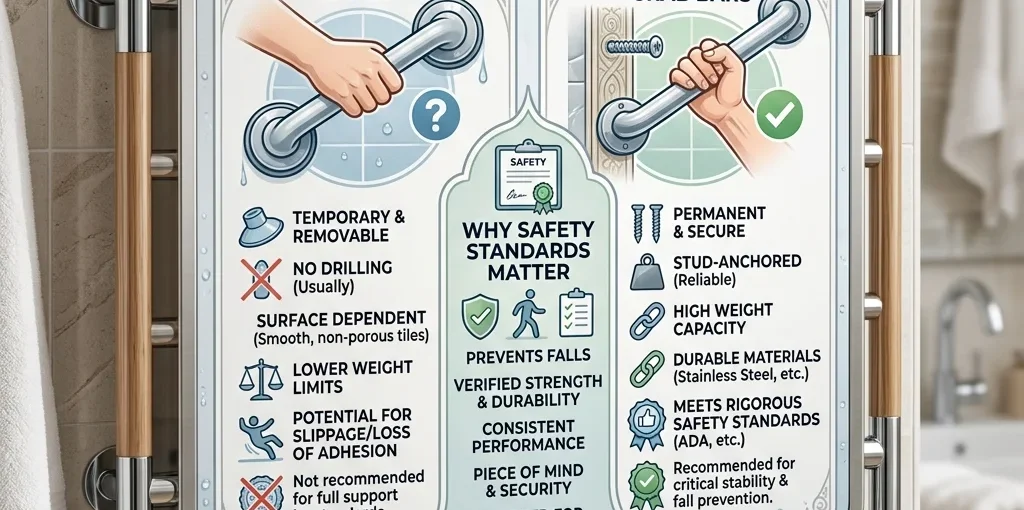
Suction grab bars are often promoted as convenient, tool-free, removable, and renter-friendly. They may help with light balance assistance in limited temporary situations. But in commercial bathrooms, accessible bathrooms, healthcare environments, senior living projects, and hospitality facilities, suction grab bars should not be treated as substitutes for code-compliant mounted grab bars.
The ADA Standards require grab bars, fasteners, mounting devices, and supporting structures to withstand a 250-pound vertical or horizontal force applied at any point. They also require correct spacing, height, gripping surface, anti-rotation performance, and installation at specified locations. These requirements are fundamentally different from a removable suction product attached only by surface adhesion. (ADA.gov)
For commerce buyers, the core question is not simply “Which grab bar is cheaper?” The better question is:
Can this product provide reliable support, meet project standards, pass inspection, and reduce liability risk over years of daily commercial use?
For project-based sourcing, SourceZJ can support bulk commercial bathroom accessories for hotels, offices, hospitals, and public buildings with mounted grab bars, towel racks, shower accessories, bathroom mirrors, faucets, and OEM/ODM customization.
1. What Are Suction Grab Bars?
Suction grab bars use suction cups, rubber bases, locking levers, or vacuum-style pads to attach to a smooth bathroom surface. They usually do not require drilling, screws, backing plates, or permanent wall modification.
They are commonly used for:
- Temporary balance assistance
- Travel
- Rental housing where drilling is restricted
- Short-term recovery support
- Non-commercial household use
- Demonstration or temporary placement
Suction grab bars normally work best on smooth, flat, nonporous surfaces such as glazed tile, glass, acrylic, or fiberglass. They do not perform well on textured tile, grout lines, painted drywall, uneven surfaces, porous stone, or surfaces with soap residue. Lowe’s notes that suction cup grab bars are designed as balance and stability aids, not full weight-bearing supports, and recommends permanently mounted grab bars into wall studs for maximum support. (Lowe’s)
That distinction is critical. A product that helps someone feel steadier is not automatically suitable for catching a user during a slip, transfer, or sudden loss of balance.
2. What Are Mounted Grab Bars?
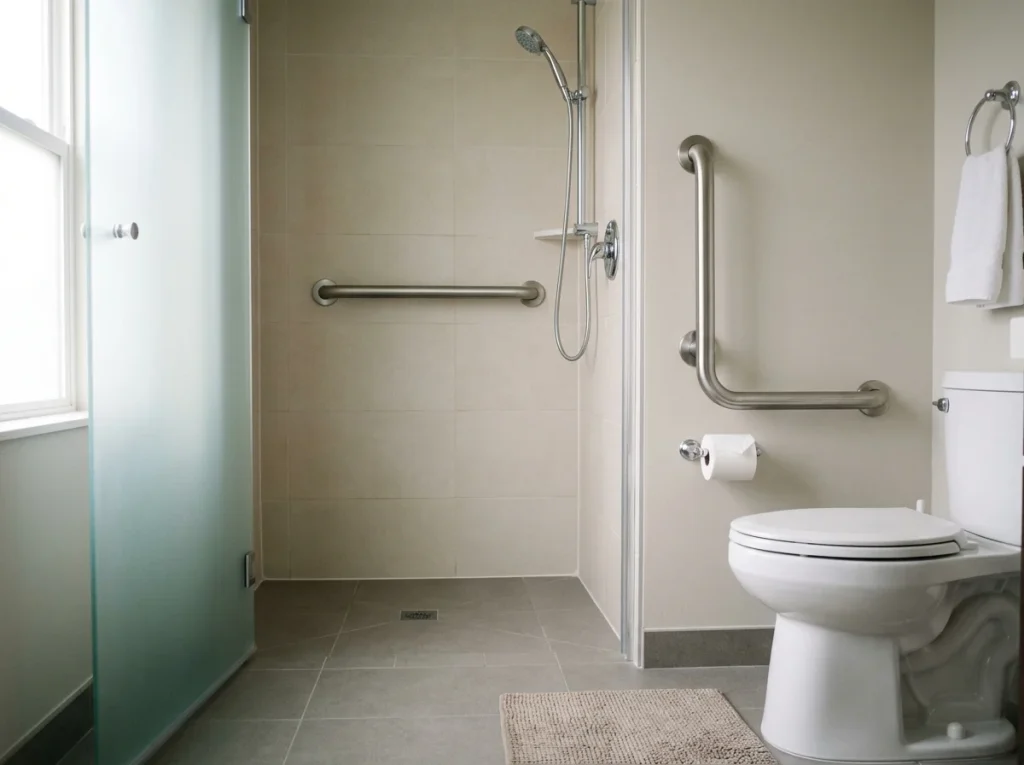
Mounted grab bars are mechanically fixed to a wall or structure using screws, anchors, flanges, backing plates, studs, masonry anchors, or engineered mounting systems. In commercial bathrooms, mounted grab bars are usually made from stainless steel, nylon-coated steel, or other durable materials.
Mounted grab bars are used in:
- ADA accessible toilet compartments
- Accessible hotel bathrooms
- Public restrooms
- Hospitals and clinics
- Senior living facilities
- Shower rooms
- Bathtub areas
- Rehabilitation spaces
- Schools, airports, and commercial buildings
A properly mounted grab bar is not just attached to the wall finish. It is installed into a supporting structure that can carry real loads. The ADA Standards state that grab bars must be installed at specified locations without obstructing required clear floor space, must not rotate in their fittings, and must withstand the required force through the bar, fastener, mounting device, and supporting structure.
This is why commercial grab bar planning must start before wall closure. If backing is missing behind tile or wall panels, installers may not be able to mount the grab bar safely without rework.
3. Suction vs. Mounted Grab Bars: Quick Comparison
| Comparison item | Suction grab bars | Mounted grab bars |
|---|---|---|
| Installation method | Attached by suction cups or vacuum pads | Mechanically fixed into structure |
| Drilling required | No | Yes, in most cases |
| Best use | Temporary balance assistance | Safety support and commercial accessibility |
| Suitable for ADA-style commercial bathrooms | Generally no | Yes, when properly specified and installed |
| Load reliability | Depends on surface, suction condition, moisture, and rechecking | Depends on product, fasteners, wall backing, and installation |
| Surface compatibility | Smooth, clean, nonporous surfaces only | Stud walls, masonry, reinforced walls, bathroom pods |
| Inspection suitability | Weak for commercial compliance | Suitable when documented and installed correctly |
| Maintenance requirement | Frequent suction checks and reattachment | Periodic inspection for looseness, corrosion, and damage |
| Risk during sudden slip | Higher risk of detachment | Lower risk when properly installed |
| commerce recommendation | Not a substitute for mounted grab bars | Preferred for commercial and accessible bathrooms |
commerce takeaway: Suction grab bars may have a place as temporary balance aids, but mounted grab bars are the correct solution for commercial safety, accessibility planning, and long-term project use.
4. Why Safety Standards Matter
Commercial grab bars must meet safety expectations under real bathroom conditions: wet hands, soap residue, sudden movement, body weight transfer, cleaning chemicals, repeated use, and different user strengths.
The ADA grab bar provisions include several requirements that directly affect product design and installation:
| ADA-related requirement | Why it matters |
|---|---|
| 250-pound force requirement | Confirms the bar system can resist real support forces |
| 33–36 inches AFF for many adult horizontal bars | Places the bar within usable reach |
| 1½-inch wall clearance | Provides gripping space and reduces entrapment risk |
| No rotation in fittings | Prevents the bar from twisting during use |
| Rounded, non-sharp surfaces | Reduces injury risk |
| Correct toilet, shower, and bathtub placement | Supports transfer and balance where users need it |
| Supporting structure requirement | Makes wall backing part of the safety system |
AFF means “above finished floor.” The ADA Standards state that many horizontal grab bars must be installed 33–36 inches above the finished floor, measured to the top of the gripping surface; they also require 1½ inches between the wall and the grab bar, no sharp or abrasive elements, no rotation, and the 250-pound structural force capacity.
A suction grab bar usually cannot prove this complete system performance because it is not mechanically tied to the wall structure. Its holding power depends on surface condition, suction quality, cup condition, moisture, temperature, and user behavior.
5. The Main Safety Problem with Suction Grab Bars
The biggest issue with suction grab bars is unpredictable holding reliability.
A suction grab bar may feel secure immediately after installation, but its grip can weaken over time. Moisture, soap film, grout lines, textured surfaces, temperature changes, cleaning chemicals, and slight air leakage can reduce suction. Lowe’s recommends checking suction grab bars before every shower and reattaching them if there is any movement; it also notes that humidity, soap residue, and temperature changes can weaken suction over time.
That level of maintenance is not realistic in many commercial environments.
In a hotel, guestroom bathroom, hospital, airport restroom, or senior living bathroom, the facility cannot assume that every user will check the suction before use. Housekeeping teams also cannot reliably verify every suction bar before every guest interaction, shower, or transfer. During a slip, users do not stop to think whether the product is intended only for “balance assistance.” They grab it instinctively.
This creates a serious mismatch:
| User expectation | Suction grab bar limitation |
|---|---|
| “This will hold me if I slip.” | It may only be rated for light balance assistance |
| “It is called a grab bar, so I can pull on it.” | Many suction products are not designed for full body weight |
| “It looks secure.” | Suction can weaken without visible warning |
| “It is in a hotel or commercial bathroom, so it must be safe.” | Product may not meet commercial accessibility standards |
| “The wall looks smooth.” | Grout lines, film, texture, or moisture can reduce adhesion |
For commercial bathrooms, this expectation gap is the real danger.
6. Why Mounted Grab Bars Are Safer for Commercial Bathrooms
Mounted grab bars are safer for commercial use because they are designed as a system:
- The bar body provides the gripping surface.
- The flanges transfer load into the wall.
- The fasteners secure the bar to backing or masonry.
- The supporting structure carries the load.
- The placement supports user movement.
- The inspection process confirms stability.
This system-based approach aligns with accessibility standards. ADA requirements apply not only to the visible grab bar but also to fasteners, mounting devices, and supporting structures. (ADA.gov)
In commercial bathrooms, properly mounted grab bars are especially important near:
- Toilets
- Transfer showers
- Roll-in showers
- Bathtubs
- Accessible hotel bathrooms
- Healthcare bathing areas
- Senior living bathrooms
- Locker rooms
- Public washrooms
For projects that require coordinated bathrooms, SourceZJ can supply grab bars together with commercial bathroom shower hardware, bathroom faucet selections, and other matching accessories.
7. ADA Placement Makes Mounted Grab Bars a Design Requirement
Commercial grab bars are not only about strength. They must also be placed correctly.
For accessible water closets, ADA Standards require grab bars on the side wall closest to the toilet and on the rear wall. The rear wall grab bar must be at least 36 inches long, extending at least 12 inches from the water closet centerline on one side and at least 24 inches on the other side. Toilet paper dispensers must also be positioned so they are not behind grab bars.
For showers and bathtubs, placement depends on the fixture type. ADA Standards specify different grab bar layouts for transfer showers, roll-in showers, bathtubs with permanent seats, and bathtubs without permanent seats. For example, transfer shower grab bars must extend across the control wall and back wall to a point 18 inches from the control wall, while standard roll-in showers without seats require grab bars on three walls.
Suction grab bars are usually repositionable. That sounds convenient, but in a commercial accessibility context it is a weakness. If a user, guest, cleaner, or maintenance worker moves the bar, the required placement may be lost. Mounted grab bars provide fixed, inspectable, repeatable placement.
8. When Can Suction Grab Bars Be Considered?
Suction grab bars should not be used as a substitute for mounted grab bars in accessible commercial bathrooms. However, there are limited situations where they may be considered as temporary balance aids.
| Scenario | Can suction grab bars be considered? | Important limitation |
|---|---|---|
| Temporary home use | Yes, with caution | Not for full weight support |
| Travel | Yes, for light balance only | Surface must be smooth and clean |
| Rental housing | Sometimes | Must follow manufacturer instructions |
| Hotel accessible bathroom | No as primary support | Use mounted compliant grab bars |
| Hospital or senior living bathroom | No as primary support | Use professionally installed support |
| Public restroom | No as primary support | Must meet applicable standards |
| Commercial shower | No as primary support | High moisture increases risk |
| Short-term demonstration | Yes | Not a compliance solution |
Even where suction grab bars are used temporarily, the user must understand the limitation: they are not a reliable fall-arrest product. They should be checked frequently, installed only on smooth and clean nonporous surfaces, and never used as the only support for users with significant mobility limitations.
9. Procurement Risk: Why Cheap Grab Bars Can Become Expensive
From a purchasing perspective, suction grab bars may look attractive because they are cheaper, faster to install, and do not require wall work. But in commercial projects, the lowest initial cost can create higher lifecycle risk.
Unit Price vs. Total Risk
| Cost factor | Suction grab bar risk | Mounted grab bar advantage |
|---|---|---|
| Initial product cost | Lower | Higher |
| Installation cost | Lower | Higher |
| Compliance risk | High in commercial accessible bathrooms | Lower when installed correctly |
| User injury risk | Higher if used for body support | Lower with proper structure |
| Maintenance burden | Frequent checking required | Periodic inspection |
| Guest perception | May look temporary or unreliable | Looks professional and permanent |
| Liability concern | Higher if misused as support | Better defensibility with documented compliance |
| Replacement frequency | Potentially higher | Lower with quality stainless steel |
| Inspection approval | Weak | Stronger with documentation |
For hotels, hospitals, senior living facilities, and public buildings, the cost of one failed support point can far exceed the cost difference between suction and mounted bars.
For bulk projects, SourceZJ can help buyers prepare a mounted grab bar schedule by room type, including bar length, finish, packing label, and installation drawing reference.
10. Material and Finish Choices for Mounted Grab Bars
Mounted grab bars should be selected according to project environment, user group, cleaning method, and design style.
| Material / finish | Best use | Key advantage | Procurement note |
|---|---|---|---|
| 304 stainless steel | Hotels, offices, malls, schools | Durable and cost-effective | Check wall thickness and weld quality |
| 316 stainless steel | Coastal hotels, spas, humid environments | Better corrosion resistance | Higher cost but better for harsh conditions |
| Brushed stainless steel | General commercial bathrooms | Hides fingerprints and water marks better | Common hospitality choice |
| Polished stainless steel | Premium interiors | Bright visual finish | Shows scratches more easily |
| Matte black coating | Boutique hotels and modern offices | Strong design effect | Test coating adhesion and scratch resistance |
| Nylon-coated grab bars | Healthcare and senior living | Warmer touch and visual contrast | Confirm cleaning chemical resistance |
| PVD gold / custom finish | Luxury hotels | Premium appearance | Require strict color sample approval |
For coordinated commercial bathroom packages, SourceZJ can match mounted grab bars with hotel-style bathroom towel racks and commercial bathroom mirror options for consistent finish control.
11. Wall Reinforcement: The Hidden Factor Behind Grab Bar Safety
The strongest grab bar is only as safe as the wall it is attached to.
Commercial grab bars should be anchored into:
- Wood blocking
- Metal backing plates
- Structural studs
- Reinforced wall systems
- Masonry walls with suitable anchors
- Factory-installed backing in bathroom pods
They should not be installed only into drywall, tile, thin panels, or hollow wall surfaces unless an engineered anchor system has been approved for the specific substrate and load requirement.
Recommended Wall Reinforcement Planning
| Wall type | Recommended approach | Risk if ignored |
|---|---|---|
| New stud wall | Install blocking or backing plates before wall closure | Grab bar cannot be safely mounted later |
| Masonry wall | Use approved masonry anchors and correct embedment depth | Anchor loosening or wall cracking |
| Tile over cement board | Anchor through finish into structure | Tile failure or weak support |
| Prefabricated bathroom pod | Confirm backing locations from the pod supplier | Hidden backing may not match grab bar layout |
| Existing finished wall | Scan, inspect, and use engineered retrofit solution | Unknown load capacity |
| Wet wall | Seal penetrations carefully | Hidden water damage |
Because ADA structural strength requirements include the supporting structure, wall backing is part of compliance—not an optional contractor detail.
12. Installation and QC Checklist for Mounted Grab Bars
A mounted grab bar should be inspected before handover. Visual appearance alone is not enough.
| QC item | Pass criteria |
|---|---|
| Correct location | Matches approved accessibility drawing |
| Correct height | Measured from finished floor to top of gripping surface |
| Correct clearance | 1½ inches from wall and required object clearances maintained |
| Stable fixing | No looseness, movement, or rotation |
| Wall structure | Backing or masonry support confirmed |
| Surface quality | No sharp edges, burrs, scratches, or abrasive points |
| Waterproofing | Penetrations sealed in wet areas |
| Finish consistency | Matches approved sample |
| Accessory coordination | Dispensers, shelves, and controls do not block the bar |
| Documentation | Room-by-room inspection record completed |
For hotels, senior living projects, and public bathrooms, keep records of backing photos, installation drawings, product batches, and final inspection results. This protects the owner, contractor, and supplier if future maintenance or compliance questions arise.
13. How to Explain the Difference to Clients or Project Teams
Many clients ask: “Why can’t we just use suction grab bars? They are cheaper and easier.”
A professional answer should be clear:
Suction grab bars are temporary balance aids. Mounted grab bars are safety support hardware.
Use this comparison:
| Client concern | Recommended response |
|---|---|
| “Suction bars are cheaper.” | True, but they do not provide the same structural reliability for commercial use. |
| “No drilling is easier.” | Easier installation does not equal safer support. |
| “They can be moved.” | Repositioning can destroy required ADA placement. |
| “The suction feels strong.” | Suction can weaken due to moisture, soap, surface texture, or time. |
| “Can we use them in hotel accessible rooms?” | Not as primary support. Use properly mounted grab bars. |
| “Can they be used temporarily?” | Only for light balance assistance and only with clear limitations. |
This helps procurement teams, contractors, designers, and property owners understand that safety standards are not paperwork. They exist because bathrooms are wet, unstable environments where failures can cause serious injuries.
14. OEM/ODM Specification Checklist for Commercial Mounted Grab Bars
For commerce buyers, a professional grab bar inquiry should include more than quantity and price.
| Specification item | Recommended detail |
|---|---|
| Application | Toilet, shower, bathtub, hotel bathroom, hospital bathroom |
| Standard reference | ADA, local code, project specification |
| Material | 304 stainless steel, 316 stainless steel, nylon-coated steel |
| Diameter | ADA-style circular profile or approved non-circular profile |
| Length | 12, 18, 24, 36, 42 inches, or custom |
| Finish | Brushed stainless, polished, matte black, PVD gold, custom |
| Mounting type | Concealed flange, exposed flange, anti-ligature where required |
| Wall clearance | 1½ inches for ADA-style applications |
| Load performance | 250-pound structural requirement or local equivalent |
| Fasteners | Compatible with wall substrate |
| Packaging | Individual box, master carton, room-type labeling |
| Documentation | Product drawing, installation guide, QC checklist |
| OEM options | Logo, custom finish, flange design, packaging, project label |
SourceZJ supports custom OEM/ODM bathroom accessories manufacturing for commercial projects that require stable quality, coordinated finishes, project labeling, and export packaging.
FAQ: Suction vs. Mounted Grab Bars
Business negotiations are welcome
Suction grab bars and mounted grab bars are not equal products. Suction grab bars may be useful for temporary balance assistance in carefully controlled, non-commercial situations. But for hotels, hospitals, senior living facilities, public restrooms, office buildings, and accessible commercial bathrooms, they should not replace properly mounted grab bars.
The reason is simple: commercial bathroom safety depends on standards, structure, placement, and inspection. A grab bar must support real user behavior in wet conditions, not just look secure when first attached.
For commerce buyers, the safest procurement strategy is to specify mounted grab bars with verified material, correct dimensions, suitable wall backing, tested mounting systems, proper placement, and room-by-room QC documentation.
SourceZJ can help commercial buyers develop project-ready mounted grab bar solutions, including size selection, finish matching, OEM/ODM customization, packaging, and coordinated bathroom accessory sourcing. For your next hotel, healthcare, senior living, or public restroom project, start with SourceZJ’s OEM/ODM bathroom accessories manufacturing support to build a safer and more reliable commercial bathroom hardware package.
 English
 العربية
 Русский
 Español