
Table of Contents
For most commercial bathroom projects, the best alcove shower door is a:Semi-frameless sliding or bypass alcove shower door with tempered safety glass, corrosion-resistant hardware, adjustable wall profiles, replaceable rollers/seals, and project-matched finish options.
This specification offers the best balance of:
- Space efficiency
- Installation tolerance
- Water containment
- Durability
- Maintenance convenience
- Cost control
- Visual quality
- Repeatability across many rooms
For premium hotels or luxury apartments, a frameless hinged or fixed-panel system may be better visually, but it requires more accurate walls, stronger hardware, higher installation skill, and stricter quality control.
For gyms, dormitories, student housing, staff accommodation, and heavy-use bathrooms, a framed or heavy-duty semi-frameless sliding door may be the smarter choice because it is more forgiving, easier to replace, and usually more cost-effective.
1. Best Overall Choice: Semi-Frameless Sliding or Bypass Alcove Shower Door
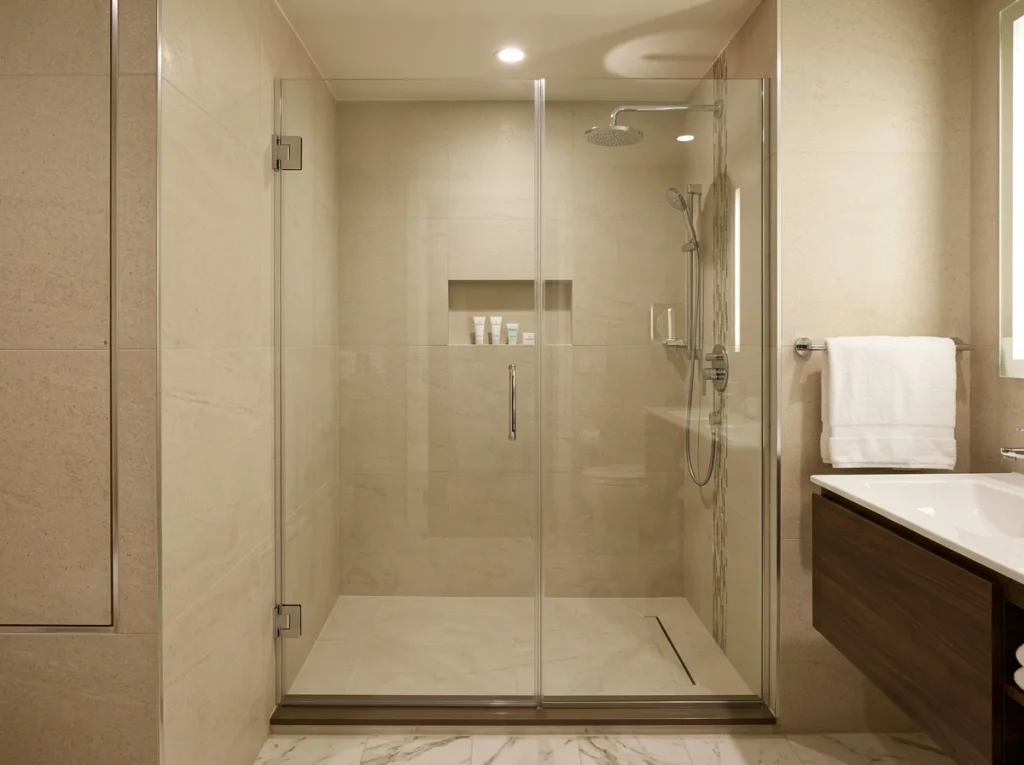
For large-scale commercial projects, the best “default” option is usually a semi-frameless sliding or bypass shower door.
This type works especially well for:
- Hotels
- Serviced apartments
- Student housing
- Rental apartments
- Staff accommodation
- Compact commercial bathrooms
- Mid-range hospitality projects
- Multi-room residential-commercial projects
A sliding or bypass system does not require outward door swing, which helps avoid conflicts with toilets, vanities, towel racks, robe hooks, bathroom doors, and other fixtures. This is important in compact hotel and apartment bathrooms where every inch of usable floor space matters.
Recommended commercial specification
| Specification Item | Recommended Choice for Most Commercial Projects | Why It Matters |
|---|---|---|
| Door type | Semi-frameless sliding or bypass | Balances appearance, durability, and installation tolerance |
| Glass | Tempered safety glass | Shower doors and enclosures are covered under safety glazing requirements in 16 CFR Part 1201 in the U.S. (联邦公报) |
| Glass thickness | 6 mm or 8 mm | 6 mm for cost-effective projects; 8 mm for hotel-grade feel |
| Hardware | Corrosion-resistant rollers, handles, guides, wall profiles | Reduces noise, jamming, and after-sales issues |
| Adjustment range | Wide wall-profile adjustment | Helps handle real site variation |
| Finish | Chrome, brushed nickel, matte black, brushed gold, or stainless finish | Should coordinate with faucets, towel racks, mirrors, and other accessories |
| Spare parts | Rollers, seals, gaskets, handles, guides | Essential for commercial maintenance |
| Packaging | Export-grade glass protection | Reduces breakage during international shipping and site handling |
Practical recommendation:For a hotel, apartment, or serviced apartment project, specify an 8 mm semi-frameless sliding alcove shower door for guest-facing bathrooms and a 6 mm framed or semi-frameless model for budget or back-of-house areas.
SourceZJ can help coordinate shower doors with commercial bathroom shower products, bulk commercial bath accessories, and matching project hardware.
2. Best Door Type by Commercial Project Scenario
There is no single shower door that is best for every commercial bathroom. The best choice depends on the building type, user frequency, budget, maintenance plan, and design level.
| Project Type | Best Alcove Shower Door Type | Why It Works |
|---|---|---|
| Mid-range hotel | Semi-frameless sliding or bypass door | Good appearance, space-saving, practical maintenance |
| Luxury hotel | Frameless hinged or fixed-panel + door | Premium look and stronger design impact |
| Serviced apartment | Semi-frameless sliding door | Durable, easy to replace, suitable for long-term rental |
| Student housing | Framed or semi-frameless sliding door | Cost-effective and more forgiving on installation |
| Gym / locker room | Heavy-duty framed sliding or pivot door | Better durability and easier maintenance |
| Staff accommodation | Framed sliding door | Lower cost and simple replacement |
| Senior living | Accessibility-reviewed door or curtain solution | Door must not block safe access or transfer |
| Hospital / care facility | Project-specific accessible enclosure | Hygiene, safety, and accessibility dominate the decision |
| Premium apartment | Frameless or semi-frameless glass system | Clean appearance and higher perceived value |
For accessible commercial bathrooms, shower doors must be reviewed carefully. The U.S. Access Board explains that shower enclosures, including doors, must not obstruct controls, faucets, shower spray units, or transfer to shower seats. (Americans with Disabilities Act)
3. Sliding vs Bypass vs Pivot vs Frameless: Which Is Best?
Sliding alcove shower doors
Sliding doors are often the safest commercial choice because they save space and are easy to repeat across many rooms.
Best for: hotels, apartments, dormitories, compact bathrooms.
Main benefits: space-saving, familiar operation, good water containment.
Main risks: poor rollers, dirty tracks, weak guides, difficult cleaning.
Choose sliding doors when bathroom floor space is limited or when the shower is close to a vanity, toilet, towel rack, or entry door.
Bypass alcove shower doors
Bypass doors have two sliding panels that pass each other. They are common in wider alcove openings, especially around 56–60 inches.
Best for: hotels, apartments, and larger alcove showers.
Main benefits: flexible entry from either side, good standardization.
Main risks: panel overlap, bottom track cleaning, roller wear.
Choose bypass doors when you need a practical, repeatable solution for a large number of similar bathrooms.
Pivot alcove shower doors
Pivot doors swing open from a pivot point. They can work well for narrower openings but need clear swing space.
Best for: narrow or medium alcove openings with open floor area.
Main benefits: simple operation, easier entry than some sliding doors.
Main risks: collision with vanity, toilet, towel rack, or bathroom door.
Choose pivot doors only after checking the full bathroom layout.
Frameless hinged shower doors
Frameless hinged doors are visually premium but less forgiving.
Best for: luxury hotels, high-end apartments, premium villas, executive suites.
Main benefits: clean appearance, luxury feel, easier glass cleaning.
Main risks: high cost, strict wall tolerance, heavier hardware, more difficult installation.
Choose frameless hinged doors when the project has strong construction control and the owner values premium appearance.
Framed shower doors
Framed doors are not always visually premium, but they remain practical for heavy-use commercial areas.
Best for: dormitories, gyms, staff housing, budget hotels, public facilities.
Main benefits: strong adjustment tolerance, lower cost, easier replacement.
Main risks: bulkier appearance, more frame cleaning.
Choose framed doors when durability, cost, and maintenance are more important than minimalist design.
4. Decision Matrix: Best Alcove Shower Door by Priority
| Buyer Priority | Best Door Type | Reason |
|---|---|---|
| Best overall balance | Semi-frameless sliding/bypass | Good appearance, cost, durability, and tolerance |
| Lowest project cost | Framed sliding door | Economical and easier to install |
| Premium appearance | Frameless hinged or fixed-panel system | Clean, high-end design |
| Small bathroom layout | Sliding or bypass door | No outward swing required |
| Heavy public use | Framed or heavy-duty semi-frameless | Stronger tolerance and easier maintenance |
| Easier cleaning | Frameless or semi-frameless with simple track design | Fewer dirt-trapping areas |
| Better installation tolerance | Framed or semi-frameless | Wall profiles can absorb small variations |
| Accessible bathroom | Project-specific; sometimes curtain is better | Door must not block transfer, controls, or clear access |
Best commercial default:Choose semi-frameless sliding or bypass doors unless the project clearly requires either a premium frameless look or a low-cost framed solution.
5. Glass Thickness: 6 mm, 8 mm, or 10 mm?
Glass thickness should match the door type, hardware quality, project grade, and installation conditions.
| Glass Thickness | Best Use | Commercial Recommendation |
|---|---|---|
| 5 mm | Basic framed doors | Suitable for low-cost projects only |
| 6 mm | Framed and semi-frameless doors | Good for budget hotels, apartments, dormitories |
| 8 mm | Semi-frameless sliding/bypass doors | Best hotel-grade balance |
| 10 mm | Frameless hinged doors | Premium projects with strong hardware |
| 12 mm | Custom luxury systems | Usually unnecessary for most commercial bathrooms |
For most commercial bathrooms, 8 mm tempered glass offers a strong balance between premium feel and manageable weight. For cost-sensitive or heavy-use projects, 6 mm glass with a stronger frame system may be more practical.
Shower doors and enclosures using glazing are included in the scope of the U.S. federal safety glazing standard under 16 CFR Part 1201. Buyers should also confirm local market requirements for tempered glass, labeling, impact testing, and documentation. (Federal Gazette)
6. Hardware Is More Important Than Glass Thickness Alone
Many buyers focus too much on glass thickness and not enough on hardware. In commercial bathrooms, hardware failure is often the real problem.
A 10 mm glass door with weak hinges or poor rollers can perform worse than an 8 mm door with high-quality hardware.
Key hardware to evaluate
| Hardware Component | What to Check | Why It Matters |
|---|---|---|
| Rollers | Bearing quality, smoothness, corrosion resistance | Prevents jamming and noisy sliding |
| Hinges | Load rating, opening angle, material | Prevents sagging and misalignment |
| Wall profiles | Adjustment range and profile thickness | Helps handle out-of-plumb walls |
| Bottom guide | Stability and replaceability | Keeps sliding panels aligned |
| Magnetic seals | Closing strength and replaceability | Improves water containment |
| Bottom seals | Flexibility and durability | Reduces leakage at threshold |
| Handles | Grip comfort, finish, projection | Affects user experience and safety |
| Screws/anchors | Stainless or corrosion-resistant material | Prevents rust stains and loosening |
For commerce procurement, always ask the supplier for spare parts availability. Rollers, seals, hinges, and handles should be replaceable after handover.
SourceZJ can help match shower door hardware finishes with commercial bathroom faucets, hotel-style towel racks, and commercial bathroom mirrors.
7. Best Choice for Hotels
For most hotel guest bathrooms, the best choice is:
8 mm semi-frameless sliding or bypass alcove shower door with smooth rollers, replaceable seals, and finish-matched hardware.
This option works well because it:
- Saves bathroom space
- Looks cleaner than a fully framed door
- Is less risky than a fully frameless hinged system
- Offers better installation tolerance
- Supports standardized room installation
- Allows easier spare parts planning
For luxury hotel suites, a frameless hinged or fixed-panel shower door may be suitable, but only if the walls are plumb, the glass is safely handled, and the contractor can install accurately.
Hotel recommendation:
Use semi-frameless sliding doors for standard rooms and frameless hinged systems only for premium room types.
8. Best Choice for Apartments and Serviced Apartments
For serviced apartments and long-term rental buildings, durability and replacement convenience are very important.
The best option is usually:
6 mm or 8 mm semi-frameless sliding alcove shower door with replaceable rollers and seals.
Rental bathrooms need products that look good but can also be repaired quickly. A fully frameless custom glass door may look premium, but replacement can be slower and more expensive.
Apartment recommendation:
Use semi-frameless sliding doors for most bathrooms. Keep spare rollers, seals, and handles in the maintenance inventory.
9. Best Choice for Dormitories, Gyms, and Staff Housing
For heavy-use commercial bathrooms, the best choice is often:
Framed or heavy-duty semi-frameless sliding shower door.
These environments prioritize:
- Durability
- Easy replacement
- Lower unit cost
- Better adjustment tolerance
- Stronger frame protection
- Simple cleaning procedures
A premium frameless door may not be the best investment in these spaces because it can be more expensive to install and repair.
Heavy-use recommendation:
Use framed or semi-frameless systems with robust rollers, simple tracks, and easy-to-source spare parts.
10. Best Choice for Accessible Commercial Bathrooms
Accessible shower areas require a separate review. A standard glass door may not be appropriate if it blocks wheelchair movement, transfer space, controls, faucets, or shower spray units.
The ADA Standards apply to places of public accommodation, commercial facilities, and state and local government facilities in new construction, alterations, and additions.
For accessible bathrooms, the best solution may be:
- A special wide-entry sliding system
- A low-threshold enclosure
- A project-specific glass layout
- Or in some cases, a shower curtain instead of a rigid door
Accessible bathroom recommendation:
Do not use a standard alcove shower door without checking accessibility requirements, transfer space, control reach, threshold design, and local code.
11. Installation Tolerance: Why Semi-Frameless Often Wins
Commercial buildings rarely have perfectly identical shower openings. Tile thickness, wall plumbness, waterproofing build-up, base placement, and construction tolerance can vary from room to room.
This is where semi-frameless doors often outperform fully frameless doors.
| Door Type | Installation Tolerance | Commercial Risk |
|---|---|---|
| Framed door | High tolerance | Bulkier appearance |
| Semi-frameless door | Medium to high tolerance | Best balance for most projects |
| Frameless hinged door | Low tolerance | Requires accurate walls and expert installation |
| Custom glass door | Project-specific | Higher cost and longer lead time |
For large projects, a door with some adjustment range can reduce site disputes and installation delays. This is one reason semi-frameless sliding or bypass doors are often the best practical choice.
12. Total Cost of Ownership Comparison
The cheapest shower door is not always the lowest-cost option over the project lifecycle. Commercial buyers should compare installation risk, maintenance cost, spare parts, breakage risk, and replacement difficulty.
| Door Type | Initial Cost | Installation Risk | Maintenance Cost | Best Use |
|---|---|---|---|---|
| Framed sliding door | Low | Low | Medium | Budget and heavy-use projects |
| Semi-frameless sliding/bypass | Medium | Medium-low | Low to medium | Best general commercial option |
| Frameless hinged door | High | High | Medium | Premium hotels and apartments |
| Custom frameless system | Very high | High | Project-specific | Luxury or irregular openings |
For most projects, the best value is not the lowest-priced framed door or the most expensive frameless system. It is usually the semi-frameless sliding or bypass door because it balances design, durability, tolerance, and maintainability.
13. Procurement Checklist Before Choosing a Supplier
Before ordering alcove shower doors for a commercial project, ask the supplier for:
| Document or Data | Why It Matters |
|---|---|
| Technical drawing | Confirms size, height, adjustment range, and hardware layout |
| Glass specification | Confirms thickness, tempering, and safety compliance |
| Width adjustment range | Helps match real site conditions |
| Hardware material details | Affects corrosion resistance and durability |
| Finish sample | Ensures coordination with other bathroom hardware |
| Installation manual | Reduces contractor mistakes |
| Spare parts list | Supports long-term maintenance |
| Packaging method | Protects glass during export and site delivery |
| Mock-up support | Reduces bulk installation risk |
| Warranty terms | Clarifies after-sales responsibility |
SourceZJ supports commercial project buyers through OEM and custom bathroom accessories manufacturing, including finish matching, project packaging, specification coordination, and bathroom accessory sourcing.
14. Final Recommendation
Best overall for commercial projects
Semi-frameless sliding or bypass alcove shower door with 8 mm tempered safety glass, corrosion-resistant rollers, replaceable seals, adjustable wall profiles, and finish-matched hardware.
Best for budget or heavy-use projects
Framed or heavy-duty semi-frameless sliding door with 6 mm tempered glass and simple replaceable parts.
Best for premium hotels or luxury apartments
Frameless hinged or fixed-panel alcove shower door with 10 mm tempered glass, high-quality hinges, and strict wall-plumbness control.
Best for accessible bathrooms
Project-specific accessible shower enclosure, or in some cases a curtain system, depending on transfer space, controls, threshold, and local code requirements.
15. FAQ about commercial niche shower doors
Conclusion
For most commercial bathroom projects, the best alcove shower door is a semi-frameless sliding or bypass system. It provides the strongest balance between appearance, cost, durability, installation tolerance, and long-term maintenance.
Frameless hinged doors are best for premium hotels and luxury apartments, while framed sliding doors remain practical for budget, dormitory, gym, and heavy-use environments. Accessible bathrooms should always be reviewed separately because a standard door may obstruct transfer space, controls, or required access.
SourceZJ helps contractors, importers, distributors, and project buyers coordinate alcove shower doors with faucets, towel racks, mirrors, door handles, and other commercial bathroom accessories. For a project-ready recommendation, contact SourceZJ through its OEM and custom bathroom accessories manufacturer page and request a commercial shower door specification proposal.
 English
 العربية
 Русский
 Español